
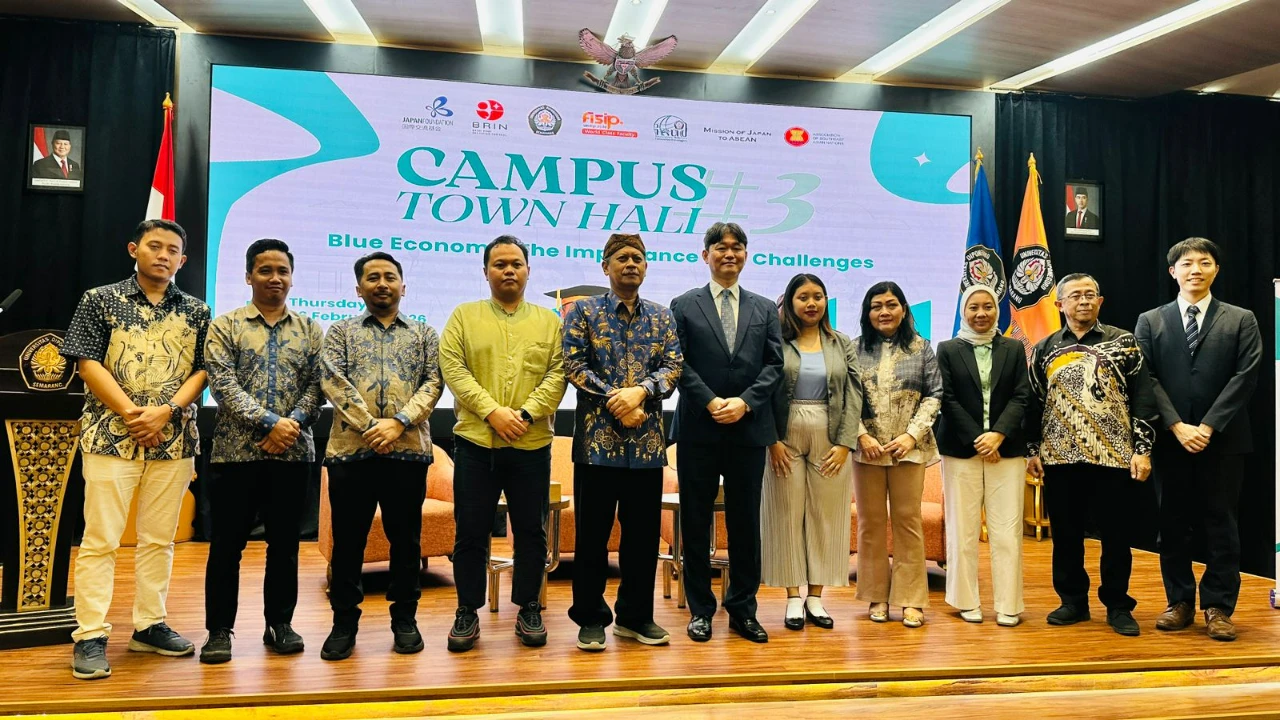

SEMARANG (02/26) – The International Relations Study Program at the Faculty of Social and Political Sciences (FISIP), Diponegoro University, in collaboration with The Japan Foundation, organized the Campus Town Hall #3 event with the theme “Blue Economy: The Importance and Challenges” at the FIMENA Auditorium, FISIP Undip, on Thursday (02/26/2026). This activity aimed to enhance students’ understanding of the blue economy concept, along with the opportunities and challenges of its implementation at the national and ASEAN regional levels.
The event was opened by the Dean of FISIP Undip, Dr. Drs. Teguh Yuwono, M.Pol.Admin, and was attended by the speakers and students of International Relations at FISIP Undip. The speakers included Mohamad Rahmat Mulianda, Director for Marine Affairs and Fisheries at the Ministry of National Development Planning/Bappenas; Reo Kawamura, Director for Environmental Policy and Regional Knowledge Center for Marine Plastic Debris, ERIA; and Gusti Ayu Meisa Kurnia Dewi Silakarma from the ASEAN Secretariat. The talk show session was moderated by Muhammad Subhan, S.IP, M.InternatRel.
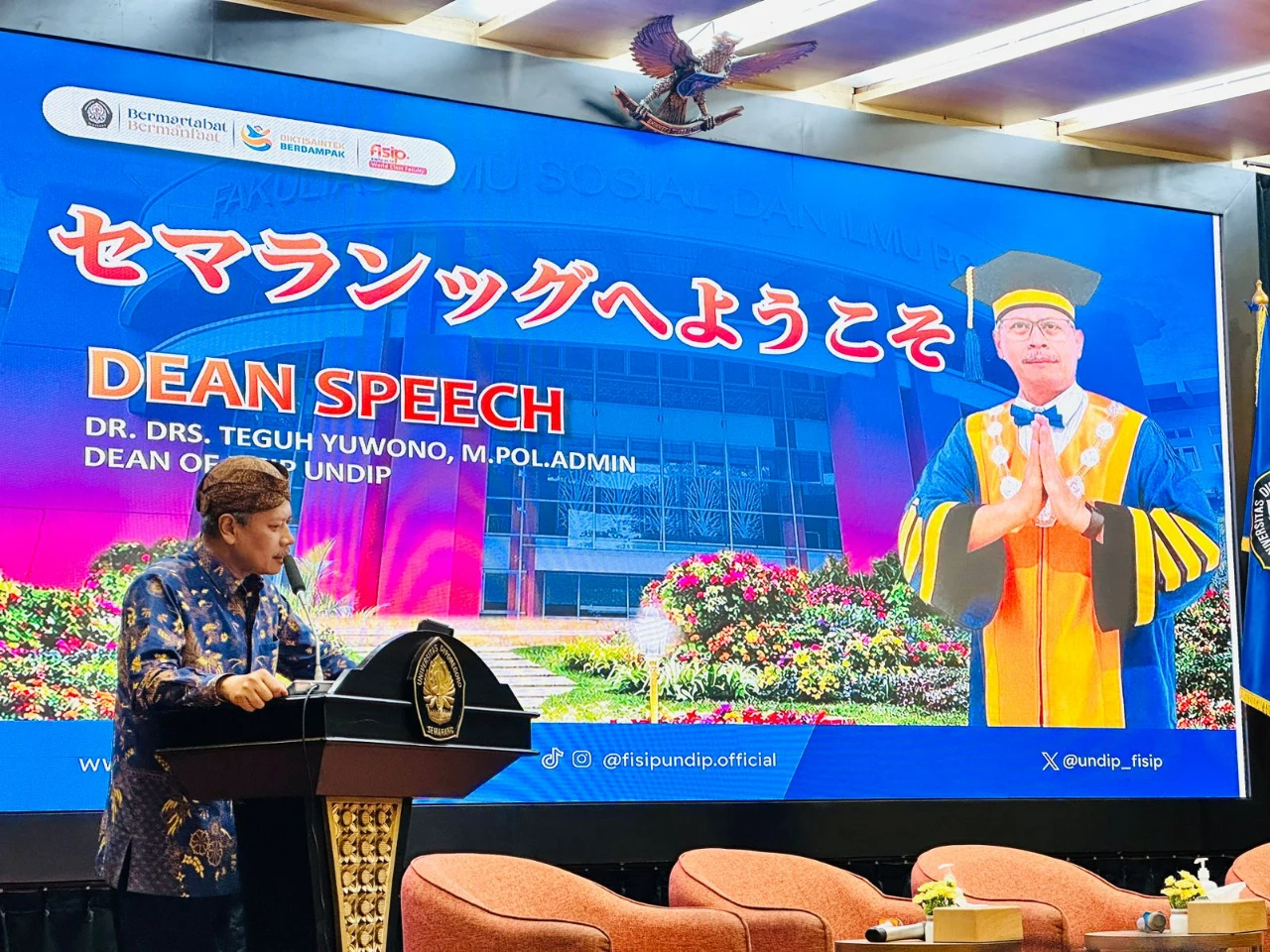
The event began with remarks from a representative of The Japan Foundation, emphasizing the importance of collaboration between academic institutions and international organizations in strengthening the capacity of the younger generation on marine sustainability issues. In his speech, the Dean of FISIP Undip, Dr. Drs. Teguh Yuwono, M.Pol.Admin, stated that the blue economy is a strategic issue impacting not only the national level but also the global level. “The challenges we face today are not only at the local level but are also global issues. In implementing the blue economy, we must ensure that no developing country is left behind. Therefore, mutual learning, experience exchange, and strengthening cross-country collaboration are necessary going forward,” he said.
Entering the talk show session, Mohamad Rahmat Mulianda presented the implementation of the blue economy in Indonesia within the framework of national development policy. He explained the relationship between the blue economy and the triple planetary crisis, global developments in the blue economy, and opportunities and modalities for its development in Indonesia. Furthermore, he highlighted the importance of integrating central and regional policies to ensure sustainable marine resource management.
Reo Kawamura discussed marine plastic pollution as a major risk to the sustainability of the blue economy in the ASEAN region. He outlined the ecological, health, and economic impacts of plastic pollution, and presented ERIA’s role through the Regional Knowledge Center for Marine Plastic Debris in strengthening databases, policies, and regional cooperation to realize healthy oceans for a sustainable blue economy.
Meanwhile, Gusti Ayu Meisa Kurnia Dewi Silakarma presented the potential of the ASEAN blue economy, policy alignment among member states, and the implementation plan for the ASEAN Blue Economy 2026–2030. She also highlighted challenges in cross-sectoral coordination and the dynamics of integrating member states in applying blue economy indicators in the region.
The activity continued with an interactive question-and-answer session. Students raised various issues, including funding for SDG 14 (Life Below Water), policy coordination between central and regional governments, the economic impact of plastic pollution, and the dynamics of blue economy implementation in ASEAN. This discussion enriched participants’ understanding of the interconnections between national, regional, and global policies in marine resource management.
Through the organization of Campus Town Hall #3, FISIP Undip reaffirms its commitment to fostering constructive academic dialogue and strengthening student literacy on strategic maritime and sustainability issues. This activity is expected to serve as an academic contribution in supporting the development of an inclusive and sustainable blue economy in Indonesia and the ASEAN region.


0 Comments