
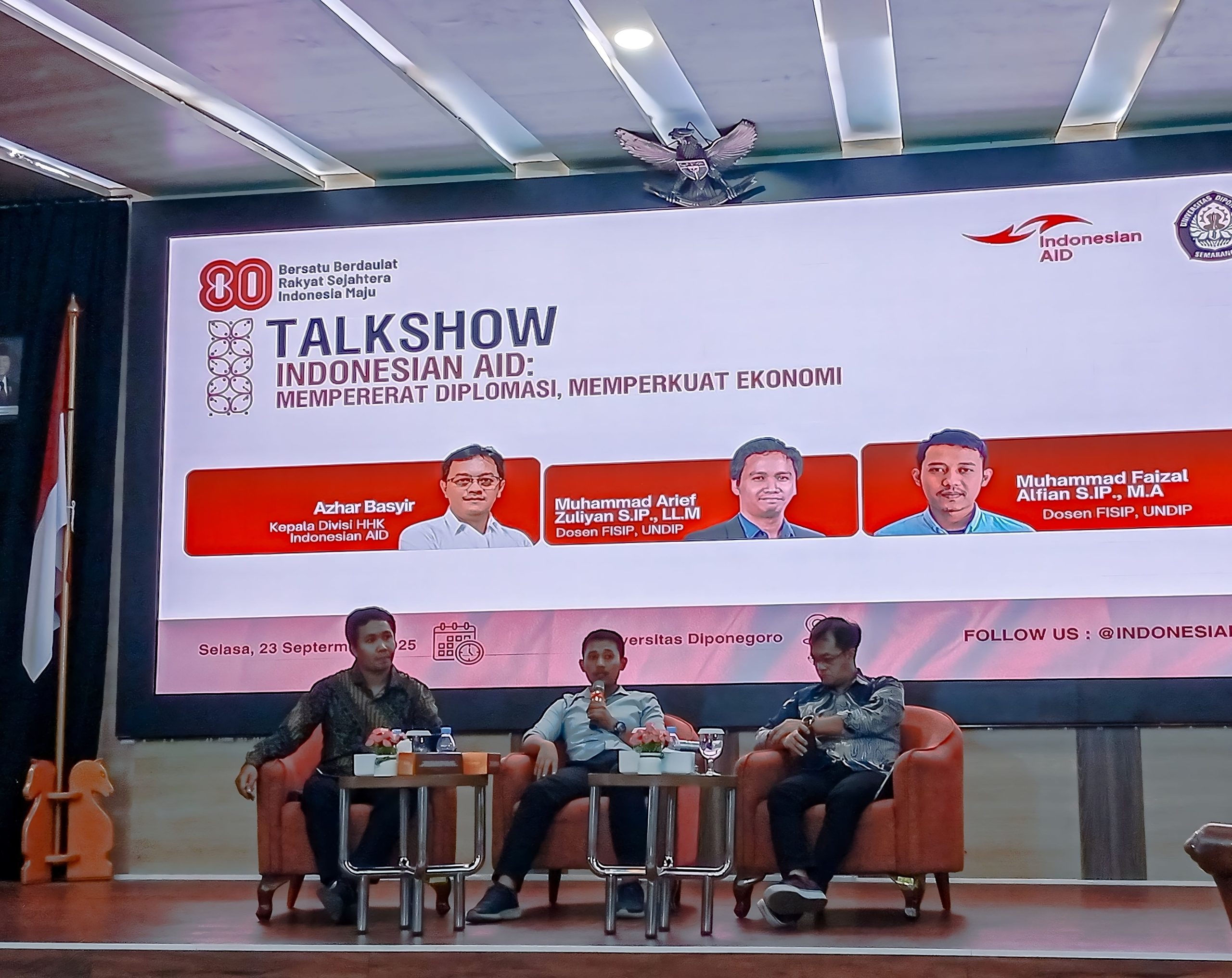

The Faculty of Social and Political Sciences (FISIP) at Diponegoro University (Undip), through its Department of International Relations, successfully held a Talk Show titled “Indonesian AID: Strengthening Diplomacy, Empowering the Economy”. This event was a collaboration with the Indonesian Agency for International Development (Indonesian AID) and took place at the FIMENA Auditorium, FISIP Undip, on Tuesday (23/09).
The event began with an opening by the MC, followed by the singing of the Indonesian national anthem, “Indonesia Raya,” and the Undip Mars. The Dean of FISIP Undip, Dr. Drs. Teguh Yuwono, M.Pol.Admin, then delivered a welcoming speech, in which he expressed appreciation for the presence of Indonesian AID President Director Daljono and his staffs. He emphasized that this collaboration was a great opportunity for students to broaden their knowledge through a question and answer (Q&A) and discussion session.
Teguh also highlighted the achievements of Undip International Relations students, who have often achieved global success, for instance, through the Indonesian International Student Mobility Awards (IISMA) program, which has sent students to study at various renowned universities such as Yale University and others in Italy, Malaysia, Korea, and even Warsaw.
“The International Relations study program is the youngest among the existing programs, but the achievements are extraordinary,” said Teguh in his remarks on Tuesday (23/09).
Closing his remarks, Teguh affirmed FISIP Undip’s readiness to collaborate on future programs with Indonesian AID.
Next, the President Director of Indonesian AID, Daljono, delivered an opening speech at the event. He stated that Indonesian AID was formed to carry out the mandate of the 1945 Constitution by distributing foreign grants as a form of Indonesia’s contribution to maintaining world peace. He mentioned that since its establishment in 2019, the value of Indonesian AID grants has increased significantly, from Rp29 billion in 2020 to Rp315 billion in 2024.
“What I want to convey here is that our performance has increased from year to year; from distributing only Rp29 billion to 3 countries in 2020, we have now distributed Rp315 billion to 87 countries in 2024. So, this increase in grants is very significant and is in line with our growing capacity and the increasing global need,” said Daljono in his opening speech on Tuesday (23/09).
Furthermore, he also stated that Undip can act as a partner for Indonesian AID in distributing grants. “So, we will technically follow up at the technical and also the strategic levels, then involve Undip as one of the partners for grant distribution in the following years,” said Daljono.
At the end of his presentation, Daljono emphasized the important role of academics and students in educating the public, promoting grants, networking with partners, and contributing as experts in training for grant-receiving countries.
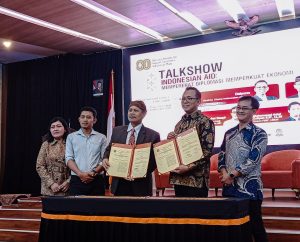
Signing of the cooperation agreement between FISIP Undip and Indonesian AID.
After the speeches, the event continued with the signing of a cooperation agreement and the exchange of souvenirs between FISIP Undip and Indonesian AID. The activities then proceeded to a talk show session and a Q&A discussion with students. The talk show featured two speakers: the Head of the Legal and Institutional Relations Division (HHK) of Indonesian AID, Azhar Basyir, and Muhammad Faizal Alfian, a lecturer from FISIP Undip. The session was moderated by another FISIP Undip lecturer, Muhammad Arief Zuliyan.
In the talk show session, Azhar Basyir explained that Indonesia has actually been providing foreign aid for a long time, one example being the shipment of rice to India in 1946. However, past aid was not yet integrated. Based on that experience, the LDKPI, or Indonesian AID, was formed in 2019 as a “single door” for the management of international aid. He also explained that the aid can be given through various forms and schemes, such as directly government-to-government (G2G) or through international institutions like the World Bank with a co-financing scheme.
Meanwhile, Muhammad Faizal Alfian, a lecturer from FISIP Undip, connected the provision of foreign aid to the book Why Nations Fail by Daron Acemoglu and James A. Robinson, which emphasizes the importance of inclusive institutions over extractive ones. According to him, international aid should be inclusive, for example, through capacity building such as peacekeeping programs or strengthening democratization.
In this context, Indonesian AID is expected to be able to develop an inclusive, capacity-building-oriented aid model. He cited challenges in several African countries, such as the presence of the terrorist group Boko Haram and extractive government practices, which demonstrate the importance of aid in encouraging an increase in government capacity so that its benefits are not only felt by the elite but also reach the wider community.
The talk show session concluded with an interactive discussion and Q&A. Students raised a variety of critical questions, ranging from green diplomacy issues and national interest strategies to the role of Indonesian AID in the dynamics of international donor provision. The speakers appreciated the active participation and even gave prizes to participants who showed high enthusiasm.***


0 Comments