
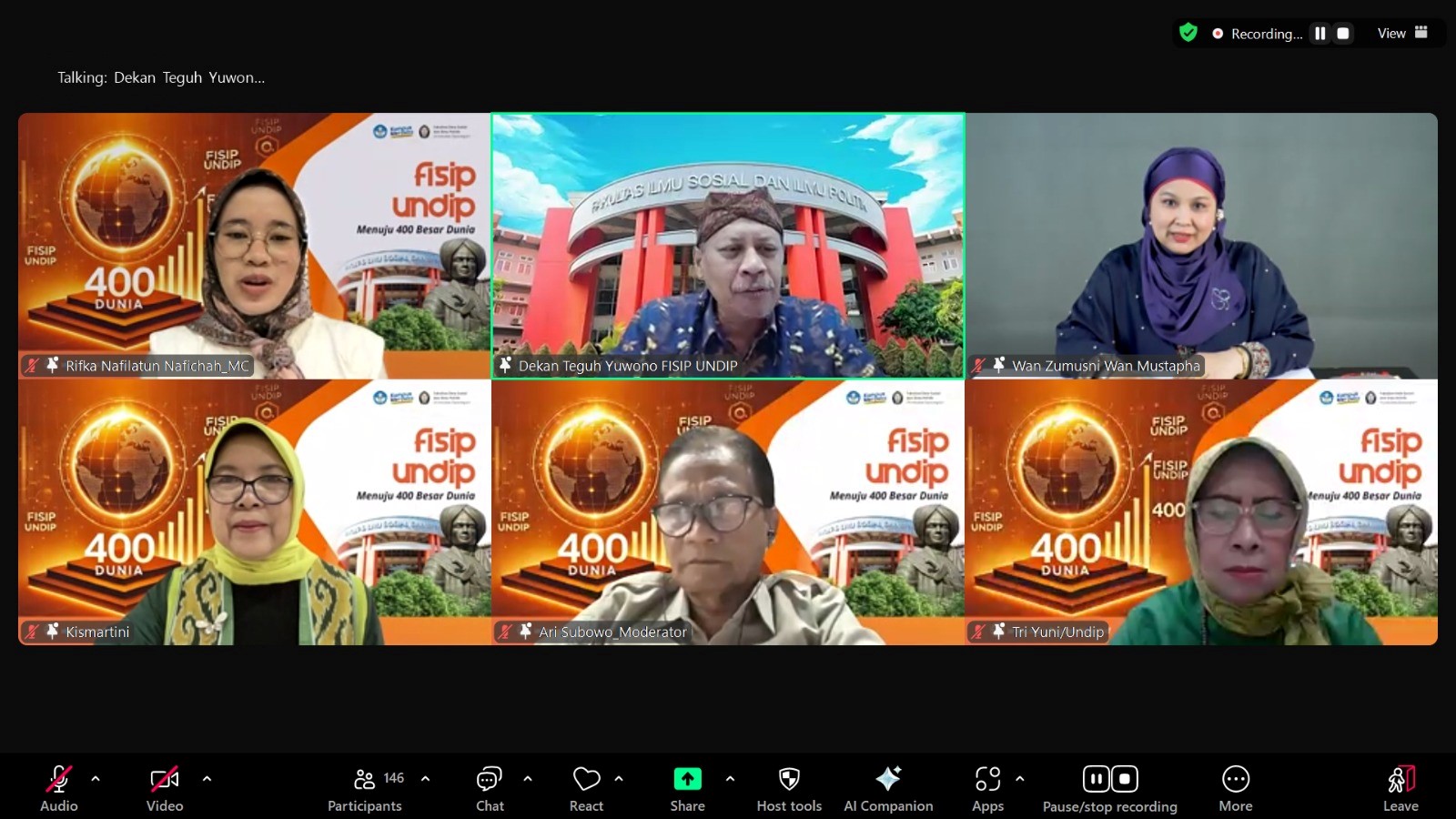

Semarang, August 28, 2025 – The Public Policy Study Program of the Faculty of Social and Political Sciences, Diponegoro University (FISIP Undip) held an international visiting lecture series on the topic of Collaborative Governance: Enhancing Public Policy Effectiveness through Inter-agency and Multi-Stakeholder Partnerships on August 28, 2025.
The forum was officially opened by the Dean of FISIP Undip, Dr. Drs. Teguh Yuwono, M.Pol. Admin, and brought together academics from two institutions, namely FISIP Undip and UITM Malaysia. The event featured three main speakers who highlighted the importance of collaborative governance in three strategic areas: inclusive public policy, sustainable environmental governance, and halal tourism development. The discussion was dynamic and presented a common thread that amid the complexity of modern society’s challenges, cross-actor collaboration—between the government, academics, the business world, civil society, and the media—is an absolute prerequisite for creating effective, fair, and sustainable policies. The event was held online and attended by 140 participants.

Inclusive Public Policy and Feminist Policy-Making
The first speaker, Wan Zumusni Wan Mustapha, Senior Lecturer at Universiti Teknologi MARA (UiTM) Malaysia, explained how collaborative governance can strengthen the effectiveness of public policy, especially on gender equality issues. She cited the role of Sisters in Islam (SIS) as a mediator that bridges grassroots communities, academics, and the government. Referring to the Ansell & Gash framework, SIS successfully established an inclusive forum, transparency, and decision-making based on mutual trust. “This kind of collaboration proves that trust, mutual understanding, and small wins are social capital for maintaining long-term cooperation momentum,” explained Zumusni.
Despite facing challenges in the form of resistance from conservative groups and limited funds, he emphasized that institutionalizing partnerships through MoUs, sustainable research grants, and the establishment of co-creation platforms at the ASEAN level are essential to expanding collaborative governance practices.
Responding to the Ecological Crisis with Collaborative Environmental Governance
The second speaker, Prof. Kismartini from the Public Policy Study Program, Faculty of Social and Political Sciences, Diponegoro University, raised the increasingly urgent environmental issues in Indonesia: air, water, and soil pollution; exploitation of natural resources; and ecosystem damage caused by illegal fishing and environmentally unfriendly mining practices. According to her, existing regulations are actually quite comprehensive, but weak law enforcement has allowed environmental damage to continue. Therefore, a new approach is needed in the form of Collaborative Environmental Governance (CEG), an environmental management model that prioritizes cross-sector cooperation, dialogue, and joint decision-making. She cited the success of the Mbah Dirjo program in Bali, which integrates local government, waste banks, and the business world in waste management; as well as the mangrove restoration collaboration at Pantai Sejarah, which involves the government, companies, and the community. “Environmental problems cannot be solved by the government or the community alone. Synergy is needed to strengthen institutional capacity while ensuring social inclusion so that the solutions produced are sustainable,” emphasized Prof. Kismartini.
Pentahelix Collaboration for Halal Tourism
The third topic was presented by Tri Yuniningsih, also from Diponegoro University, who discussed the development of halal tourism in Bintan, Riau Islands. She explained that halal tourism is a global phenomenon that continues to grow along with the increasing number of Muslim tourists. In this context, the pentahelix collaboration model—involving the government, academics, the business world, the community, and the media—is considered the most relevant approach. However, according to Tri, collaboration practices in the field are still not optimal. Many actors still work partially, specific regulations on halal tourism are not yet available, the quality of tourism human resources is limited, and the use of social media is still minimal. He emphasized the need for specific regional regulations on halal tourism, integrated promotion through mass media and influencers, and improving the competence of local human resources through training and empowerment of the Malay community. “Solid collaboration will make halal tourism not just a label, but also a real experience that is friendly and globally competitive,” said Tri.
Towards Collaborative Governance in Various Fields
This forum showed that even though the public policy contexts discussed were different—from gender mainstreaming, environment, to halal tourism—all speakers agreed that collaborative governance is the key to facing complex challenges in the current era. Through dialogue, trust, and shared responsibility, cross-actor collaboration can produce more effective, inclusive, and sustainable solutions. With this spirit, FISIP Undip affirms its commitment to continue to be an academic discussion space that generates strategic ideas for the development of Indonesia and Southeast Asia.
Relevance to FISIP Undip Public Policy KBK
This event has strategic significance for the development of FISIP Undip’s Public Policy KBK research. The theme of collaborative governance raised by the speakers is in line with the trend of public policy research, which is increasingly complex and cross-sectoral among stakeholders at the local, national, and regional levels. It must also be based on ethical and civic values, namely a commitment to sustainability, social inclusion, and substantive democracy. By featuring international and national speakers, this activity also strengthens the link and match between the curriculum and global developments, while providing students with direct experience in examining public policy based on collaborative practices. (Author: Public Policy KBK)


0 Comments