

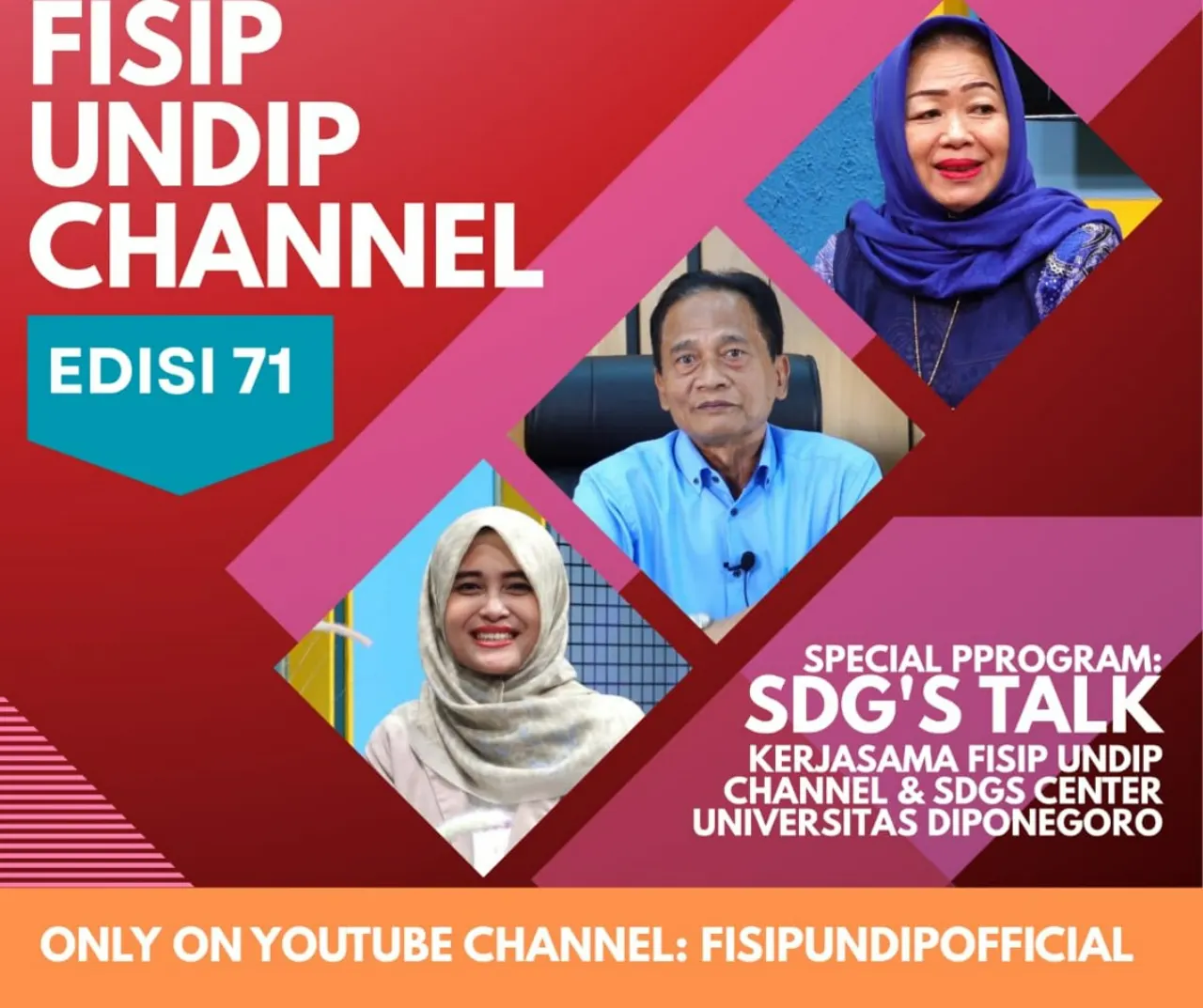
Semarang – FISIP UNDIP CHANNEL continues to present educational and insightful content through Edition 71, featuring two flagship programs, SDGs Talk and One Minute Insight. Both programs serve as platforms for knowledge dissemination, bringing academic perspectives and expert insights to explore various social issues, development challenges, and strategic topics relevant to the achievement of the Sustainable Development Goals (SDGs).
In this edition, SDGs Talk, a special program in collaboration between FISIP UNDIP CHANNEL and the SDGs Center of Universitas Diponegoro, features Prof. Dra. Indah Susilowati, M.Sc., Ph.D., a Professor at the Faculty of Economics and Business, Universitas Diponegoro. Hosted by Hanifa Maylasari, S.IP., M.Sos., the discussion explores the topic “The Dynamics of Development Inequality and Regional Disparities in the Context of Sustainable Development.”
This topic is particularly relevant, considering that development inequality and regional disparities remain significant challenges in achieving inclusive and sustainable development. Through an academic perspective, the discussion is expected to provide a deeper understanding of the various factors influencing development inequality, as well as the importance of equitable access, resource distribution, and economic opportunities for communities across different regions. Accordingly, development should not merely focus on economic growth, but also ensure the realization of more equitable prosperity.
In addition to SDGs Talk, FISIP UNDIP CHANNEL Edition 71 also features One Minute Insight, a segment that presents concise and relevant insights from a Social Sciences perspective. This edition of One Minute Insight features Drs. Ari Subowo, M.A., a retired lecturer from the Department of Public Administration, FISIP UNDIP, who discusses the topic “Poverty Is More Than Just a Number: Examining Its Root Causes and the Challenges of Measurement.”
Through this discussion, poverty is presented as a multidimensional issue that cannot be understood solely through statistical figures or economic indicators. Various factors contribute to poverty, ranging from limited access to education and employment, social inequality, and structural conditions within society to broader challenges in development governance. Therefore, poverty measurement requires a comprehensive approach to provide a more holistic understanding of people’s circumstances and serve as a foundation for formulating targeted poverty alleviation policies.
The presence of these two programs reflects FISIP UNDIP’s commitment to expanding educational opportunities, knowledge exchange, and the dissemination of academic ideas among the entire academic community. Through FISIP UNDIP CHANNEL, the faculty provides opportunities for various academic stakeholders, including professors, permanent lecturers, and visiting lecturers, to share their expertise, communicate their scholarly perspectives, and contribute to public understanding of strategic issues.
This initiative also represents part of FISIP UNDIP’s strategic efforts to support the achievement of the faculty’s vision and mission toward becoming a globally competitive institution and advancing its World Class Faculty aspirations, including its ambition to enter the world’s top 300 rankings. Through strengthening academic quality, interdisciplinary collaboration, and the dissemination of knowledge with meaningful societal impact, FISIP UNDIP continues to enhance its contribution to addressing the challenges of sustainable development.
Watch the full FISIP UNDIP CHANNEL Edition 71 on the FISIP UNDIP OFFICIAL YouTube channel. Gain inspiring academic insights and perspectives on development inequality, regional disparities, and the fundamental factors underlying poverty in Indonesia. https://youtu.be/XG-qbv0zQg0?si=1xz3posyPhNnA_g6