
SEMARANG, November 26, 2026 — The Department of Communication Science, Faculty of Social and Political Sciences (FISIP), Diponegoro University (Undip), continues to strengthen its commitment to presenting a global-standard academic atmosphere through the organization of the UNDIP Global Classroom program. On Thursday (26/11/2026), this online international guest lecture activity featured a leading academic from Malaysia, Prof. Ts. Dr. Mohamad Noorman Masrek from the Faculty of Information Science, Universiti Teknologi MARA (UiTM).
Carrying the theme “Understanding Social Media Algorithms: Digitalization and Strategic Approaches to Content Production,” this international webinar was initiated by the Media, Culture, and Gender KBK of the Department of Communication Science at Undip. The presence of an expert from a foreign partner institution is part of the faculty’s strategic effort to expand cross-country scholarly networks while also providing direct international exposure for the academic community.
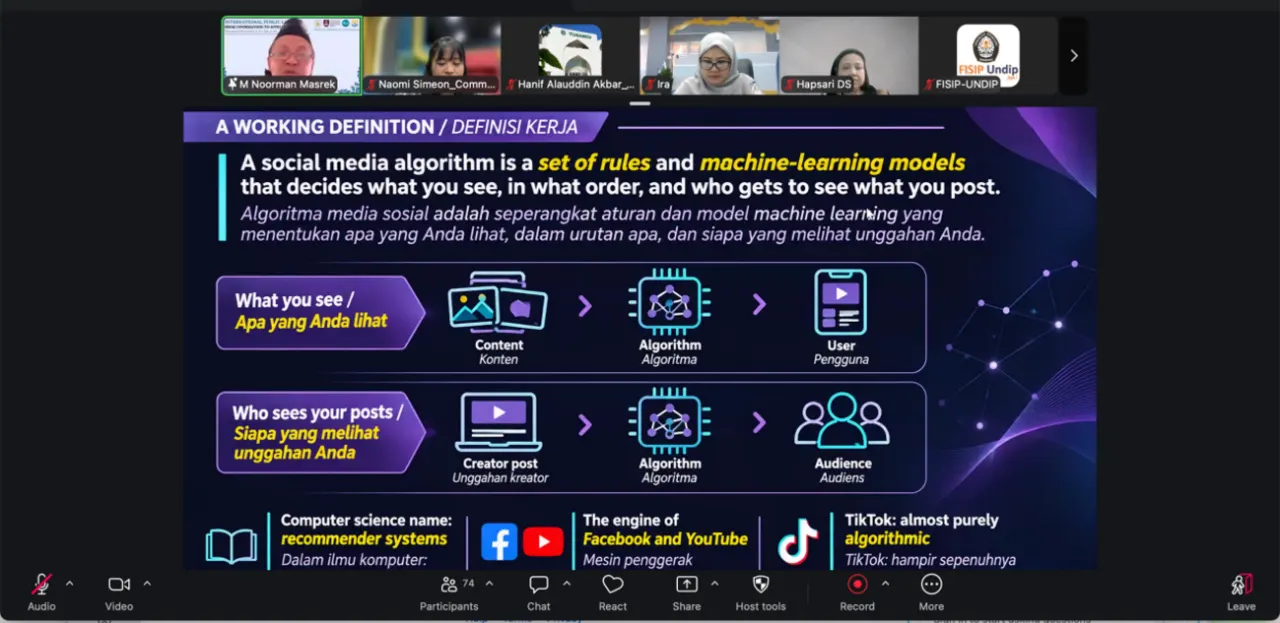
In his presentation, Prof. Noorman comprehensively reviewed how recommendation systems work behind the scenes of global digital platforms. Referring to the framework of Princeton University computer scientist Arvind Narayanan, as well as classical communication theories such as Gatekeeping Theory and Agenda-Setting Theory, he explained that algorithms are not a mysterious “black box” but rather a set of rules and machine learning models that predict user engagement based on behavioral track records.
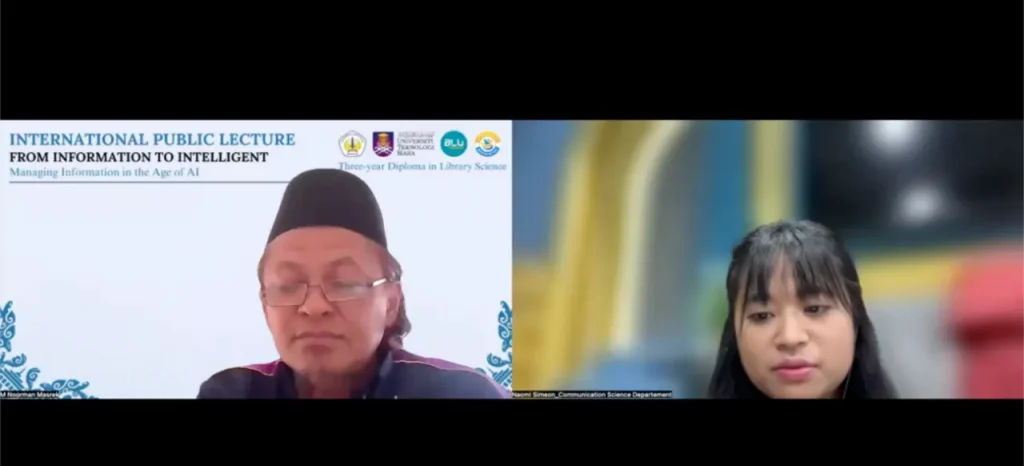
*”Social media algorithms act as digital gatekeepers that select and rank information. However, attention and broad reach do not always correspond to the value or truth of a piece of information,”* emphasized Prof. Noorman before the participants gathered in the virtual Zoom room.
This cross-country discussion is highly relevant to Indonesia’s current digital landscape, where 240 million social media user identities have been recorded, covering 83.2% of the total population. Through a comparative perspective that also touched on international regulations such as the European Union’s Digital Services Act (DSA), Prof. Noorman dissected how the shift from network-based information dissemination models to algorithmic models demands content production strategies that are adaptive while still upholding ethics.
Furthermore, he shared strategic approaches for today’s content producers—from designing audience-first content, prioritizing meaningful engagement metrics such as completion rate and saves, to applying the principle of verification or tabayyun to prevent the spread of disinformation and the trap of divisive engagement bait.
Through the organization of the UNDIP Global Classroom with Universiti Teknologi MARA (UiTM) Malaysia, FISIP Undip reaffirms its position as a World Class Faculty that actively encourages global idea exchange. This international academic collaboration is expected not only to enrich the algorithmic literacy of students and researchers within the Undip environment but also to open up broader opportunities for research cooperation and scientific publication in the Southeast Asian region.