
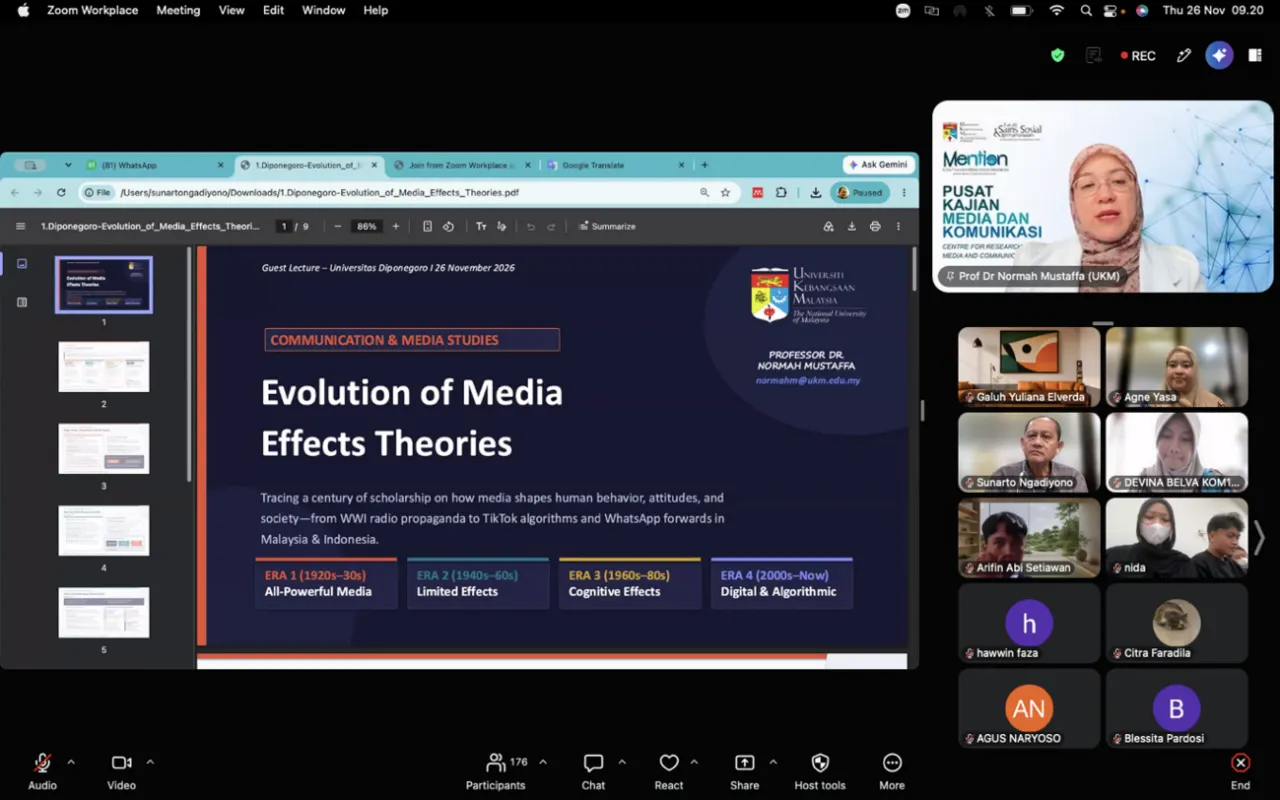
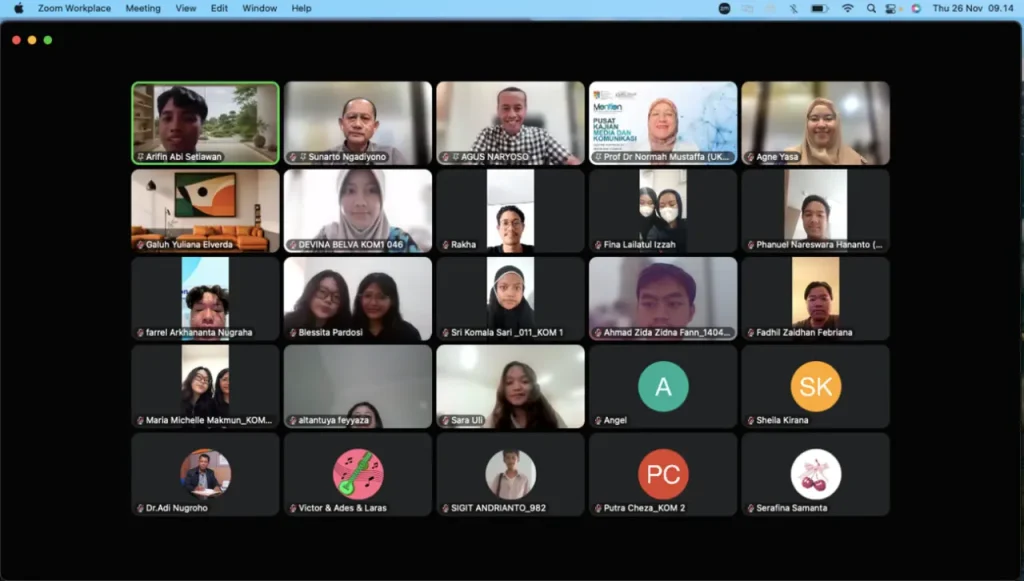
SEMARANG, November 26, 2026 – The Department of Communication Science, Faculty of Social and Political Sciences (FISIP), Diponegoro University (UNDIP), through the Media, Journalism, and Gender Expertise Cluster (KBK), held an Undip Global Classroom (UGC) program featuring Prof. Dr. Normah Mustaffa from the Faculty of Social Sciences and Humanities, Universiti Kebangsaan Malaysia (UKM), on Thursday (26/11/2026).
The activity, held online via Zoom Meeting, raised the topic “Understanding Media Effects Theories in the Digital Era” as part of the Media Communication and Audience Analysis course.
This UGC activity is one of the efforts of the Department of Communication Science at FISIP UNDIP to strengthen the internationalization of learning through academic collaboration with foreign universities.
The Head of the Department of Communication Science at FISIP UNDIP, Dr. Agus Naryoso, S.Sos., M.Si., in his remarks emphasized the importance of international academic collaboration to improve the quality of learning while also broadening students’ global insights.
*”Through the Undip Global Classroom program, we hope that students not only gain knowledge from an international perspective but are also able to develop critical thinking in understanding various changes and challenges of communication in the digital era,”* he said.
Meanwhile, the Head of the Media, Journalism, and Gender Expertise Cluster (KBK), Dr. Sunarto, M.Si., explained that the UGC program was designed to deepen students’ perspectives in the Media Communication and Audience Analysis course to understand the relationship between media and audiences.
*”The development of information and communication technology has transformed the media ecosystem into an increasingly complex one, including in influencing the way society interacts with media. Therefore, it is important to examine whether the media effects theories studied so far are still relevant in explaining communication phenomena in the digital era,”* explained Dr. Sunarto.
In her presentation entitled “Evolution of Media Effects Theories,” Prof. Normah reviewed the development of media effects theories, ranging from the Magic Bullet Theory, the Two-Step Flow of Communication, the Uses and Gratifications Theory, to the Agenda-Setting Theory and Cultivation Theory. Prof. Normah explained that these classical theories do not necessarily lose their relevance but continue to develop following changes in technology and audience behavior.
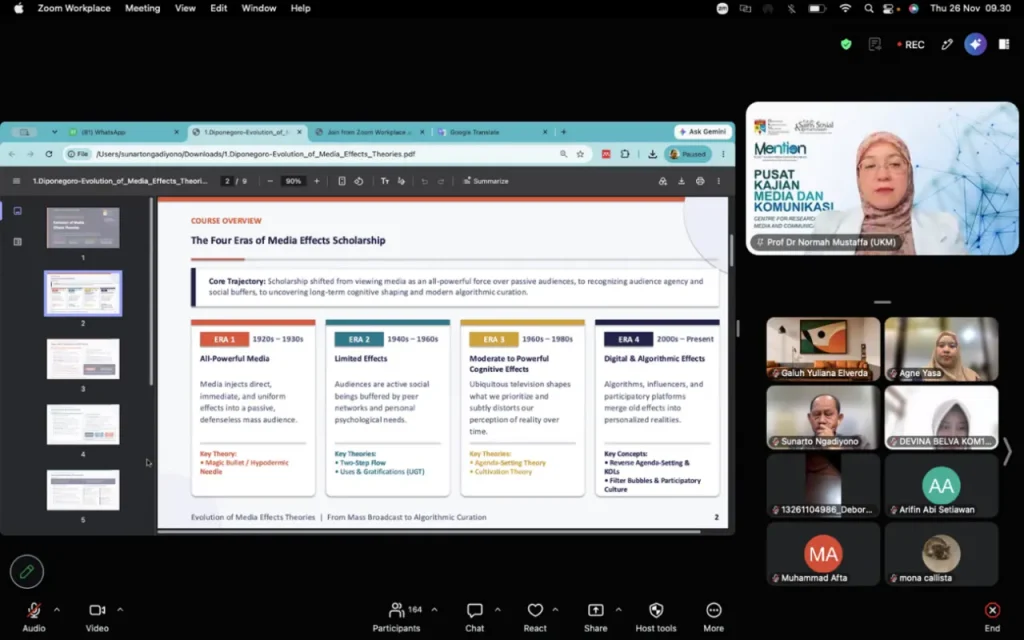
*”Old theories never died; they evolved,”* emphasized Prof. Normah, stressing that media effects theories remain an important foundation for understanding contemporary communication phenomena, even though the media ecosystem and audience characteristics continue to change.
The discussion also covered the phenomena of filter bubbles, echo chambers, social media algorithms, as well as the increasing role of audiences in producing and disseminating information. Various examples from Indonesia and Malaysia were also used to explain changes in information consumption patterns and community participation in digital spaces.
The discussion session also raised the issue of audience participation in digital political communication, including the challenges of spreading hoaxes, political buzzer activities, and the formation of echo chambers that can limit the diversity of information.
Through this activity, students are expected to be able to connect theoretical understanding of media effects with contemporary communication phenomena critically. The Undip Global Classroom program also reaffirms the commitment of the Department of Communication Science at FISIP UNDIP to strengthening the quality of learning and expanding international academic networks.
(Agne Yasa)