

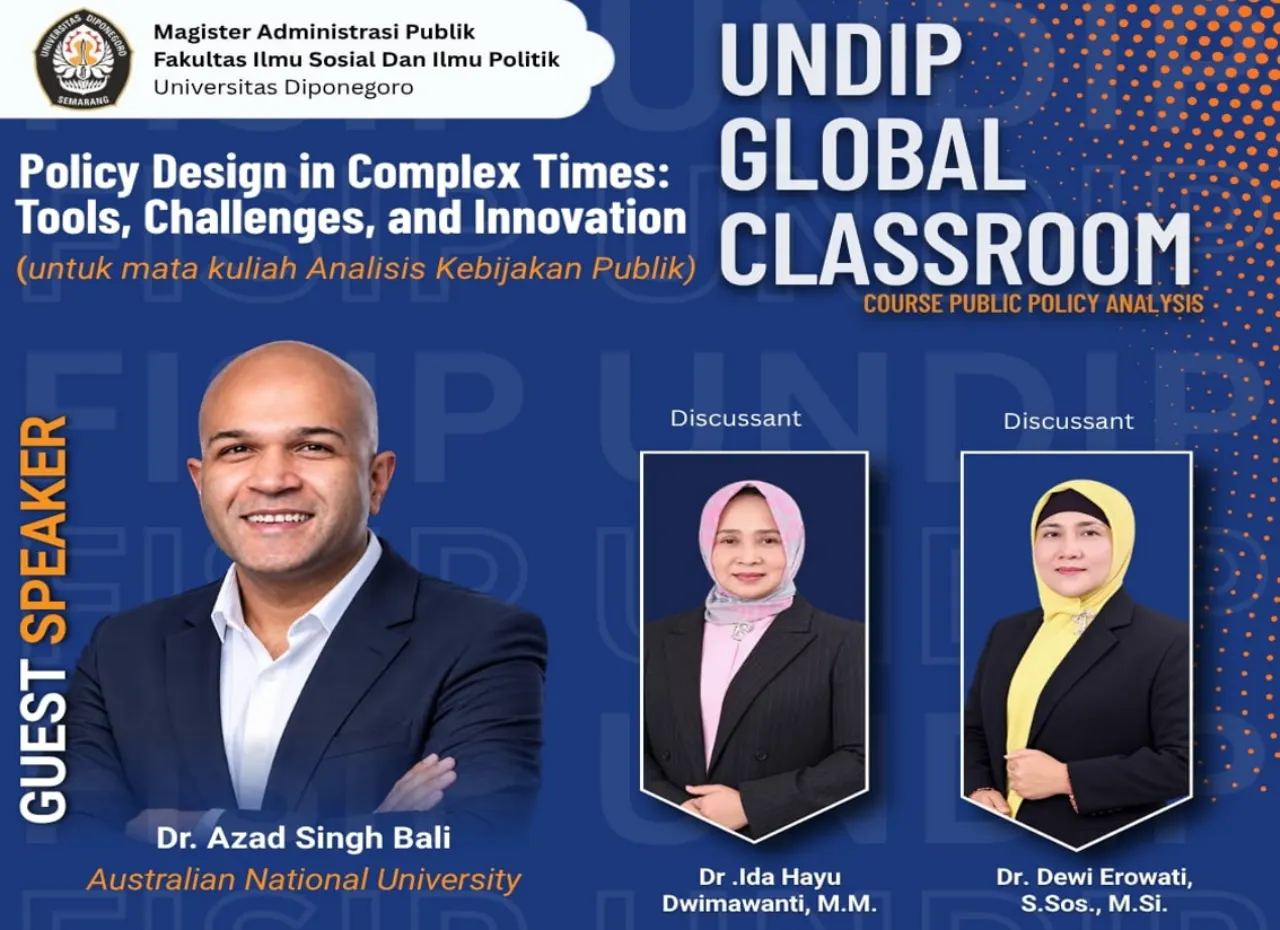
SEMARANG, November 24, 2026 — The Master of Public Administration (MAP) Study Program, Faculty of Social and Political Sciences (FISIP), Diponegoro University (Undip), held an international public lecture entitled Undip Global Classroom on Tuesday (24/11/2026). The academic activity, integrated with the Public Policy Analysis course, featured a renowned academic from the University of Melbourne, Dr. Azad Singh Bali, as the keynote speaker.
Carrying the theme “First, do no harm: A diagnostic approach towards social policy formulation?”, Dr. Azad Singh Bali dissected the fundamental challenges in designing social policy across various countries. In his presentation, he highlighted the tendency of governments to often respond to public problems merely by increasing budgets or launching new programs hastily, which actually risks creating long-term costs without resolving the root causes.

To prevent such policy design failures, Dr. Bali introduced an ex-ante evaluation framework through five diagnostic checks before a policy is implemented, namely:
- Instrumentality & Policy Goals: Ensuring that the chosen policy instruments are truly capable of solving the problem and achieving the set objectives.
- Institutional Pre-requisites: Evaluating the readiness of institutional prerequisites and local socio-economic conditions so as not to fall into policy mimesis that fails to be implemented.
- Coordination & Coherence: Ensuring the alignment of new programs with the existing policy architecture so as not to overlap or trigger misguided incentives.
- Policy Capacity: Measuring the government’s analytical, operational, and political capacity in executing the policy.
- Parametric & Systemic Calibration: Providing space for adjustment or calibration of policy parameters in the future.
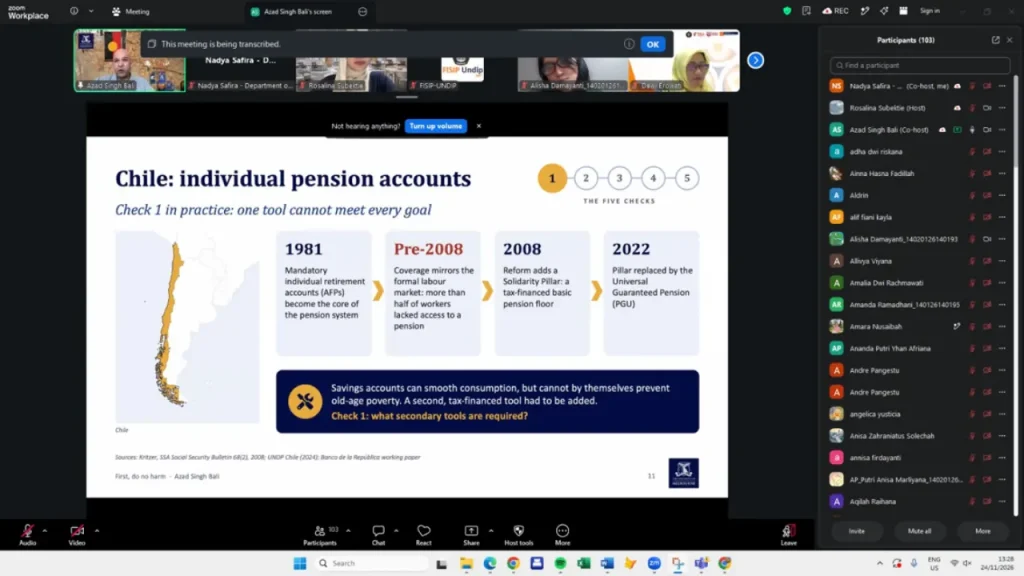
The discussion became more comprehensive with the presence of two discussant lecturers from FISIP Undip, namely Dr. Ida Hayu Dwimawanti and Dr. Dewi Erowati. Both highlighted the urgency of strengthening the field of public policy analysis amid the complexity of current government governance. Both discussants emphasized that the diagnostic approach offered by Dr. Bali is highly relevant for master’s students and policy formulators in Indonesia so that every public intervention has a strong, contextual empirical foundation and minimizes negative impacts on the wider community.
Through the organization of this Undip Global Classroom, the Master of Public Administration Study Program at FISIP Undip is committed to continuously expanding international academic networks and equipping students with comparative and analytical perspectives of global standards in addressing various contemporary public policy issues.