
Semarang, November 2026 – The development of social media has changed the way influencers build relationships with their followers. If previously the relationship between media figures and audiences tended to be one-directional, now interactions on digital platforms allow for the formation of closer, reciprocal relationships involving active participation from followers. This change has also brought a new perspective in understanding the effectiveness of influencers as part of digital marketing strategies.
This phenomenon was discussed in the Undip Global Classroom (UGC) organized by the Communication Science Study Program, Diponegoro University, on Thursday, November 12, 2026, at 18:00 Western Indonesian Time (WIB). Raising the theme “Beyond ‘I Fancy You’: Measuring Trans-Parasocial Relationships in Influencer Advertising.” The online international class was delivered by Assoc. Prof. Chen Lou from the Wee Kim Wee School of Communication and Information, Nanyang Technological University (NTU), Singapore.
In the class, Assoc. Prof. Chen Lou discussed the development of the concept of parasocial relationship (PSR) toward trans-parasocial relationship (trans-PSR) in the context of influencer marketing. The concept refers to the research entitled “Beyond ‘I Fancy You’: Measuring Trans-Parasocial Relationships in Influencer Advertising” written by Chen Lou together with Xuan Zhou and Pengya Ai. The research was published in journal format on March 16, 2026, through the International Journal of Advertising on March 16, 2026.

PSR is a one-directional relationship formed between audiences and media figures, for example public figures and influencers. Although the relationship formed does not always obtain or involve direct reciprocal communication, audiences can still feel closeness and emotional attachment to the public figure or influencer.
However, the increasingly massive development of social media today can show different and complex dynamics. Various diverse social media features, as well as increasingly adequate communication facilities, greatly open opportunities for public figures and influencers to communicate and interact further. Communication and interaction can be carried out through comment columns, Direct Messages (DM), live streaming, to follower engagement in determining ideas and content creation. This condition then becomes an illustration that the relationship between influencers and their followers can no longer be fully explained through the concept of traditional parasocial relationships.
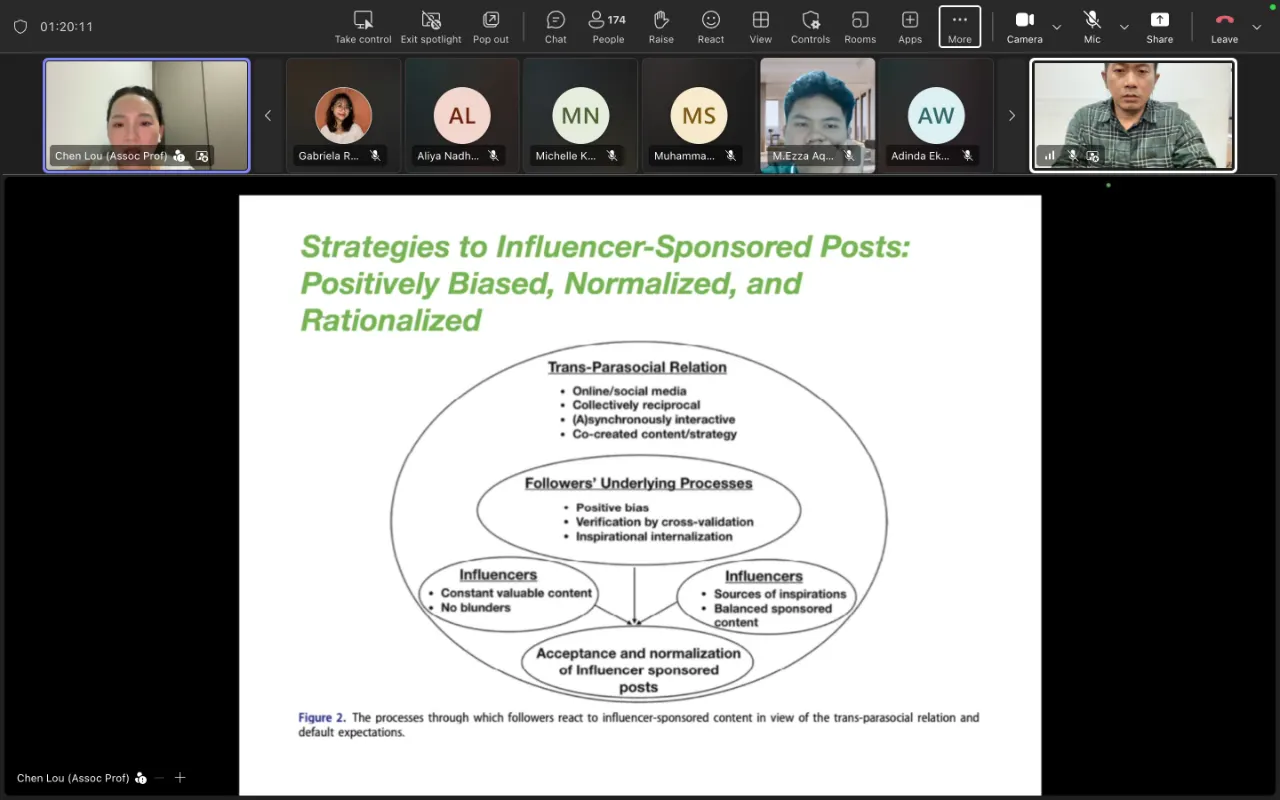
Through the concept of trans-PSR, the research shows a broader understanding of the relationship between influencers and their followers. The concept emphasizes three main dimensions, namely collective reciprocity; (a)synchronous interactivity; and co-creation.
Collective reciprocity, namely a reciprocal relationship in which influencers provide responses or attention to their followers. Although influencers cannot always provide responses to their followers, such actions can provide the perception that there is a reciprocal relationship, namely giving and receiving.
Then it continues to the second dimension, namely (a)synchronous interactivity, which means explaining the existence of two-way communication between influencers and followers, whether directly or indirectly. Interaction can take place through comments, private messages, discussions on social media, or live streaming sessions that allow followers to communicate and obtain responses from influencers.
Meanwhile, the third dimension, co-creation, means the involvement of followers in the content creation process. Followers do not only act as recipients of information but can also be involved in providing ideas, input, and suggestions capable of influencing the topic as well as the form of content that will be produced by public figures or influencers.
The research by Chen Lou, Xuan Zhou, and Pengya Ai developed the concept of trans-PSR and tested the measurement instrument for the concept through four studies. The results of the research produced a measurement scale consisting of three existing dimensions with a total of 18 indicators. The development of this instrument is an important contribution in providing an empirical basis for measuring the relationship between influencers and followers that is more complex than conventional parasocial relationships.
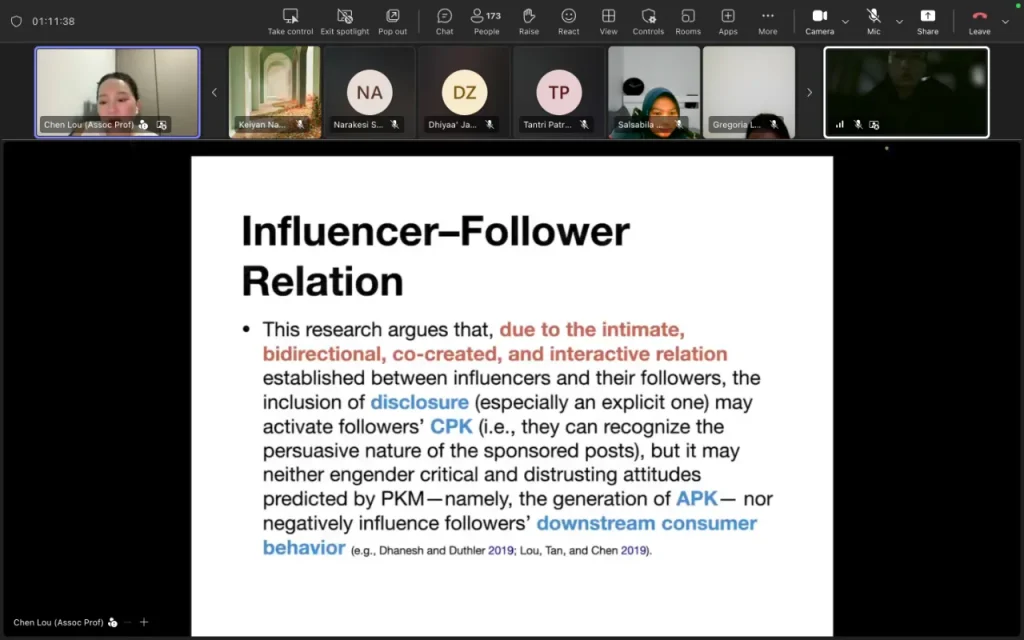
In addition, the research shows the power of influencers in marketing activities. This power is not only seen from the side of popularity but also from how the influencer builds relationships with followers through the interactions carried out. This is in line with the research results that trans-PSR has a relationship with consumer purchase intentions and provides its own explanatory contribution beyond the concepts of parasocial relationship and parasocial interaction.
The research contributes important understanding for the development of digital communication studies, particularly in understanding the relationship between influencers, audiences, and the marketing industry. The increasingly developing dynamics of interaction and communication on social media show that audiences increasingly have the opportunity to participate in the communication process, even influencing the production of messages, in this case, the creation of content that will later be delivered by the influencer themselves.
Through the organization of UGC, the Communication Science Study Program at Diponegoro University strives to present an international academic perspective into the learning process. The presence of an academic from Nanyang Technological University provides an opportunity to become acquainted with the development of communication research and digital marketing more broadly, while also bringing together theoretical discussion with phenomena close to people’s lives today.
The discussion on trans-PSR also shows that the relationship between influencers and audiences can develop into something more complex amid the increasingly interactive social media ecosystem today. More than just building interest, the relationship involves a process of reciprocal communication, involvement, and collaboration that has the potential to influence consumer attitudes and behavior.
Through academic forums such as UGC, the Communication Science Study Program at Diponegoro University continues to encourage the strengthening of global insights and students’ critical understanding of the development of Communication Science, particularly in facing the transformation of relationships between media, audiences, and marketing practices in the digital era.
Communication Science Study Program Department of Communication Science Faculty of Social and Political Sciences Diponegoro University