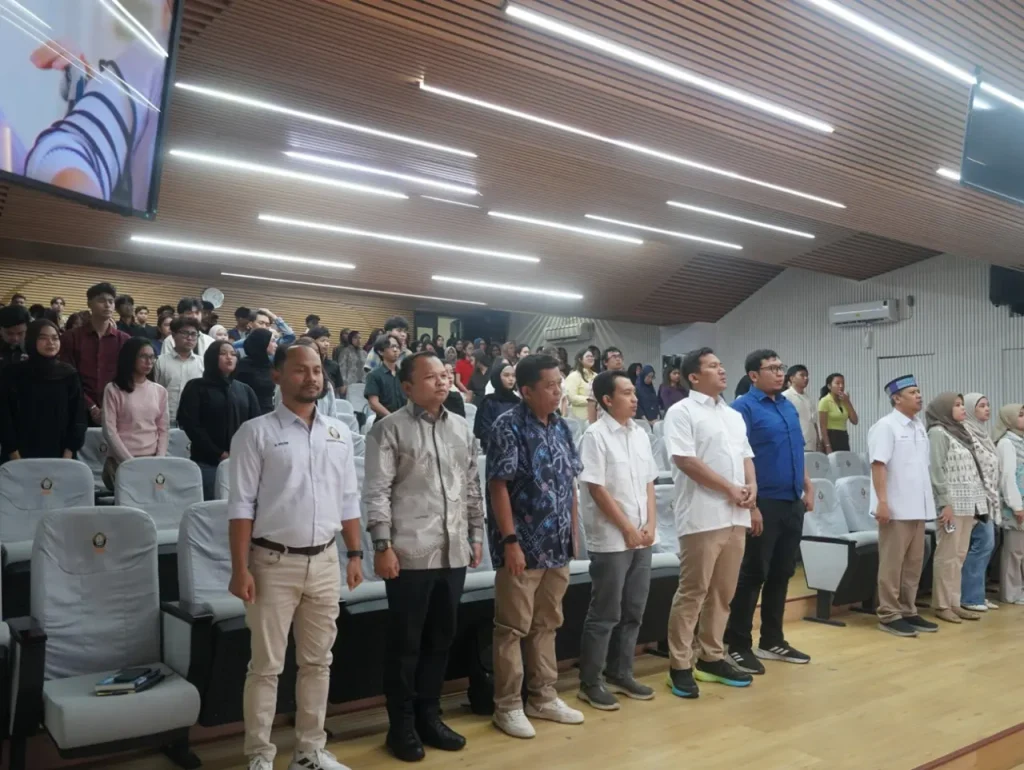

SEMARANG — The Faculty of Social and Political Sciences (FISIP) Diponegoro University (Undip), through a collaboration between the Department of Politics and Government Science and the Department of International Relations, held a Public Discussion and Book Review titled “Hybrid Warfare: Modern War, Lessons from the Russia vs Ukraine Conflict” on Monday, November 16, 2026, from 12:30–16:00 WIB, at the Theater Room, Building C, 1st Floor, FISIP Undip, Semarang. The event, organized in cooperation with the Yayasan Pustaka Obor Indonesia and supported by Bank Rakyat Indonesia (BRI), featured the book’s author in person, Mujaddid Akbar, S.IP., M.Han., who is an alumnus of the Government Science program, FISIP Undip, class of 2001.
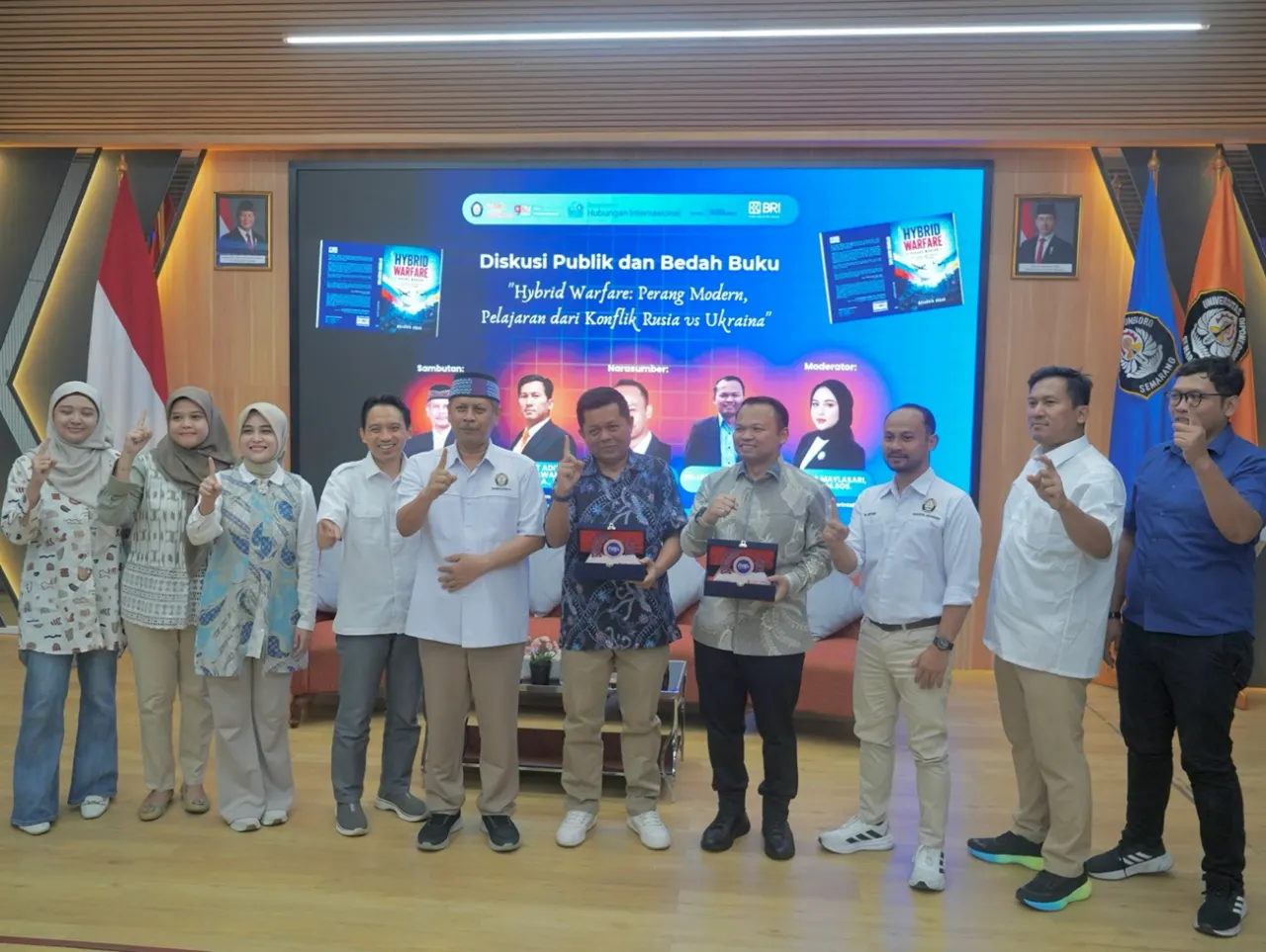
The series of activities was officially opened by the master of ceremonies (MC), followed by opening remarks from the Dean of FISIP Undip, Prof. Dr. Drs. Teguh Yuwono, M.Pol.Admin. A representative from the collaborating partners, Andreas Haryono from Yayasan Pustaka Obor Indonesia, also delivered remarks on the importance of publishing collaboration in enriching the literacy of strategic studies in Indonesia. As a token of appreciation for this academic synergy, the Dean of FISIP Undip presented souvenirs to the book’s author, Mujaddid Akbar, S.IP., M.Han., and to partner representative Andreas Haryono, which was then followed by a group photo session before entering the main event.
The discussion session, moderated by Hanifa Maylasari, S.I.P., M.Sos., Lecturer at the Department of Politics and Government Science, FISIP Undip, began with the book’s author, Mujaddid Akbar, S.IP., M.Han., outlining the main ideas of his work. Currently serving as a Civil Servant (ASN) at the State Secretariat as Head of the Events Section, Bureau of Protocol, Presidential Secretariat, he explored the dynamics of modern warfare through lessons drawn from the Russia-Ukraine conflict. In his review, Mujaddid highlighted the use of two main instruments in hybrid warfare, namely military and non-military power. He emphasized that, within the contemporary conflict landscape, non-military power—such as information operations, disinformation, technological dominance, economic pressure, and shaping public opinion—actually has a far more destructive and decisive impact than the deployment of conventional military force alone.
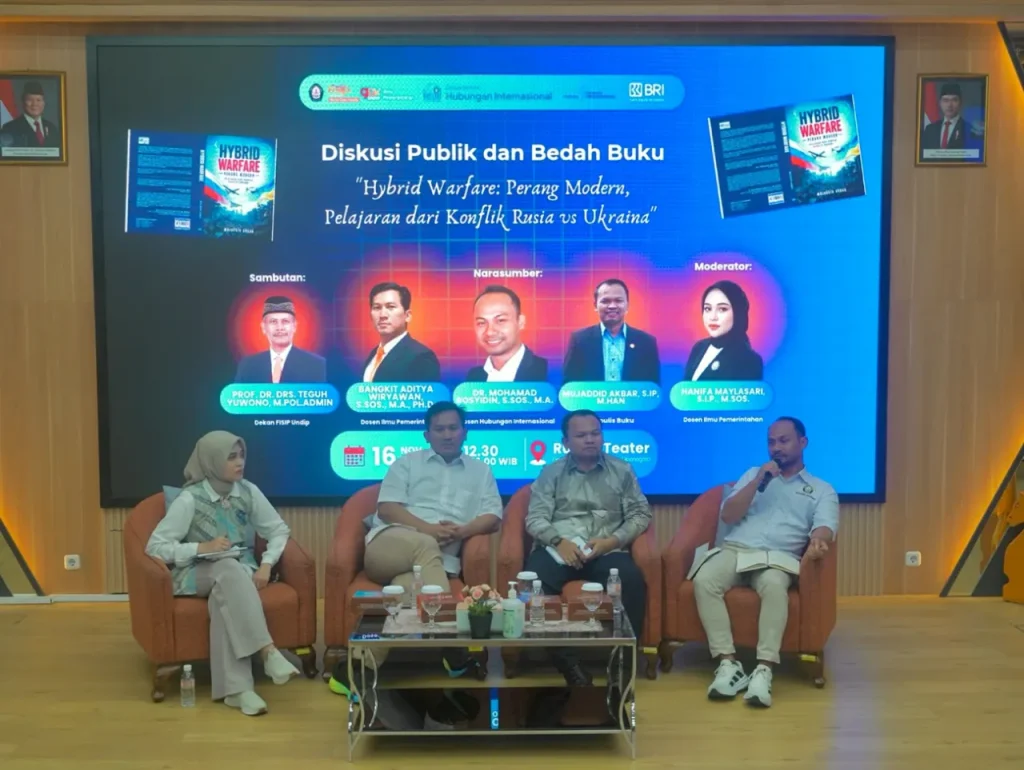
The first response was delivered by discussant Bangkit Aditya Wiryawan, S.Sos., M.A., Ph.D., Lecturer at the Department of Politics and Government Science, FISIP Undip, who reviewed the development of warfare strategies from a historical and geopolitical perspective. He explained that patterns of warfare have continued to evolve from the Roman and Mongol Empires through to the modern era, which now presents complex threats from both state and non-state actors, as well as conflicts that are increasingly personalized because they involve the interests and identities of the actors. Additionally, he underscored the author’s idea that war is not only a contest of military power but also a cultural expression reflecting the historical background and character of a nation.
Meanwhile, the second discussant, Dr. Mohamad Rosyidin, S.Sos., M.A., Lecturer at the Department of International Relations, FISIP Undip, considered the book timely and relevant for students as well as policymakers, but offered constructive criticism that the early chapters should be arranged more systematically, Ukraine’s perspective examined more evenly, and the war’s impact discussed more broadly. Through the lenses of realism and offensive realism, he dissected the Russia-Ukraine conflict as an expression of Russian imperial ambition (Velikaya Derzhava) to maximize power and respond to Ukraine’s closeness with the West and NATO. He also highlighted power imbalances between states, the use of disinformation, the role of technology-based non-state actors such as Elon Musk, Europe’s energy vulnerability, and the fact that military superiority is not a guarantee of victory, so Indonesia needs to make global stability a primary foundation for its foreign policy direction.
Through the organization of this book review, FISIP Diponegoro University affirms its commitment to continuously bridge academic discourse with the practical experience of alumni at the national level, while equipping the academic community and the public with critical understanding of the security challenges of the 21st century.