SEMARANG – The Department of Communication Science, Faculty of Social and Political Sciences (FISIP), Universitas Diponegoro (UNDIP), through its Media Sociology Research Cluster (KBK), once again organized the Undip Global Classroom (UGC) as part of its efforts to strengthen academic insights and broaden global perspectives in the field of communication studies. Entitled “Digital Information & Social Media Impact: Exploring the Evolving Role of Digital Media in Contemporary Society,” the event featured an academic from Universiti Malaya, Malaysia, Dr. Ali Fauzi Bin Ahmad Khan, on Monday, November 16, 2026, and was conducted online via Zoom Meeting.
The session was moderated by Dr. Phil. Nuriyatul Lailiyah, S.Sos., M.I.Kom., and attended by the Head of the Media Sociology Research Cluster, Dr. Nurul Hasfi, S.Sos., M.A., along with all members of the research cluster: Dr. Yanuar Luqman, S.Sos., M.Si.; Dr. Agus Naryoso, S.Sos., M.Si.; Muchammad Yuliyanto, S.Sos., M.Si.; Herlina Kusumaningrum, S.Sos., M.A.; and Muhammad Rif’at Al-Razi, S.I.Kom., S.Pd., M.I.Kom.
Strengthening Academic Perspectives on Digital Media Transformation
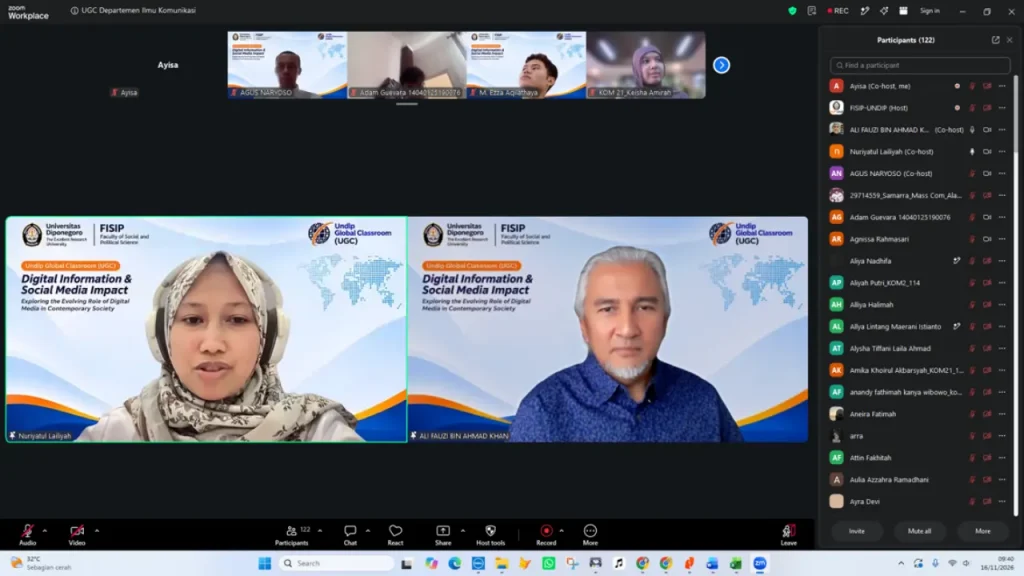
The event commenced with welcoming remarks from the Head of the Communication Science Study Program, Dr. Agus Naryoso, S.Sos., M.Si. In his remarks, he expressed his appreciation and gratitude to Dr. Ali Fauzi Bin Ahmad Khan for his willingness to participate and share his knowledge and academic experiences with the FISIP UNDIP academic community.
Dr. Agus emphasized that the topic of Digital Information and Social Media Impact is highly relevant to contemporary society. The development of digital media has brought significant changes to various aspects of everyday life, ranging from communication patterns and learning processes to information dissemination and public participation in social spaces.
“Digital media has changed the way we communicate, learn, share information, and participate socially. Alongside the numerous opportunities it offers, there are also challenges, such as misinformation, digital ethics, and responsible communication,” said Dr. Agus.
Furthermore, he expressed his hope that the UGC would serve as a platform for exchanging knowledge and academic experiences across countries while enriching participants’ understanding of digital media developments from broader perspectives.
Exploring the Dynamics of Digital Information and Social Media Impact
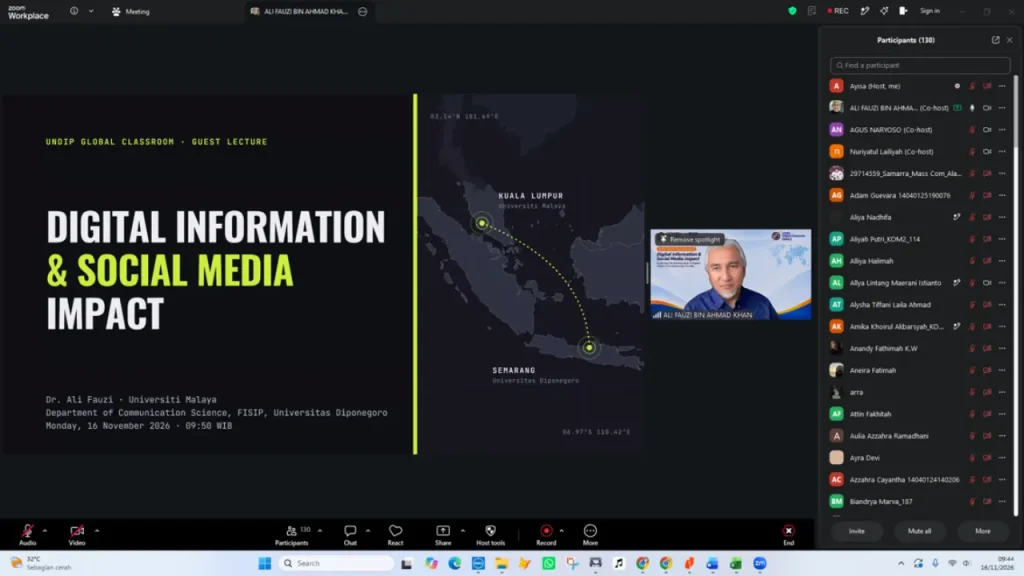
Moving into the main session, Dr. Ali Fauzi Bin Ahmad Khan delivered a presentation entitled “Digital Information and Social Media Impact.” In his presentation, he invited participants to understand how social media has evolved into one of the primary sources of information and how it shapes communication dynamics in contemporary society.
The discussion began by examining changes in people’s news consumption patterns, which are increasingly shifting toward social media platforms. Drawing on various data and research findings, he explained that social media usage continues to grow, while digital platforms such as WhatsApp, Instagram, TikTok, Facebook, and YouTube play significant roles in information dissemination in both Indonesia and Malaysia. In 2026, social and video networks even surpassed television as the leading sources of weekly news consumption.
However, the ease of access and speed of information distribution have also introduced new challenges, particularly concerning misinformation, disinformation, and the growing circulation of AI-generated manipulative content. One issue of particular concern is the increasing accessibility of deepfake technology, which enables the creation of videos or statements that closely resemble authentic content. Consequently, people need to develop the ability to identify and verify information before believing or sharing it.
Dr. Ali also discussed the development of digital platform regulations in several countries, including Indonesia, Malaysia, and Australia. This discussion highlighted various government approaches to protecting users, particularly children and adolescents, as well as efforts to regulate platform responsibilities regarding content and user activities.
In addition, the presentation explored the influence of social media on people’s social lives, ranging from public participation and social movements to youth wellbeing. Social media is not merely a space for information dissemination and public expression; it can also facilitate social solidarity, mobilize humanitarian assistance, and strengthen public engagement in responding to various social issues.
Concluding his presentation, Dr. Ali highlighted three important considerations in understanding the development of digital media: shifting attention from individual messages to platform systems and designs, recognizing the importance of understanding the sources behind every piece of data or information, and acknowledging speed as a determining factor in the effectiveness of information dissemination and correction.
Therefore, digital literacy must be continuously strengthened to encourage people to become more critical and responsible users of social media.
Interactive Discussion and Strengthening Global Academic Collaboration
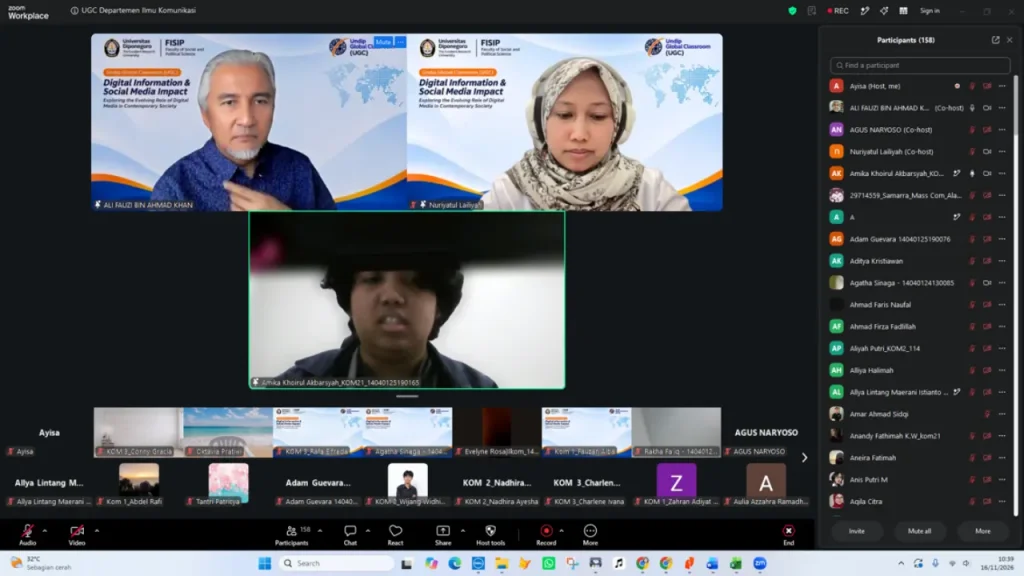
Following the presentation, the event continued with an interactive question-and-answer session. Participants demonstrated great enthusiasm through various questions and responses related to the issues discussed, particularly the challenges of digital information credibility, social media regulations, and the impact of digital platform usage on everyday life.
The discussion provided participants with an opportunity to deepen their understanding while connecting the academic perspectives shared by the speaker with real-world phenomena surrounding social media usage.
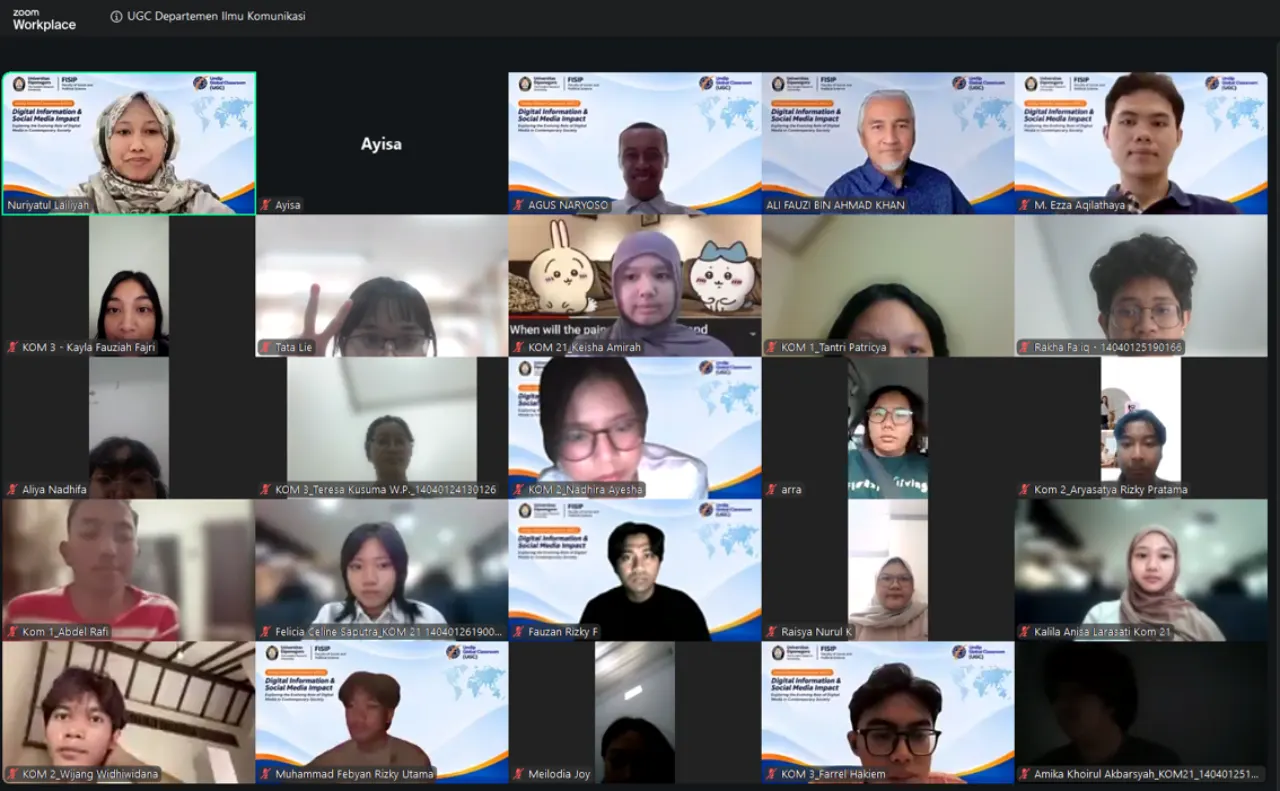
The event concluded with a group photo session as a form of documentation and appreciation for the successful implementation of this international academic activity.
Through the Undip Global Classroom initiative organized by the Media Sociology Research Cluster, the Department of Communication Science, FISIP UNDIP, continues to promote academic development, cross-border knowledge exchange, and critical perspectives on the dynamics of digital communication.
The participation of an academic from Universiti Malaya is expected to provide valuable insights for all participants while broadening their understanding of the role and impact of digital media in contemporary society.
Given the increasing relevance of these issues in everyday life, this activity is also expected to encourage the academic community to become more critical, adaptive, and responsible digital media users amid the continuous development of information technology.