

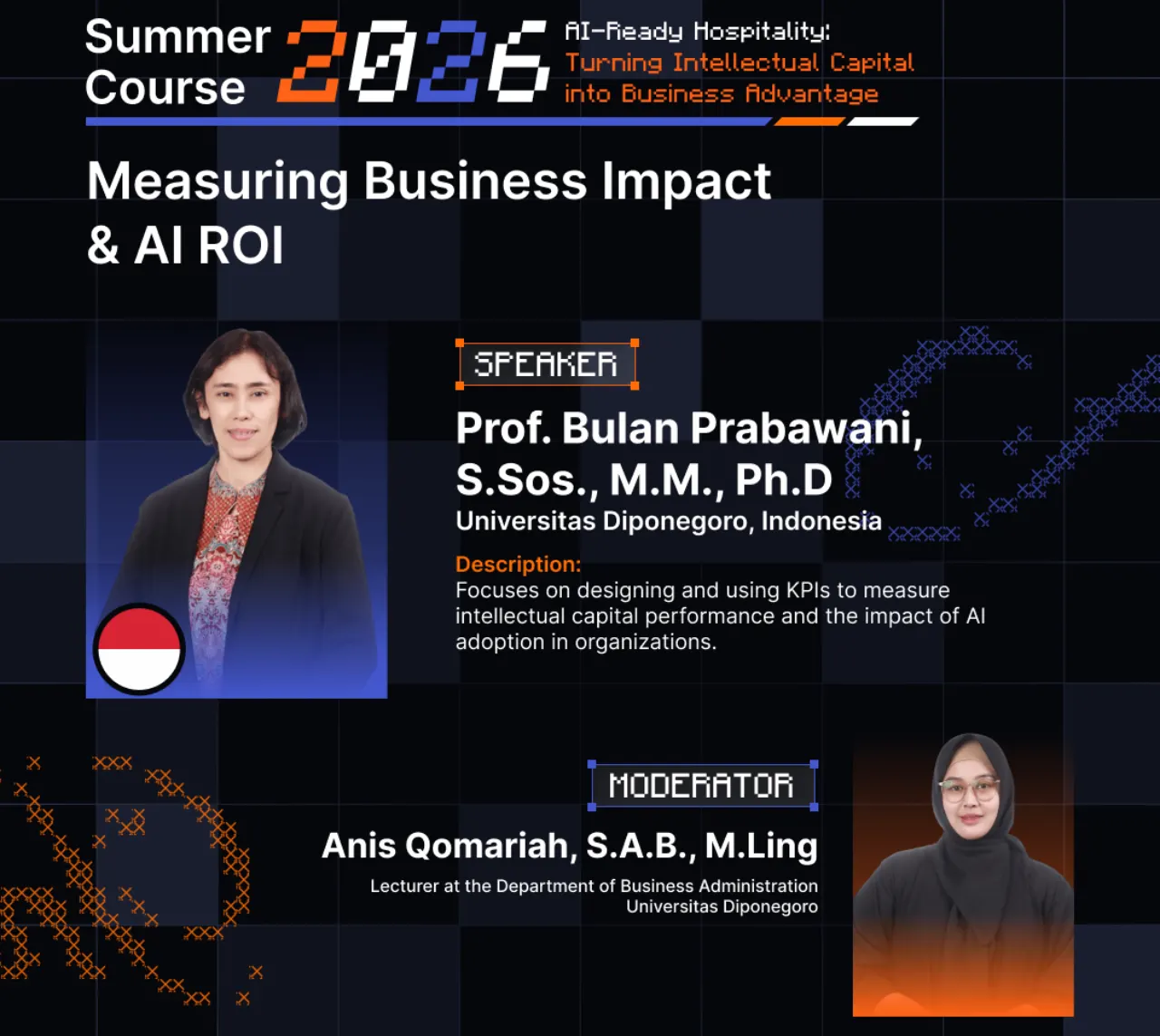
Semarang, September 23, 2026 – The Department of Business Administration, FISIP Universitas Diponegoro, continued its Summer Course 2026 series on Wednesday, September 23, 2026. Under the overarching theme “AI-Ready Hospitality: Turning Intellectual Capital into Business Advantage,” the sixth day focused on the topic “Measuring Business Impact & AI ROI.” The session featured Prof. Bulan Prabawani, S.Sos., M.M., Ph.D., from Universitas Diponegoro as the keynote speaker.
The session served as part of a learning series bringing together domestic and international participants to discuss designing and utilizing key performance indicators (KPIs) to evaluate intellectual capital performance and measure the impact of AI adoption within organizations.
The session was moderated by Anis Qomariah, S.A.B., M.Ling., a lecturer in Business Administration at Universitas Diponegoro. In her presentation titled “Measuring Business Impact & AI ROI: From Intangible Capital to Measurable Value in AI-Ready Hospitality Organizations,” Prof. Bulan Prabawani emphasized that this session served as a capstone to earlier modules on human, structural, and relational capital, as well as AI applications across marketing, guest experience, governance, and service recovery—addressing whether these initiatives genuinely deliver tangible business value.

She opened her presentation by defining the metrics of evaluation, noting that competitive advantage in the hospitality sector increasingly relies on intangible resources rather than physical assets, manifested across three dimensions of intellectual capital. Human capital encompasses employee skills, digital literacy, creativity, and adaptability. She further elaborated on why measuring the value of AI proves challenging: its outputs are largely intangible, making it difficult to isolate causal factors and standardize metrics; AI investments often incur short-term costs and disruptions before long-term benefits materialize; and organizations must balance value-creation opportunities against risk consequences. Without standardized measurements for intangible outcomes, AI investments cannot be effectively benchmarked within an individual hotel or across wider portfolios. Participants were also invited to discuss which form of capital presents the greatest measurement challenge in their respective organizations, whether AI projects yielding strong financial ROI but low fairness or trust scores should proceed, and a key KPI that could be implemented immediately.
Through the session titled “Measuring Business Impact & AI ROI,” participants gained comprehensive insights into evaluating the full value of AI through a balanced synthesis of financial, operational, and ethical metrics. This discussion further reinforced the central theme of Summer Course 2026 regarding the importance of optimizing intellectual capital to navigate industry transformations.