

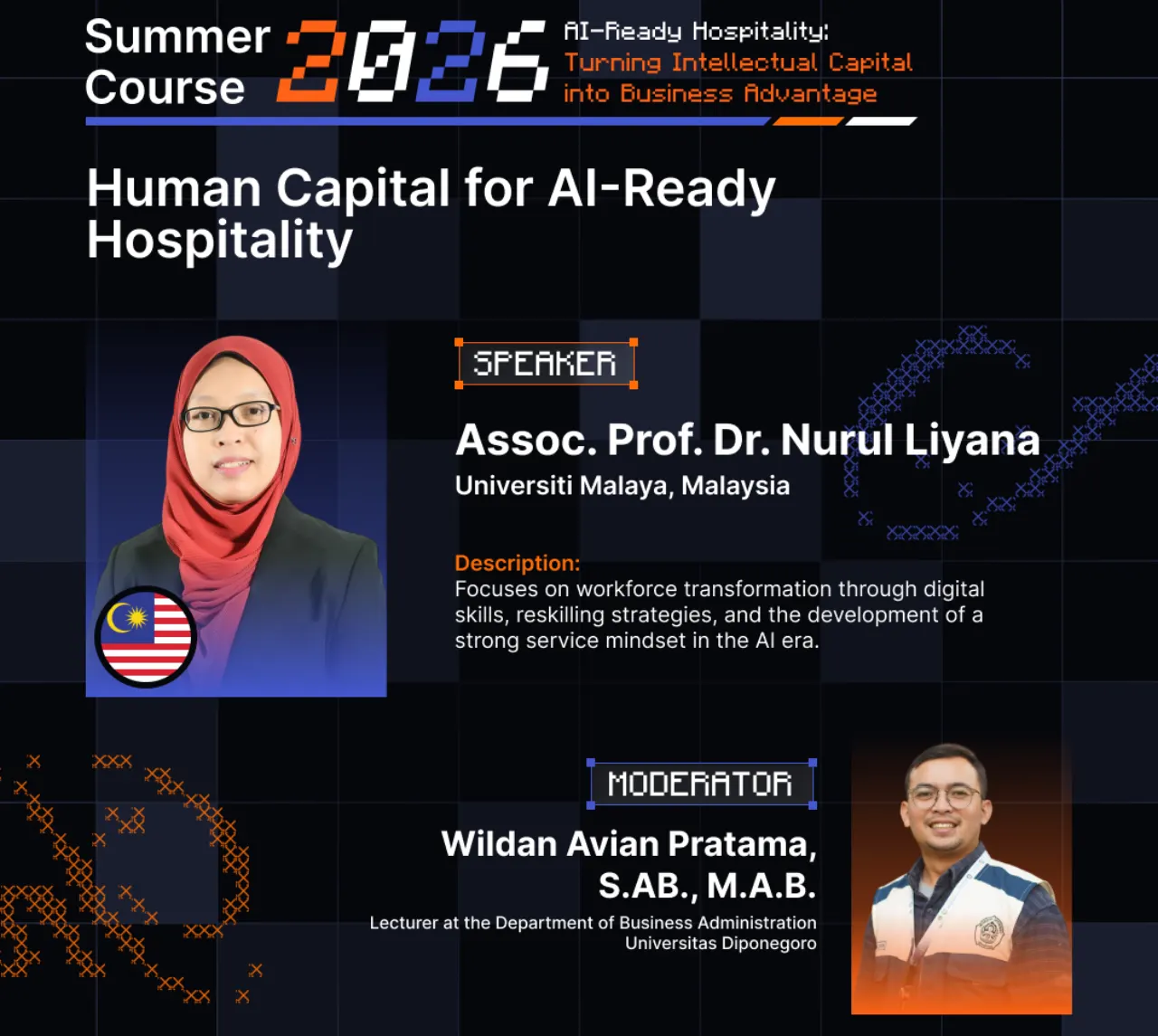
Semarang, September 21, 2026 – The Department of Business Administration, FISIP Universitas Diponegoro, continued its Summer Course 2026 series on Monday, September 21, 2026. Under the overarching theme “AI-Ready Hospitality: Turning Intellectual Capital into Business Advantage,” the fourth day focused on the topic “Human Capital for AI-Ready Hospitality.” The session featured Assoc. Prof. Dr. Nurul Liyana Mohd Kamil from the Faculty of Business and Economics, Universiti Malaya, Malaysia, as the keynote speaker.
The session served as part of a learning series bringing together domestic and international participants to examine workforce transformation through digital skills, reskilling strategies, and the cultivation of a robust service mindset in the age of AI.
The session was moderated by Wildan Avian Pratama, S.AB., M.A.B., a lecturer in Business Administration at Universitas Diponegoro. In her presentation titled “Human Capital for AI-Ready Hospitality: Leading People, Technology and Service Innovation,” Assoc. Prof. Dr. Nurul Liyana Mohd Kamil addressed how leaders can harmoniously align human talent, technology, and service innovation.
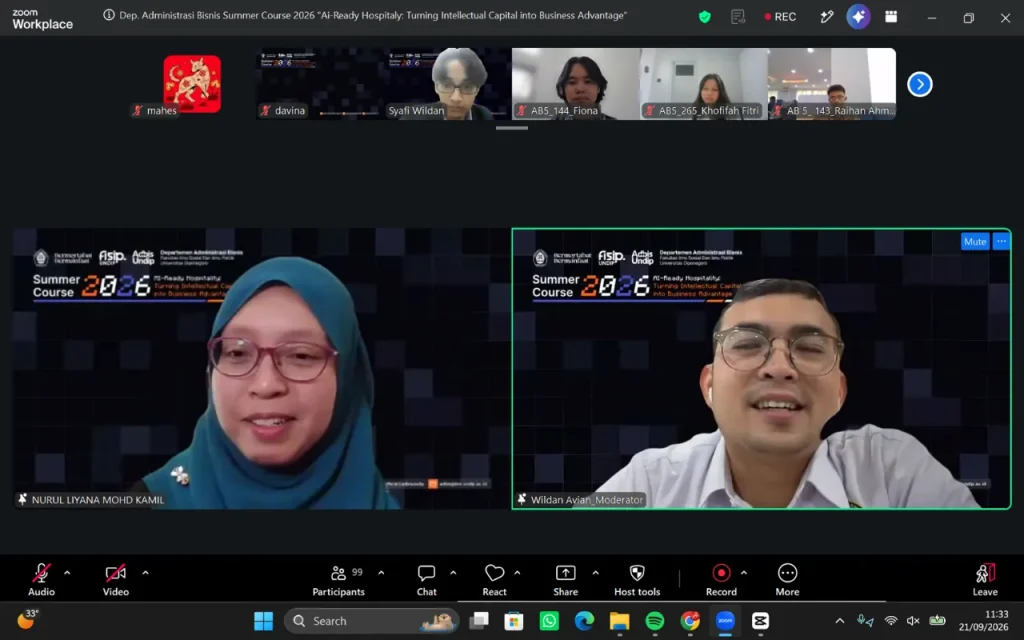
In her presentation, she highlighted the key strengths of Indonesian hospitality in the AI era, including personal warmth and tailored service, culturally relevant multilingual communication, local knowledge alongside cultural sensitivity, and human interaction remaining at the center. The opportunity lies in blending digital speed with authentic Indonesian hospitality: while AI enhances efficiency, humans preserve the warmth and cultural authenticity that guests cherish. Within the Industry 5.0 framework, she emphasized the fusion of technology and empathy, where AI, automation, and digital platforms are utilized to enhance human well-being rather than replace people, with leaders serving as the “bridge” between humans and technology.
Closing her address, she affirmed that AI readiness relies on employee capability, managerial support, and organizational trust. AI readiness is ultimately a human capital responsibility—leaders must redesign roles and build workforce capabilities, technology must enhance human service, and organizational culture determines whether people adopt, question, and refine AI. She concluded with the message that the future of hospitality belongs to organizations that blend intelligent technology with genuinely humanized service.
Through the session titled “Human Capital for AI-Ready Hospitality,” participants gained valuable perspectives on leadership roles, a culture of listening, and human capability development to prepare the hospitality sector for the AI era. This discussion further reinforced the central theme of Summer Course 2026 regarding the importance of optimizing intellectual capital to navigate industry transformations.