

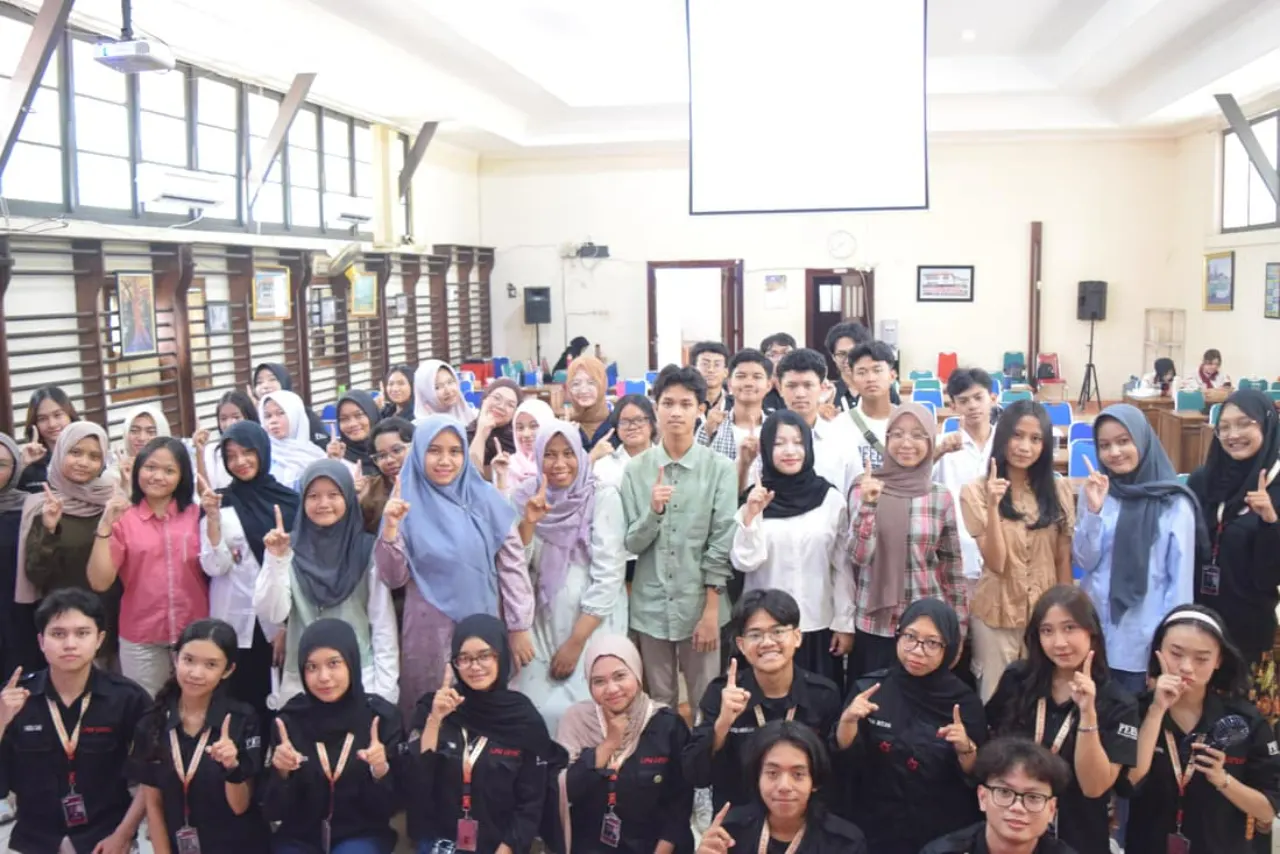
The Student Press Organization (LPM) OPINI of the Faculty of Social and Political Sciences, Universitas Diponegoro, once again presented its OPINI Goes to School (OGTS) 2026 program at SMA Negeri 1 Semarang on Saturday (3/10). Carrying the theme “Youth Journalism with Integrity,” the event equipped students with an understanding of the press world, media literacy, interview techniques, and news writing practice. Taking place from 09.00 to 13.34 (GMT+7), the activity reached 75 participants consisting of members of the journalism extracurricular program and Literacy Ambassadors of SMA Negeri 1 Semarang. Through a blend of material delivery, discussions, case studies, practical exercises, and games, OGTS 2026 was designed not only as a space to introduce journalism but also as a forum for participants to develop critical thinking skills and process information responsibly.
The series of activities began with an opening and remarks from the Project Officer of OGTS 2026, Marsya Cinta Nadhitasari, and the General Leader of LPM OPINI FISIP Undip, Moh. Arif Maulana Azmi. In her remarks, Cinta expressed her hope that participants would produce impactful journalistic works and grow into a critical and integrity-driven generation. Meanwhile, Azmi emphasized that journalism is not merely about delivering information but also about how information is conveyed based on facts so that it can be understood by readers and bring about a positive impact.
The first session, titled “Getting to Know the World of the Press: Press, Ethics, and Propaganda in the Media,” was delivered by Moh. Arif Maulana Azmi and Musyaffa Afif. Participants were invited to understand the press, from the history of its development in Indonesia to the characteristics and roles of the press amid the evolution of digital media. The discussion then shifted toward propaganda and its relationship to agenda setting, accompanied by a case study on news coverage of forest and land fires (karhutla) threatening the existence of proboscis monkeys. Through this case study, participants were not only asked to understand concepts but also to analyze how a media message can shape audience responses. Participants identified the use of emotional appeal techniques in news coverage that can evoke emotional responses such as sadness, pity, and disappointment. This session then became a space to emphasize the importance of media literacy, critical thinking, and awareness in receiving information from social media and other media outlets.
The enthusiasm of participants was also evident in the discussion session. Various questions were raised, ranging from positive propaganda and the challenges faced by the press to ways of addressing the spread of excessive information. In the discussion, the speakers emphasized the importance of presenting facts in simple and easily understandable language, as well as taking a gradual and patient approach toward society.
Afterwards, participants attended the second session titled “Interview Techniques and News Writing,” delivered by Najwa Rahma and Ridzqie Abdillah. The material focused on the reporting process, interview techniques, news structure, the use of the 5W+1H elements, and the principle of balance in journalism. Participants were introduced to the inverted pyramid structure consisting of the lead, body, and tail, and were invited to analyze the 5W+1H elements through case studies. Beyond writing techniques, participants also gained an understanding of interview ethics. The speakers discussed the importance of maintaining politeness, requesting permission when recording, explaining the purpose of the interview, and respecting information stated as off the record. The discussion on balance was further reinforced through participants’ experiences in covering the student council president election, which was then linked to the importance of gathering and verifying perspectives from various parties.
The knowledge acquired by participants was then applied through an individual practice of writing a news lead. Participants chose one of three themes—forest and land fires, the Free Nutritious Meals (Makanan Bergizi Gratis / MBG) program, and cyberbullying—and then composed a single lead paragraph while paying attention to the 5W+1H elements. The practice was carried out individually using mobile phones over 35 minutes, while the written results were corrected and curated by the speakers.
To keep the atmosphere interactive, participants also took part in a mini game called “Tembak Makanan” (Shoot the Food), involving students of SMA Negeri 1 Semarang and members of LPM OPINI FISIP Undip. The game brought together six groups with unique food-themed names and took place over several rounds. The group Spaghetti Carbonara Cabe Ijo was eventually declared the winner after the final determination was made through hompimpah or gambreng (a group toss) due to time constraints.
As a form of appreciation for participants’ engagement and practical results, OGTS 2026 also presented Best Participant awards to three individuals. The awards were given based on activeness throughout the activity as well as the quality of the leads written, which had been corrected and curated by the speakers. Locita Kalyana secured first place, followed by Maheswari Nesya in second place and Eloy Smartha in third place. All three received certificates and prizes in the form of e-wallets presented by Marsya Cinta Nadhitasari as the Project Officer of OGTS 2026.
The implementation of OGTS 2026 demonstrated that journalism learning can be packaged through an interactive and applicative approach. Participants not only received material on the press and news writing but also engaged in discussions, case analysis, writing practice, and group activities. Participants’ enthusiasm was evident from their active involvement in asking questions, completing practical exercises, and participating in the series of activities. Through “Youth Journalism with Integrity,” LPM OPINI FISIP Undip hopes that OGTS 2026 can become a learning space that encourages students to become more critical in understanding information, responsible in using media, and courageous in producing journalistic works of integrity. This activity also forms part of the effort to build collaboration between the student press and the school environment in strengthening a culture of media literacy among the younger generation.