

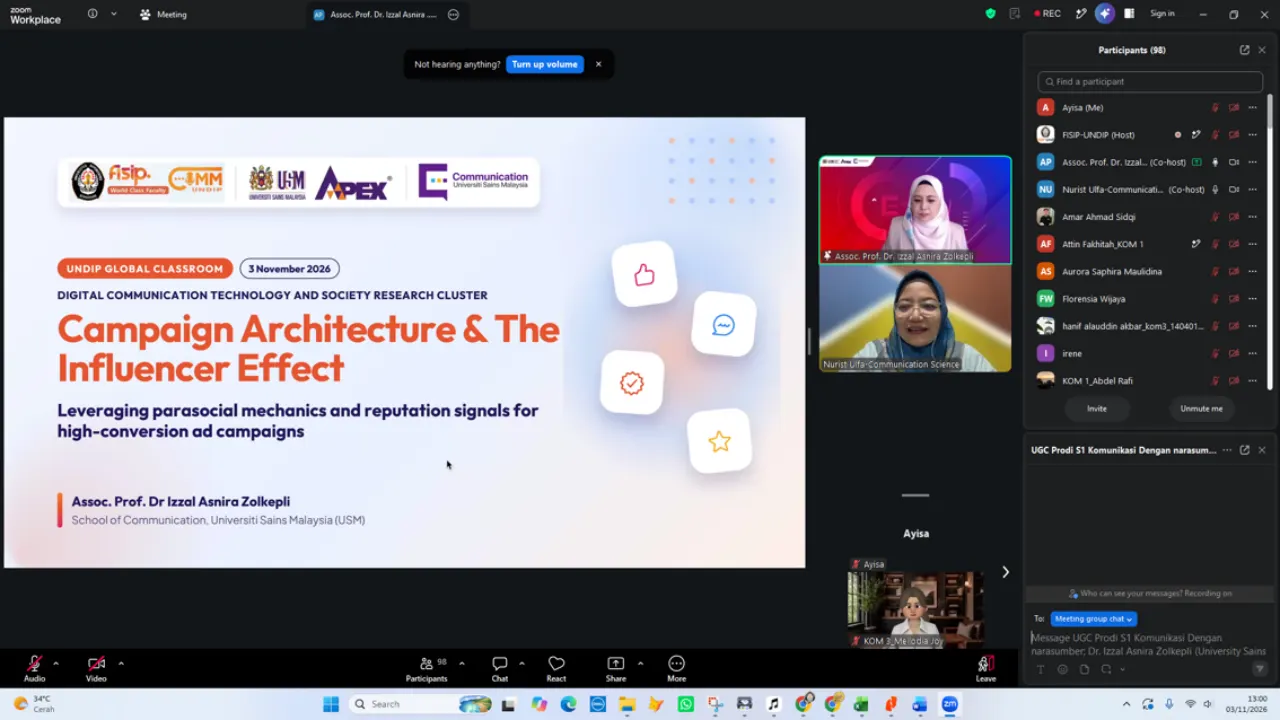
Semarang, 3 November 2026 — Why do audiences trust recommendations from creators they have never met? This question opened an UNDIP Global Classroom guest lecture for the Strategic Media Planning course. The online session was organised by the Bachelor of Communication Science Programme, Faculty of Social and Political Sciences, Universitas Diponegoro, as part of the activities of the Digital Communication Technology and Society Research Cluster.
The lecture, “Campaign Architecture & The Influencer Effect: Leveraging Parasocial Mechanics and Reputation Signals for High-Conversion Ad Campaigns,” featured Associate Professor Dr Izzal Asnira Zolkepli from the School of Communication, Universiti Sains Malaysia, as the keynote speaker. Nurist S. Ulfa, M.Si., Ph.D., the course lecturer, served as discussant.
Dr Izzal specialises in digital communication, social media, and digital consumer behaviour. Her research interests include communication mediated by artificial intelligence, social media adoption, audience engagement, and user experience. She also uses quantitative modelling to examine how audiences interpret and respond to messages in digital settings. For students of media planning, this work offers a way to investigate why a message that attracts widespread attention may still fail to earn trust or prompt a purchase.
Recently, Dr Izzal received Malaysia’s Research Star Award (MRSA), jointly conferred by Malaysia’s Ministry of Higher Education (MOHE) and Scopus. She has secured competitive research funding from MOHE, the Malaysian Communications and Multimedia Commission (MCMC), the British Council, and Yayasan PETRONAS, and has published extensively in international journals.

During the lecture, Dr Izzal explained how parasocial relationships develop when followers feel they know a creator personally, even though the relationship is largely one-sided. Regular posts, stories about everyday life, and a conversational style can make a recommendation feel more personal. That sense of closeness can also make followers more critical when promotions become too frequent, products fall outside the creator’s area of expertise, or paid partnerships are left undisclosed.
The lecture also examined how the basis for trust varies by product category. In beauty advertising, a demonstration can help audiences judge visible features such as colour, texture, or ease of application. For health supplements, the claimed benefits are harder to assess from a social media post. Relevant expertise and evidence supporting product claims therefore become particularly important when selecting campaign partners.
For Strategic Media Planning students, the session connected consumer research with three practical decisions: choosing creators who fit the audience and product category, disclosing sponsorship clearly, and selecting measures that reflect the campaign’s objectives. Dr Izzal also distinguished purchase intention from actual purchases. The former indicates whether consumers say they are likely to buy; transaction data show whether they followed through.