

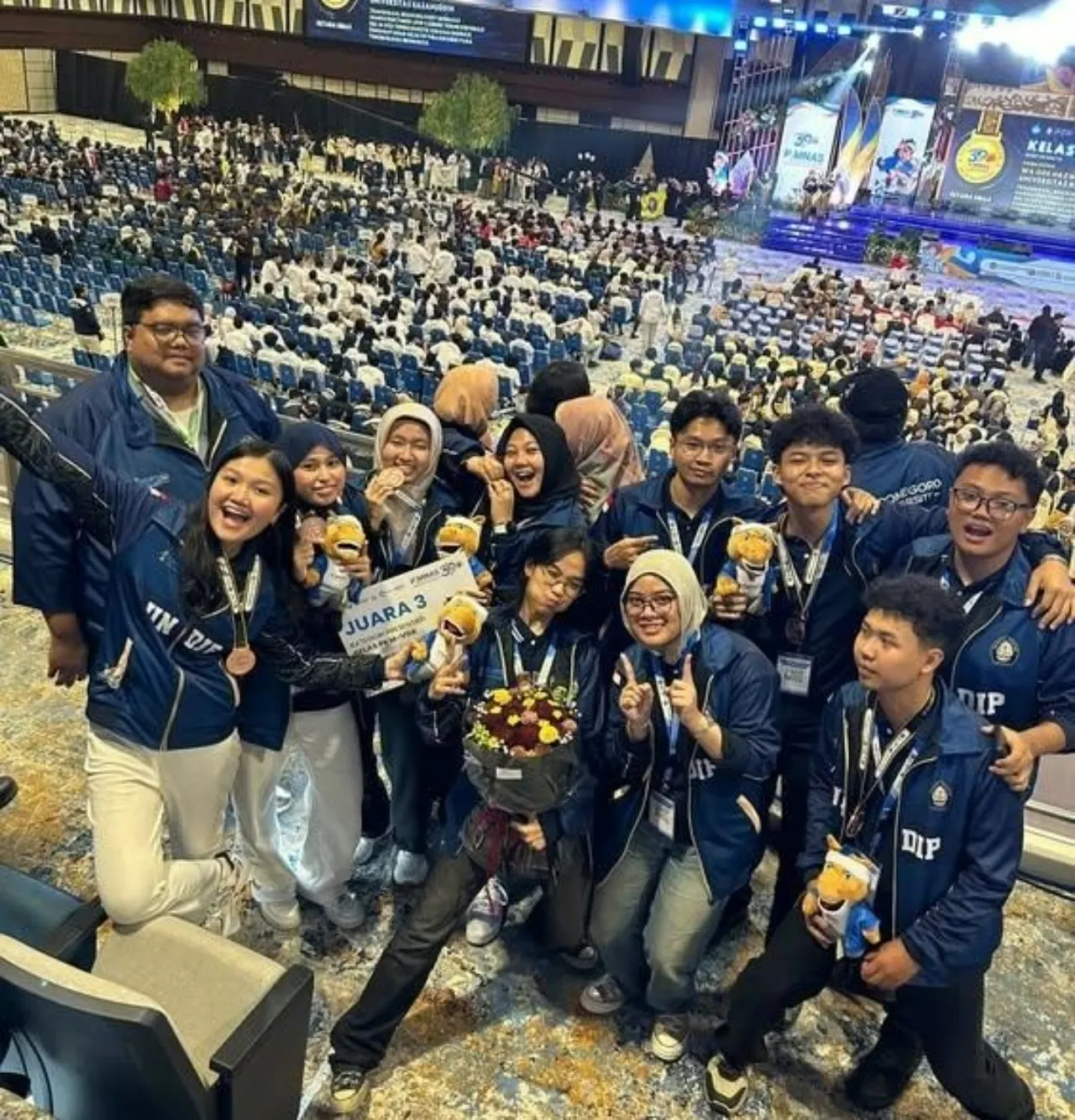
SEMARANG – Students from the Faculty of Social and Political Sciences at Diponegoro University (FISIP UNDIP) have once again achieved success on the national stage. The “RECULA” team—participating in the Student Creativity Program for Constructive Idea Videos (PKM-VGK)—secured a bronze medal by placing third in the Presentation Category at the 39th National Student Scientific Week (PIMNAS) in 2026.
This achievement was commended by the Dean of FISIP UNDIP, Prof. Dr. Drs. Teguh Yuwono, M.Pol.Admin. According to him, the success of the RECULA team demonstrates that FISIP students possess significant potential to generate innovative ideas—ideas that are not only competitive within academic forums but also highly relevant to the various issues faced by society.
“The achievement of the RECULA team is a source of pride for FISIP UNDIP. It is clear that our students have a great capacity for developing innovative, collaborative, and problem-solving-oriented ideas. This also illustrates how the competencies of social and political science students can synergize with other disciplines to produce solutions that provide tangible benefits to the community,” said Teguh Yuwono.
He added that universities must continue to foster an academic ecosystem that encourages students to compete, conduct research, and cultivate creativity and innovation. He noted that students are expected not only to excel academically but also to possess the ability to respond to various social and developmental challenges.
“This success will hopefully inspire other students to continue developing their potential, embrace new challenges, and build collaborations. FISIP UNDIP remains committed to fostering spaces for student creativity and achievement, both at the national and international levels,” he added. The announcement and awards ceremony for the 39th PIMNAS (National Student Scientific Week) took place on Friday evening (November 6, 2026) at the Muladi Dome, Diponegoro University (UNDIP), in Tembalang, Semarang. For this year’s event, UNDIP not only participated through a delegation of students but also served as the host for this national-level student scientific competition.
RECULA Proposes Waste Management Innovation Based on a Circular Economy
The RECULA team achieved success with their proposal titled “Innovation in a Circular Economy-Based Waste Management System and Valorization: A Step Toward Indonesia’s Energy Independence by 2045.”
The proposal introduces an integrated waste management system rooted in a circular economy approach. RECULA developed a concept to transform organic waste, liquid waste (leachate), and plastic waste into valuable resources.
The proposed system integrates biogas production from leachate, the use of thermal energy to convert plastic waste into “eco-paving blocks,” and the utilization of digestate as fertilizer. This approach aims to shift waste management beyond mere disposal, transforming it into a process that generates energy and economically valuable products.
The proposal demonstrates how the integration of communication, environmental technology, and chemistry can provide a more comprehensive response to waste management challenges.
A Long Journey to PIMNAS
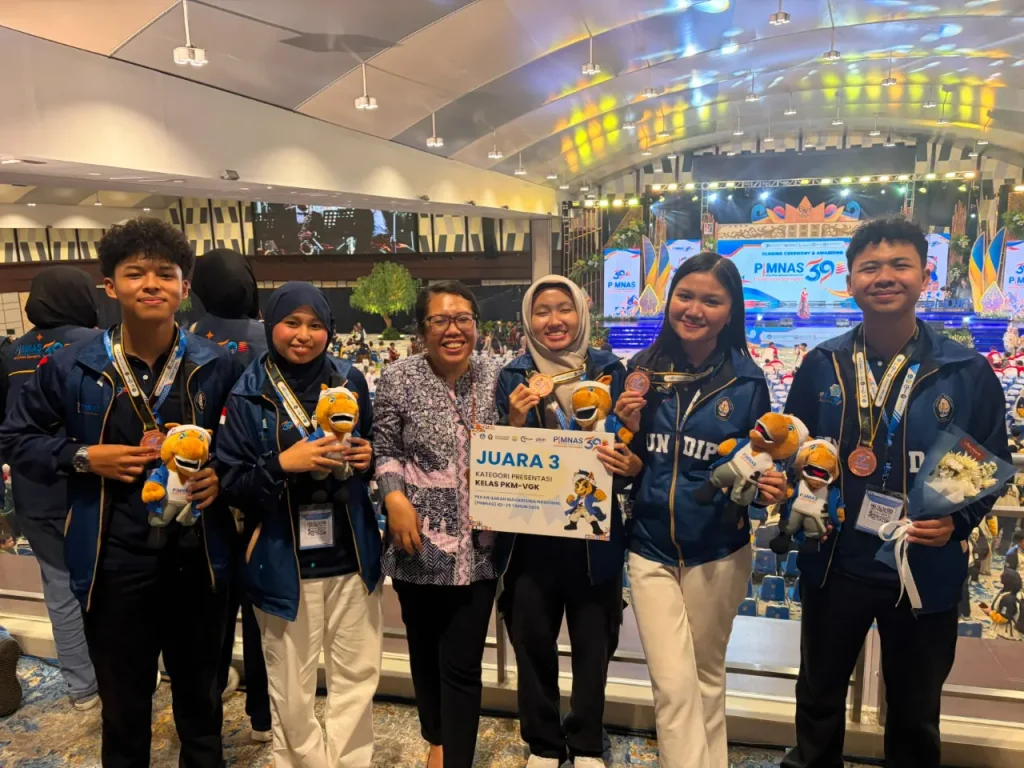
Yohanes Thianika Budiarsa, S.I.Kom., MGMC., a lecturer and advisor to the RECULA team from the Communication Studies Program at the Faculty of Social and Political Sciences (FISIP) UNDIP, explained that this achievement is the result of a long process involving multiple stages of selection and evaluation.
“The scoring for posters and presentations differs, with presentations carrying more weight. Thankfully, the FISIP team succeeded in winning a medal in the presentation category,” said Yohanes. She explained that the journey toward PIMNAS begins with a proposal selection process at the faculty and university levels, followed by a national-level competition to secure funding through the Student Creativity Program (PKM). Once awarded funding, teams must implement their projects and undergo the Progress Assessment for the Student Creativity Program (PKP2)—a crucial evaluation stage that determines whether a team is eligible to advance to PIMNAS.
“It is a long and exhausting endeavor. It starts with proposal selections at the faculty and university levels, moves on to a national-level competition, and culminates in being named a recipient of a PKM grant. Following this, the team must execute their project, and two-thirds of the way through, they must face the PKP2—an assessment stage where a team’s eligibility to advance to PIMNAS is evaluated,” she added.
Interdisciplinary Student Collaboration
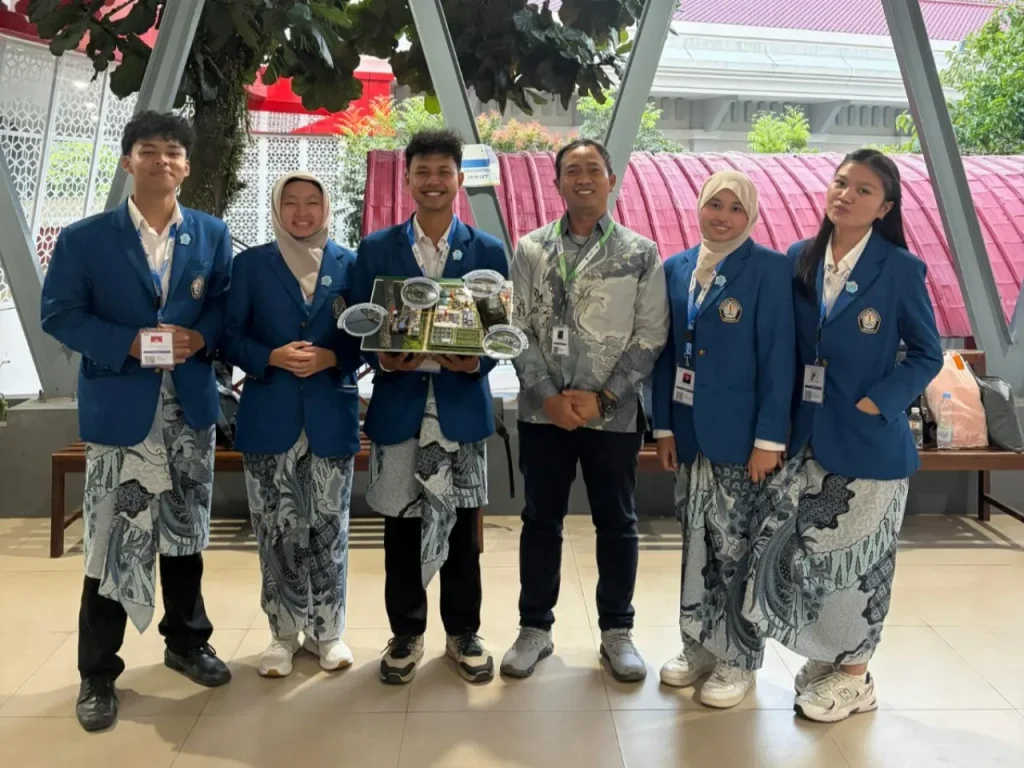
The RECULA team consists of five students from two different faculties and three distinct fields of study. This composition serves as a key strength in developing ideas that integrate perspectives from communication, environmental engineering, and chemistry.
The members of the RECULA team are:
- Naurah Safa Labibah – Communication Studies Program – FISIP UNDIP (2025).
- Muhammad Rafly Andika Putra – Communication Studies Program, FISIP UNDIP (2025).
- Aulia Keyla Chairunissa – Communication Studies Program, FISIP UNDIP (2025).
- Faishal Rahman Irawan – Environmental Engineering Program, UNDIP (2025).
- Loisa Margaret Ambarita – Chemistry Program, UNDIP (2025).
The success of Team RECULA serves as evidence of the importance of cross-disciplinary collaboration in addressing increasingly complex problems. For FISIP UNDIP, this achievement also demonstrates that students in the social sciences and communication fields have ample scope to contribute to the development of innovations, including those related to environmental and sustainability issues.
It is hoped that this achievement will encourage more FISIP UNDIP students to develop creative ideas, build cross-disciplinary collaborations, and participate in competitions and innovation-driven initiatives at both the national and international levels.