

REMBANG, November 3, 2026 – The Undergraduate Program in Public Administration at the Rembang Campus, Department of Public Administration, Faculty of Social and Political Sciences (FISIP), Universitas Diponegoro (UNDIP), organized an international academic session under the UNDIP Global Classroom initiative, themed “Policy Advocacy and Strategic Communication in Global Context,” on Tuesday (November 3, 2026).
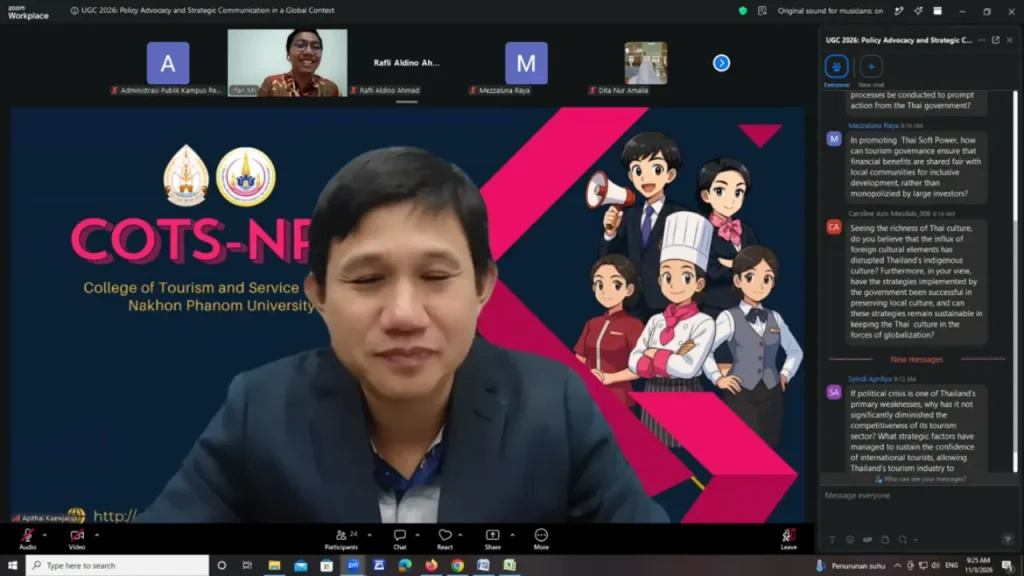
Held virtually, the session featured Dr. Apithai Kaewjarus, a lecturer at the College of Tourism and Service Industry, Nakhon Phanom University, Thailand, as the guest speaker. Attended by students and faculty members, the event provided an opportunity to explore international perspectives on public policy advocacy and strategic communication through Thailand’s experience in developing a globally competitive tourism industry.
Exploring Thailand’s Strategies for Global Tourism Competitiveness
During his presentation, Dr. Apithai highlighted how Thailand has strengthened its position as a leading international tourism destination by integrating natural attractions, cultural heritage, and consistent government policies under the globally recognized Amazing Thailand brand.
A key highlight of the session was Thailand’s 7F soft power framework, comprising Food, Fashion, Fight, Festival, Faith, Fit, and Film. This approach illustrates how Thailand transforms its cultural identity into tourism assets while utilizing cultural diplomacy and strategic communication to enhance its international appeal.
Beyond destination branding, Dr. Apithai discussed Thailand’s broader tourism policy framework, including the Thailand Tourism Strategy 2023–2027, the Bio-Circular-Green (BCG) Economy Model, and their alignment with the United Nations Sustainable Development Goals (SDGs).
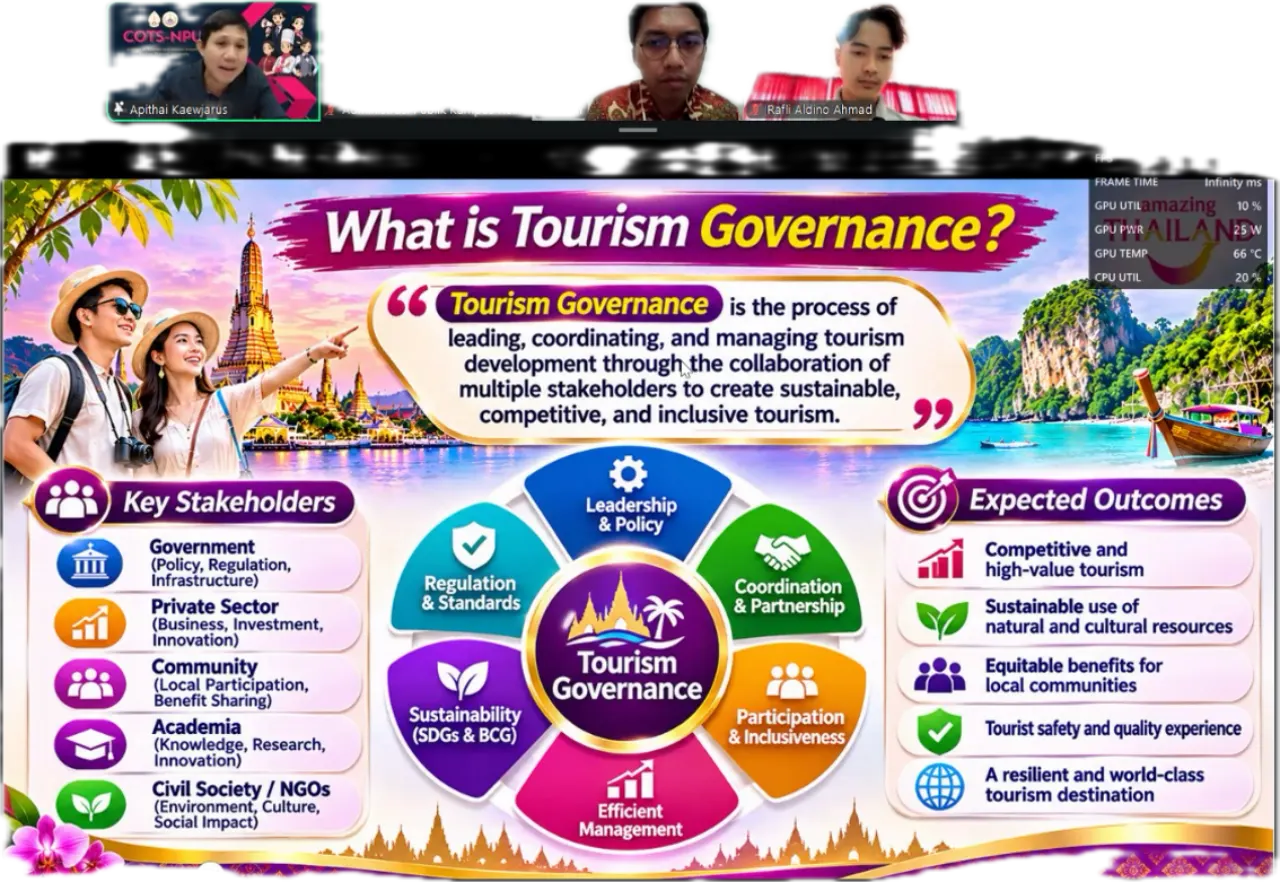
These policy approaches emphasize the importance of integrating economic competitiveness, environmental sustainability, cultural preservation, and effective public governance into tourism development. Dr. Apithai also underscored the significance of multi-stakeholder governance, highlighting the collaborative roles of government institutions, private-sector actors, local communities, and academic institutions in supporting sustainable tourism policies.
Interactive Discussion Connects Public Policy Theory with International Practices
The session continued with an engaging discussion in which students actively raised questions about contemporary challenges in tourism governance and public policy.
The discussion addressed several critical issues, including the roles of policy actors and advocacy coalitions in tourism policymaking, government communication strategies during tourism-related crises, and opportunities for Indonesia to adapt relevant lessons from Thailand’s experience in sustainable tourism development.
Through this exchange, students enrolled in the Policy Advocacy and Communication course gained opportunities to connect theoretical concepts with international policymaking practices, particularly in understanding how strategic communication, stakeholder engagement, and policy advocacy contribute to effective tourism governance.
Dr. Apithai expressed his appreciation for the students’ warm reception and enthusiastic participation. He was particularly impressed by the quality of their questions, which reflected a strong understanding of the relationship between public policy, strategic communication, and the tourism industry.
The interactive discussion also demonstrated the value of international academic engagement in encouraging students to develop analytical perspectives and critically examine public policy challenges beyond national boundaries.
Strengthening Global Perspectives on Policy Advocacy and Strategic Communication
The UNDIP Global Classroom initiative highlighted that successful tourism development depends not only on the availability of attractive destinations but also on governments’ capacity to formulate consistent policies, foster collaboration among stakeholders, and strategically communicate national identity to international audiences.
Thailand’s experience offers valuable insights for Indonesia, particularly as the country seeks to shift its tourism development approach from prioritizing visitor numbers toward promoting high-quality, sustainable tourism that generates broader economic benefits for local communities.
By examining Thailand’s policy strategies, students were encouraged to critically evaluate how policy advocacy, institutional coordination, and strategic communication can support more adaptive and internationally competitive tourism governance.
The session is expected to broaden students’ understanding of global policy practices and strengthen their ability to analyze public policy issues from comparative and international perspectives.
Furthermore, the event reflects the commitment of the Undergraduate Program in Public Administration at UNDIP’s Rembang Campus to advancing higher education internationalization through meaningful academic collaboration.
By connecting students directly with international scholars, UNDIP Global Classroom contributes to the development of globally minded graduates equipped with the knowledge, analytical skills, and cross-cultural perspectives necessary to address increasingly complex public administration challenges.
Through initiatives such as this, Universitas Diponegoro continues to promote international academic engagement and enrich students’ learning experiences by bringing global perspectives into the classroom.
Narahubung: Irfan — Dosen FISIP Universitas Diponegoro irfanmurtadho@lecturer.undip.ac.id