

SEMARANG, October 28, 2026 – As Indonesia commemorates Youth Pledge Day (Hari Sumpah Pemuda) and Universitas Diponegoro (UNDIP) prepares to host the 39th National Student Scientific Week (PIMNAS), the spirit of academic excellence and international collaboration continues to grow across the university. Reflecting this commitment, the Undergraduate Communication Science Program at the Faculty of Social and Political Sciences (FISIP), Universitas Diponegoro, organized an international guest lecture for its Quantitative Communication Research Methods course on Wednesday (October 28, 2026).
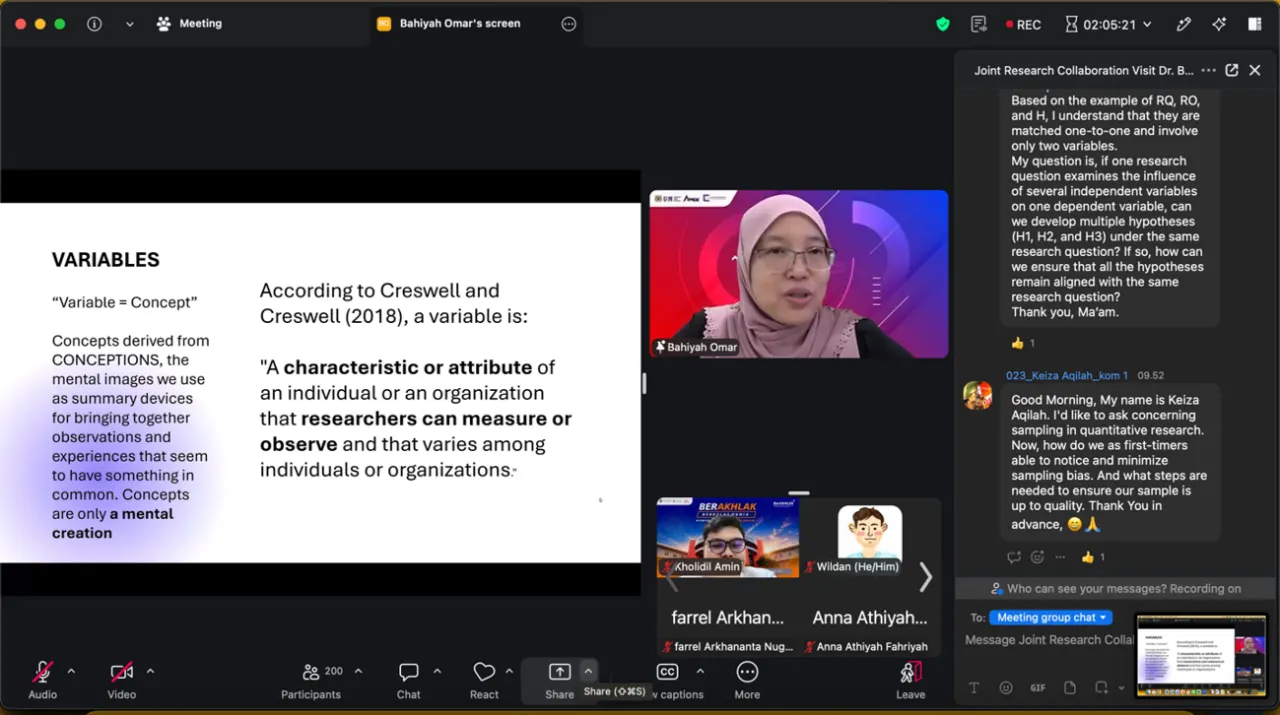
The lecture, conducted virtually via Zoom, featured Dr. Bahiyah Omar, Dean of the School of Communication, Universiti Sains Malaysia (USM), as the guest lecturer. The event was part of an ongoing academic collaboration between the Digital Communication Technology and Society Research Group at FISIP UNDIP and Dr. Bahiyah Omar, aimed at strengthening international academic networks and enriching students’ learning experiences.
The guest lecture was organized by the course’s teaching team, consisting of S. Rouli Manalu, Ph.D., Yohanes Thianika Budiarsa, MGMC., and Kholidil Amin, M.I.Kom. Through this session, students had the opportunity to deepen their understanding of quantitative research approaches while engaging directly with an international scholar on methodological challenges in communication research.
One of the highlights of the session was an engaging discussion that demonstrated students’ enthusiasm and critical perspectives on various methodological issues in contemporary communication research.
Achsanul Jaya Al Amin, commonly known as Jay, raised a thought-provoking question about the objectivity of quantitative data in an era when social media algorithms increasingly shape users’ behaviors and preferences. He questioned how researchers could distinguish individuals’ genuine preferences from those influenced by digital platform algorithms. His question also highlighted the broader challenge of determining the extent to which quantitative research findings can objectively represent public opinion.
Meanwhile, Monita Pradhipta Salma explored the relationship between research questions (RQ), research objectives (RO), and hypotheses (H). Specifically, she asked whether multiple hypotheses could be developed under a single research question involving several independent variables and how researchers could ensure consistency and alignment among these research components.
Another important issue was raised by Keiza Aqilah, who focused on the challenges of sampling in quantitative research. She asked how novice researchers could identify and minimize sampling bias and what steps should be taken to ensure the quality of their research samples.
These three questions reflected students’ growing awareness of methodological challenges, ranging from data validity and objectivity in digital environments to research design consistency and sampling quality. The discussion also emphasized the continued relevance of quantitative research methods in addressing increasingly complex communication phenomena in the digital age.
During the session, Dr. Bahiyah Omar encouraged students to remain curious and open to exploring different quantitative research approaches.
“I encourage students to explore quantitative research methods,” said Dr. Bahiyah Omar.
Her message underscored the importance of understanding research methodology beyond numerical data analysis. Quantitative research also requires the ability to formulate meaningful research problems, make appropriate methodological decisions, and critically interpret findings within their social contexts.
Representing the teaching team, Kholidil Amin, M.I.Kom., emphasized that the presence of an international guest lecturer provided valuable opportunities for students to broaden their perspectives, particularly regarding the application of quantitative methods in communication studies.
“This session offers students a different perspective on understanding quantitative methodology, particularly its application within the field of communication studies,” said Kholidil Amin.
Beyond its contribution to classroom learning, the guest lecture was also part of the Digital Communication Technology and Society Research Group’s efforts to expand international academic collaboration through knowledge exchange, educational activities, and research networking with scholars from international institutions.
The event’s coincidence with Indonesia’s Youth Pledge Day added further significance to the occasion. The spirit of young people striving to learn, think critically, and contribute to society through knowledge and innovation resonates with the academic atmosphere at UNDIP as the university prepares to host the 39th PIMNAS on November 2–7, 2026.
Through initiatives such as this international guest lecture, FISIP UNDIP continues to foster a globally connected academic environment while equipping students with methodological competencies and critical thinking skills essential for understanding and addressing the evolving challenges of digital society.