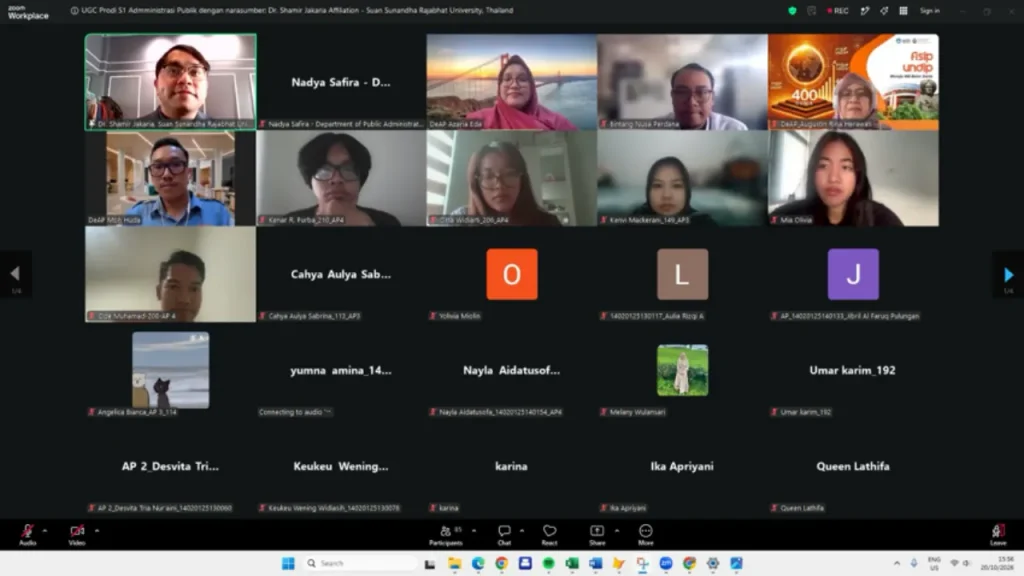

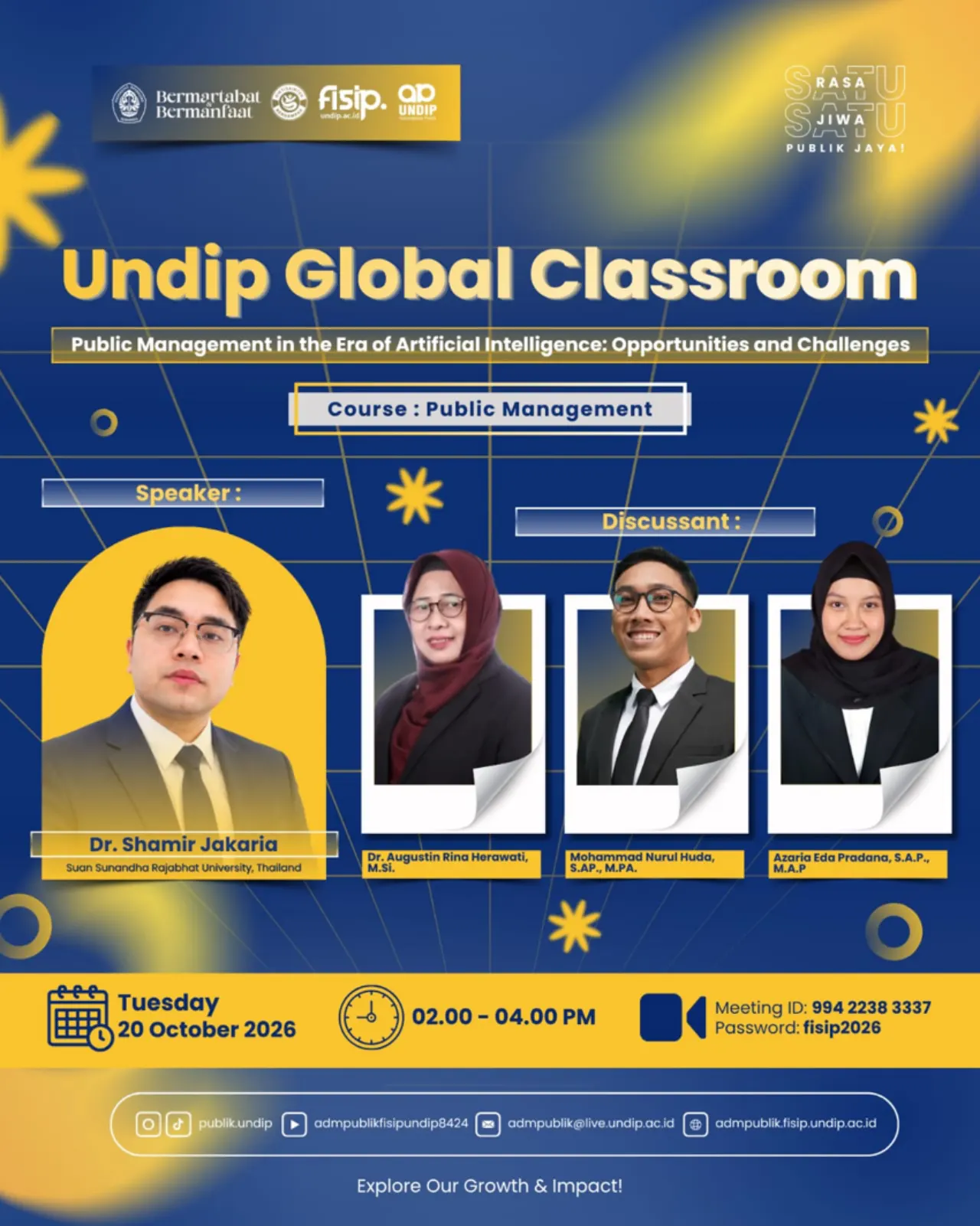
The Undergraduate Program in Public Administration, Faculty of Social and Political Sciences (FISIP), Diponegoro University (Undip), held an Undip Global Classroom activity entitled “Public Management in the Era of Artificial Intelligence: Opportunities and Challenges” on Tuesday, October 20, 2026. This activity is part of the Introduction to Public Management course for first-semester students of the Public Administration Study Program. The activity featured Dr. Shamir Jakaria from Suan Sunandha Rajabhat University, Thailand, as the keynote speaker. The discussion also involved three academics from the Public Administration Study Program at FISIP Undip—Dr. Agustin Rina Herawati, M.Si., Mohammad Nurul Huda, S.AP., M.P.A., and Azaria Eda Pradana, S.A.P., M.A.P.—as discussants.
Through this internationally oriented learning forum, students were introduced to the dynamics of contemporary public management, particularly how the development of artificial intelligence affects governance, the management of public sector organizations, and the quality of services to the community. This theme is relevant to changes in the public administration environment that is increasingly influenced by digital transformation and the use of technology in decision-making processes. The discussion on artificial intelligence in public management provided an opportunity for students to understand that technological innovation not only presents opportunities to improve the efficiency, effectiveness, and responsiveness of public services but also raises challenges that need to be carefully managed. These challenges include data protection, public privacy, algorithmic transparency, decision accountability, the digital divide, and inclusivity in access to public services.
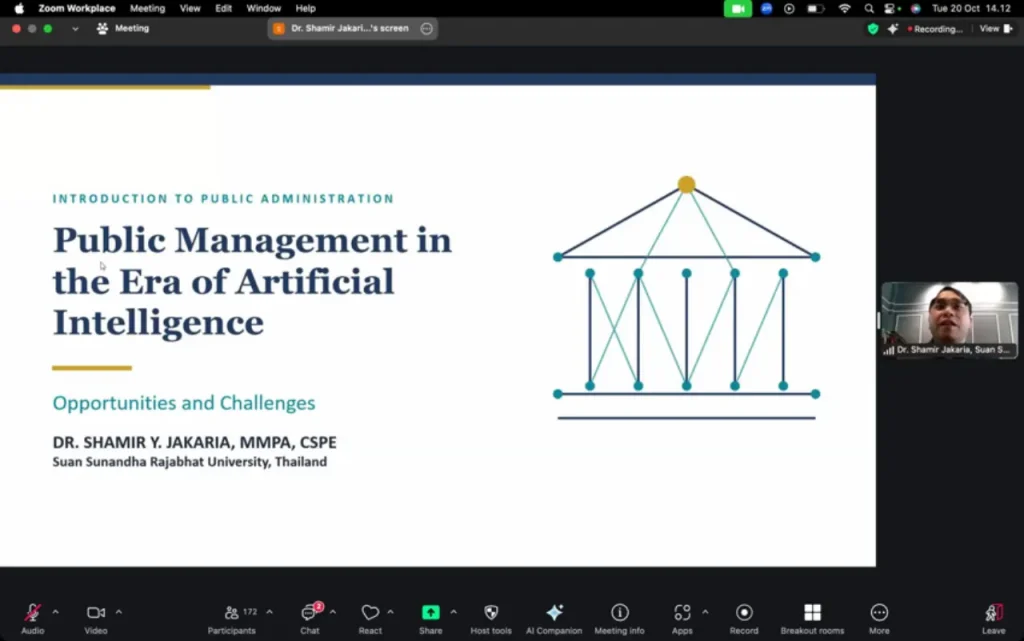
In the context of Public Administration education, understanding these issues is important for building students’ critical perspectives from the beginning of their studies. Students are not only required to understand the concepts and theories of public management but must also be able to connect them with the real problems faced by governments in adopting new technologies. Thus, the use of AI needs to be understood not merely as a technical issue but also as part of the responsibility of democratic, transparent, accountable governance oriented toward the public interest. The presence of an academic from Thailand also enriched the learning process through the exchange of cross-country perspectives. International experiences and viewpoints provided space for students to see that digital transformation in the public sector takes place within diverse institutional, social, and policy contexts. This comparative perspective is expected to encourage students to develop more open thinking in understanding public management practices in Indonesia and other countries.
The organization of the Undip Global Classroom also reflects the effort of the Public Administration Study Program at FISIP Undip to expand students’ learning experiences through international academic interaction. This kind of learning serves as a means to connect course materials with global issue developments while strengthening students’ competencies in critical thinking, cross-cultural communication, and understanding public governance challenges in the digital era.
The Public Administration Study Program at FISIP Undip continues to encourage the development of learning that is adaptive to changing times, open to global perspectives, and relevant to the needs of government administration. Through the Undip Global Classroom, students are expected to be increasingly prepared to understand and respond to public management challenges amid technological developments and digital transformation.