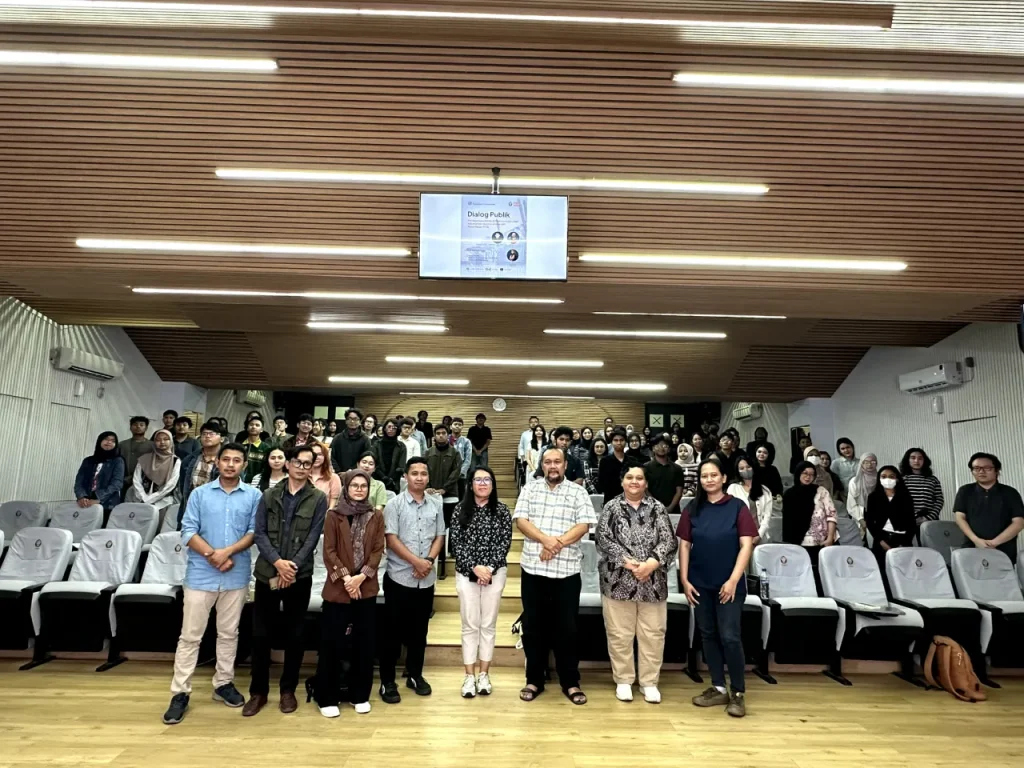
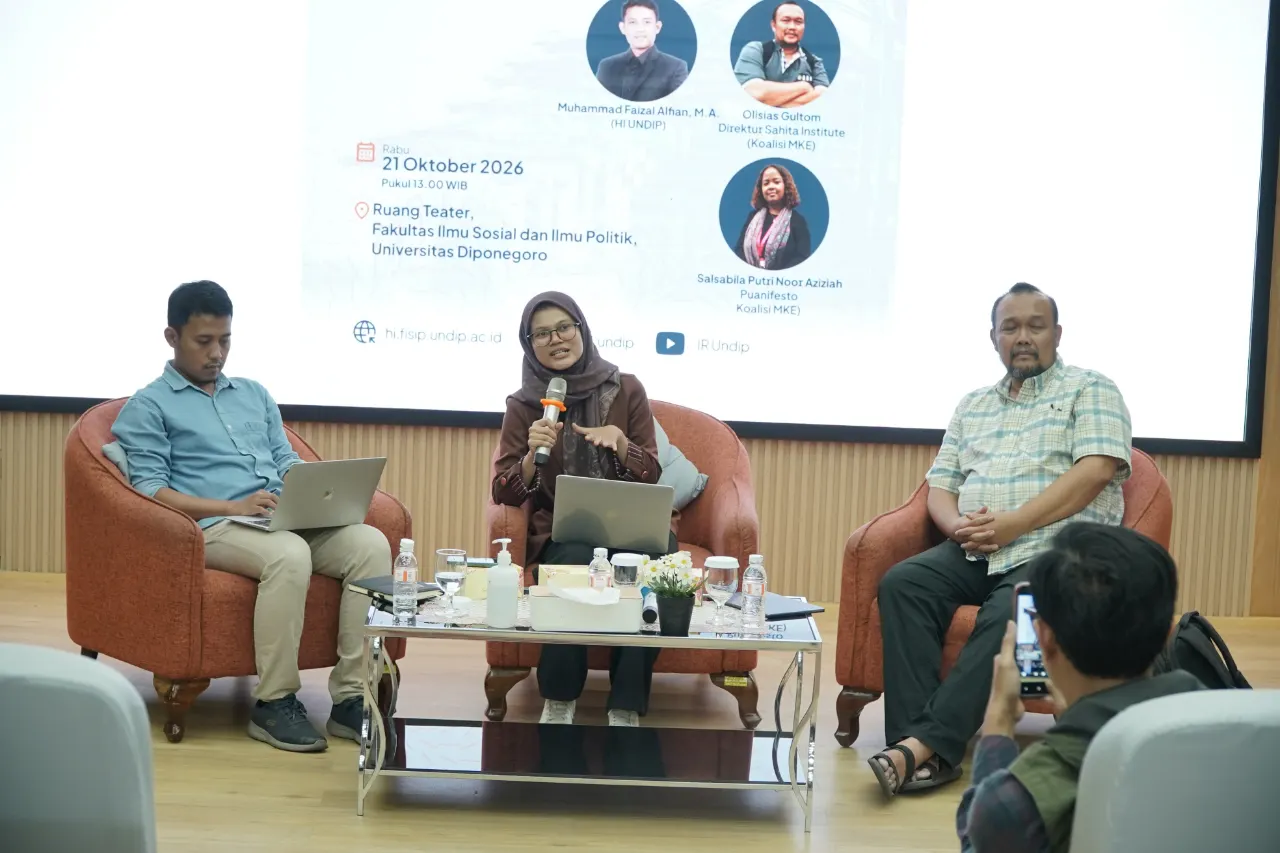
Semarang, 21 October 2026 – The Department of International Relations, Faculty of Social and Political Sciences, Universitas Diponegoro (FISIP UNDIP) held a Public Dialogue themed “Free Trade at a Crossroads: The Rise of Nationalism and the Future of the WTO” on Wednesday, 21 October 2026, at 1:00 PM WIB in the FISIP Universitas Diponegoro Theater Room.
The event featured three speakers: Olisias Gultom (Director of Sahita Institute, Civil Society Coalition for Economic Justice/Koalisi MKE), Muhammad Faizal Alfian, M.A. (lecturer in International Relations at UNDIP), and Salsabila Putri Noor Aziziah (Puanifesto, Koalisi MKE). Attended by academics, students, and civil society representatives, the dialogue was designed as a critical forum on the changing character of international trade and the future of global trade governance.
Throughout the discussion, international trade was no longer seen merely as a tool for economic efficiency, but increasingly as part of state strategy to protect national interests and economic security. Muhammad Faizal Alfian explained that the world has entered an era of economic nationalism, marked by geopolitical rivalry, supply chain restructuring, the use of sanctions as weapons, and trade realignment. Phenomena such as decoupling and geoeconomic fragmentation show how global economic integration is now being reversed by state policy.
On global institutions, Olisias Gultom invited participants to read globalization as interconnection supported by bodies such as the UN and the WTO, through three perspectives: realist, liberal, and critical. The realist view sees peace goals as often overridden by the national interests of major powers; the liberal view stresses cooperation to solve shared problems; and the critical view holds that global institutions help perpetuate Western hegemony. Against this backdrop, policies such as unilateral tariffs and the rejection of several international institutions were discussed as signs of weakening globalization pillars. Olisias also stressed that the WTO’s impact is not an elite concern alone, as it touches daily life, all the way to the dining table.
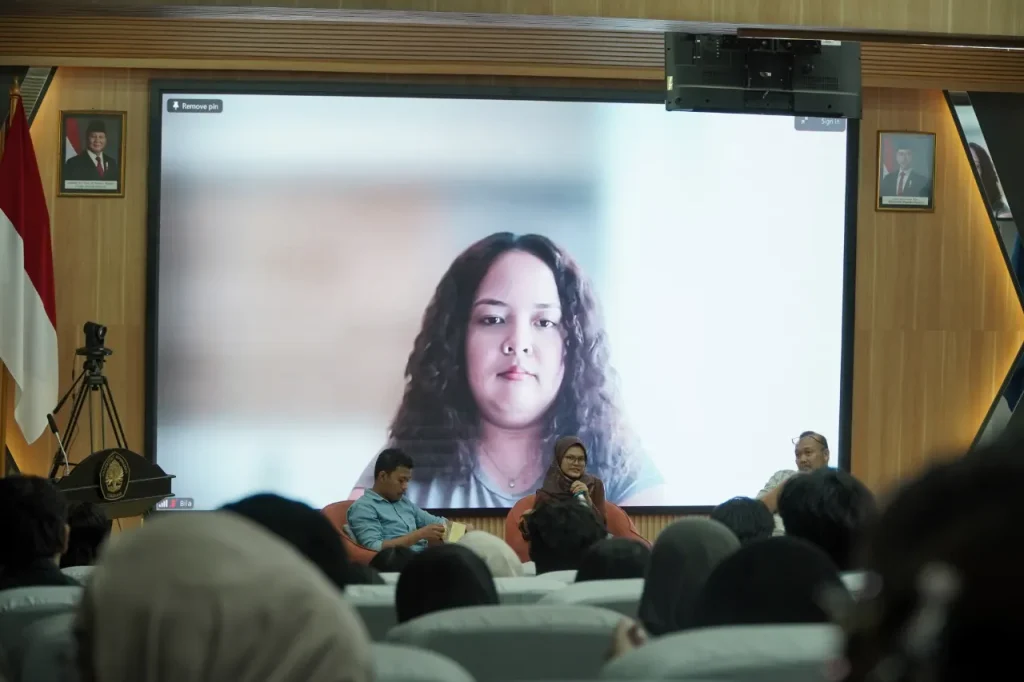
Another highlight was Salsabila Putri Noor Aziziah’s presentation on the 14th WTO Ministerial Conference (MC14) in Yaoundé, Cameroon, the first WTO ministerial held in Central Africa. In her view, the WTO is not a neutral referee but a space where asymmetric power relations play out. Two main issues became the arena of tug-of-war between the Global South and the Global North: a US proposal for WTO “reform,” which she said sidelines the consensus principle and Special & Differential Treatment, and the Global South’s unfinished agenda, covering food sovereignty, digital trade, and fisheries subsidies. On fisheries, Indonesia was noted as playing an important role in the Agreement on Fisheries Subsidies negotiations by reaffirming state sovereignty over its seas under UNCLOS.
The discussion also touched on civil society’s room to maneuver in WTO forums, which formally exists but is increasingly restricted. Even so, civil society resistance has been present since the WTO’s early years, from the Battle of Seattle in 1999 to the farmers’ protest in Cancun in 2003, and is expected to be sustained by fishers, farmers, workers, women, youth, academics, and Indigenous peoples.
For International Relations students, the theme is highly relevant as it touches fundamental questions in global political economy: whether the rise of economic nationalism marks the decline of free trade or its transformation into a more selective and strategic system; whether the WTO needs reform or simply adaptation; and how developing countries, including Indonesia, can preserve policy space for industrialization and national development.
Through this public dialogue, the academic community and civil society are expected to develop a more critical understanding of the direction of global trade. The event also reflects the commitment of the FISIP UNDIP Department of International Relations to fostering dialogue among academics, practitioners, and civil society on a more adaptive, inclusive, and responsive future for global trade governance.