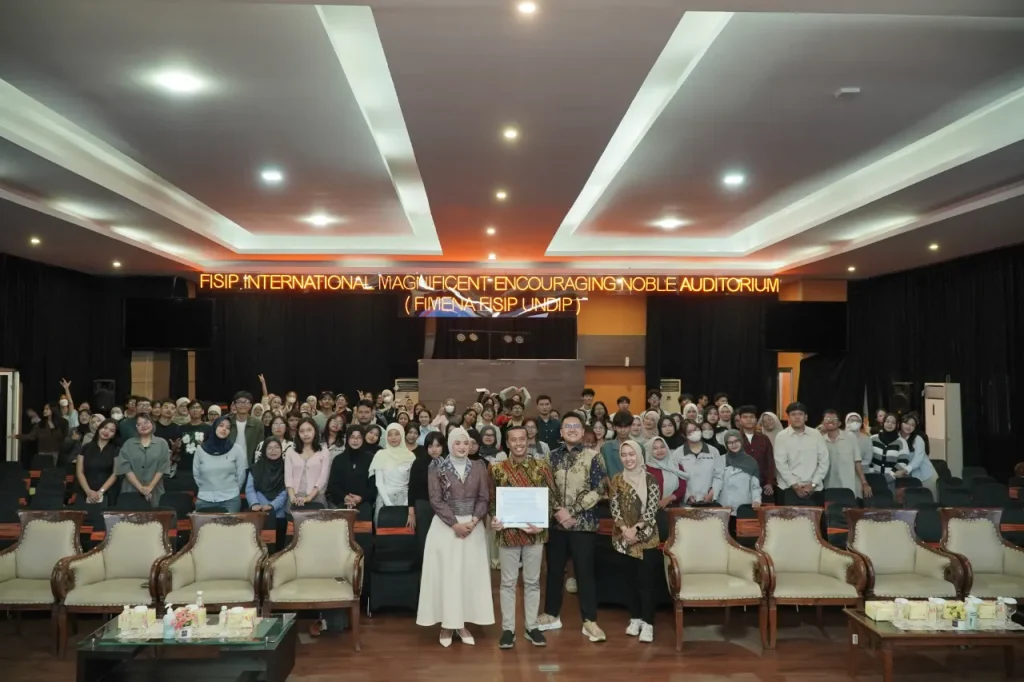

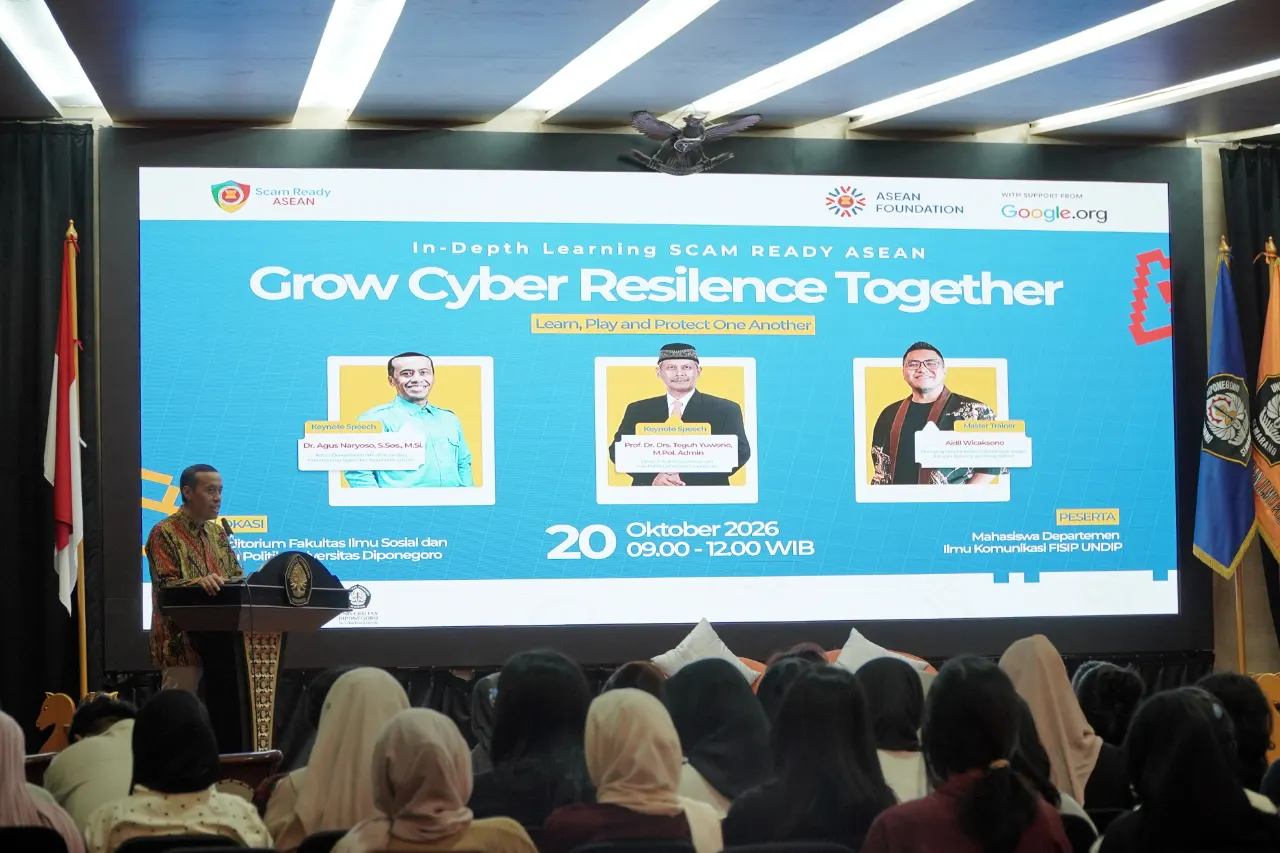
Semarang – The Faculty of Social and Political Sciences, Diponegoro University (FISIP UNDIP), held the Scam Ready ASEAN training program entitled “Grow Cyber Resilience Together: Learn, Play and Protect One Another” on Tuesday (20/10/2026). The activity, held at the FISIP UNDIP Auditorium, was attended by students of the Department of Communication Science as an effort to improve understanding and skills in recognizing, preventing, and dealing with various modes of digital fraud.
The In-Depth Learning Scam Ready ASEAN program featured three speakers: the Dean of FISIP UNDIP, Prof. Dr. Drs. Teguh Yuwono, M.Pol.Admin.; the Head of the Department of Communication Science at FISIP UNDIP, Dr. Agus Naryoso, S.Sos., M.Si.; and Aidil Wicaksono Juniarto, Managing Director of Kaizen Collaborative Impact and Master Trainer of Scam Ready ASEAN. This activity is part of the effort to strengthen digital resilience through education that is participatory, interactive, and relevant to people’s lives in the digital era.
The event began with participant registration, an opening by the master of ceremonies, the singing of the Indonesia Raya anthem and the Diponegoro University Hymn, and remarks from the Head of the Department of Communication Science. The opening series continued with a symbolic plaque presentation and a group photo session before entering the main training session.
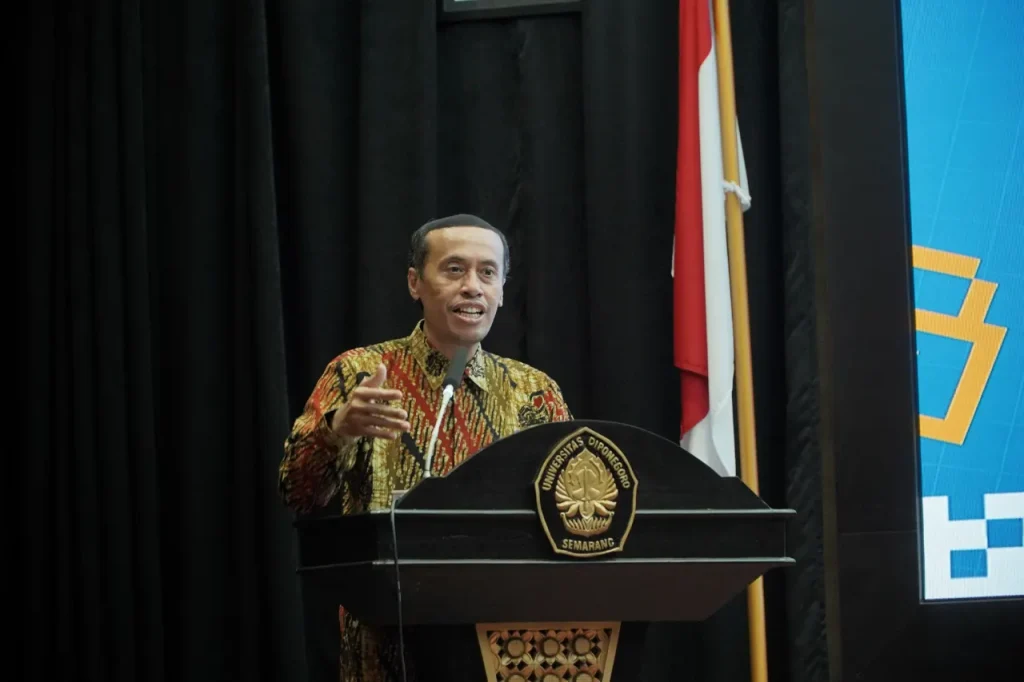
In his remarks, Dr. Agus Naryoso, S.Sos., M.Si., emphasized the importance of educational activities that complement students’ academic learning in the classroom. According to him, students need learning experiences that can broaden their horizons, develop practical skills, and provide tangible benefits to society.
Training activities such as Scam Ready ASEAN also provide opportunities for students to learn how to develop educational materials, deliver information effectively, and organize activities oriented toward positive social change. These competencies are relevant to the field of Communication Science, particularly in developing public communication strategies capable of raising public awareness and understanding of social issues.
Dr. Agus Naryoso, S.Sos., M.Si., also expressed appreciation to Scam Ready ASEAN for initiating the organization of the activity at FISIP UNDIP. He hoped that this program could serve as a means to expand the dissemination of information regarding the warning signs of digital fraud, both within the campus environment and in the wider community.
Furthermore, he encouraged students to improve their accuracy in identifying information, understand the risks of digital media use, and not easily trust messages, offers, or unclear sources of information. These abilities are becoming increasingly important as communication technology develops, opening up opportunities for interaction while also presenting the risk of digital crime with various new modes.
Dr. Agus Naryoso, S.Sos., M.Si., also hoped that this kind of collaboration could be sustained and developed through broader cooperation, including with communities and partners in the Asian region. Thus, the results of the activity would not only provide direct benefits to participants but also have the potential to be developed into educational materials and scientific publications that support the improvement of public digital literacy.
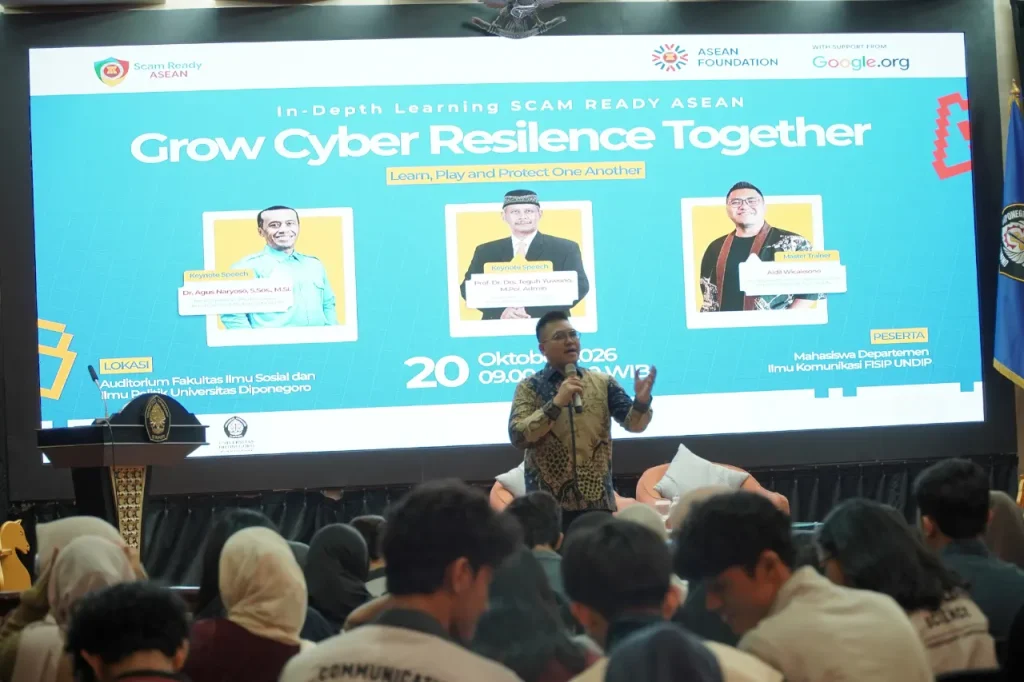
In the core session, Aidil Wicaksono Juniarto guided the students of the Department of Communication Science through training materials designed to build a practical understanding of digital fraud. The session lasted 110 minutes, from 9:50 to 11:40 WIB, integrating interactive learning approaches and simulations.
The training materials covered four main parts: Understand, Identify, Game Be SCAM Ready, and SCAM Tactic Labs. Through the Understand section, participants were invited to understand the mechanisms of digital fraud and how perpetrators exploit situations and user behavior to carry out their actions. Next, in the Identify section, students learned to recognize warning signs or red flags that may indicate an attempted fraud.
The game-based and practical approach through Game Be SCAM Ready and SCAM Tactic Labs provided space for participants to test their understanding and practice their ability to identify fraud tactics. Through this method, students were expected not only to understand the concepts theoretically but also to be able to apply preventive measures when facing risky digital situations.
After the training session, the activity continued with a question-and-answer session with the speaker to deepen participants’ understanding of the material that had been delivered. The event then closed at 12:00 WIB.
The organization of the Scam Ready ASEAN training is in line with the role of higher education in developing knowledge and skills that are adaptive to technological change. Amid society’s increasing dependence on digital communication and services, digital literacy is not enough if it only relates to the ability to use technology; it must also include the skills to assess information, recognize risks, protect data security, and make wise decisions.
For Communication Science students, these competencies are also important provisions in designing public education campaigns and delivering digital fraud prevention messages effectively to various groups in society. Students are expected to be able to act as agents of digital literacy capable of spreading accurate information, increasing vigilance, and encouraging safe and responsible digital behavior.
Through this activity, FISIP UNDIP reaffirms its commitment to supporting the strengthening of student capacity while expanding the contribution of higher education in addressing social challenges in the digital era. Collaboration through Scam Ready ASEAN is expected to be a sustainable step toward building a society that is increasingly smart, vigilant, and resilient against the threat of digital fraud.