

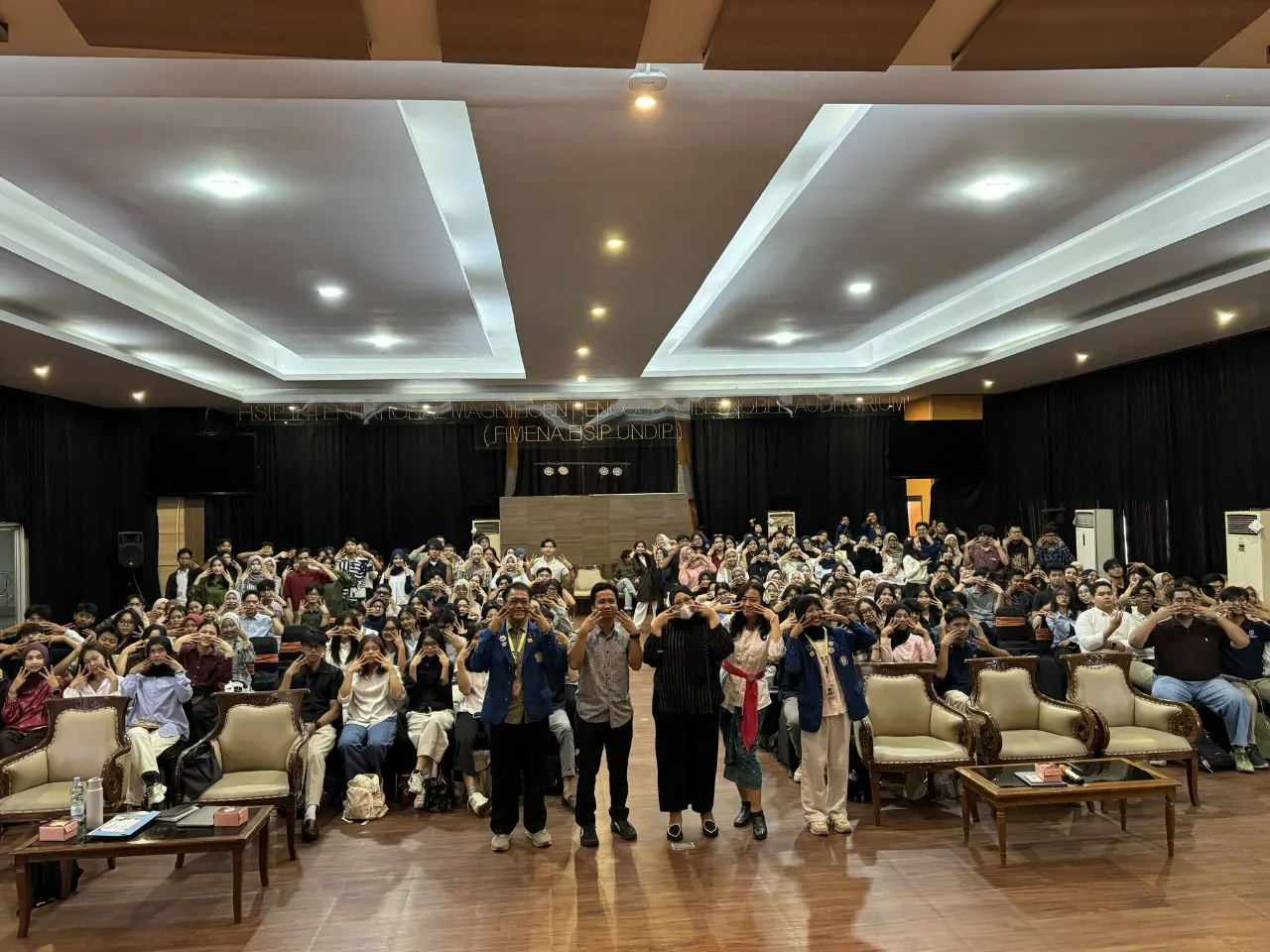
In an effort to create a prestigious academic climate on campus, the Student Association of the International Relations Study Program at Diponegoro University (HMPS HI Undip) through the Science and Analysis Division officially implemented the Research School ft. Writing Session work program on August 29, 2026, located at the FIMENA Auditorium, FISIP Undip. This program serves as the initial step to introduce and explore the research potential of new International Relations students. In the program, there was Caroline Kartika Felia Wibowo, a 2025 International Relations student, serving as the moderator alongside Anjani Tri Fatharini, S.IP., M.A., the speaker who is also a lecturer in International Relations.
Research School ft. Writing Session serves as an introductory platform and initial training for new students to familiarize themselves with various research topics within the International Relations Study Program. This program explains how new students can start and organize research through steps such as choosing an area of interest, creating a mind map, transforming interests into specific questions, and finally creating an outline or writing scheme. The writing scheme includes why you are curious about a certain topic and why that question is important to answer (introduction), how you will find the answer and what approach you will use (methods), what you found (results), and what your findings are, how those findings connect to a broader context, as well as what solutions or recommendations you can propose (discussion). This knowledge can be used for various purposes such as completing college assignments, participating in essay competitions, writing opinion articles, and entering scientific writing competitions.
In addition to explaining how to start and organize research, the Research School ft. Writing Session also explains the Program Kreativitas Mahasiswa (PKM) to new students. New students are given an explanation of what PKM is, the fields available in PKM, which PKM fields can be taken by International Relations students, how the scheme works, the difference between funding schemes and incentive schemes, the themes available, the systematics of PKM implementation, PKM criteria, and the benefits of participating in PKM at Undip.
The explanation continued with a deeper discussion on PKM-RSH. The speaker explained the types and characteristics of social and humanities research based on fields of study. In social research, for example, the characteristics emphasize social interaction phenomena in community life, covering fields such as economics, psychology, sociology, education, management, and politics. In humanities research, the characteristics focus on the fundamental aspects of behavior in community life and cover fields such as cultural studies, arts, philosophy, customs, history, beliefs, as well as law and values. This program concluded with an explanation of common mistakes in PKM-RSH proposals and how to generate title ideas from the analysis of current trends.
In addition to introducing PKM, this program also holds a Writing Session, which is an activity for new students to apply the material they have previously learned to create a simple PKM proposal through a presentation. New students are required to choose 1 news article provided by the committee. The selected news article can then be developed into a PKM idea that aligns with the type of PKM for each existing group. The presentation must include the problem encountered in the news, who is affected, the solutions that can be used, and the expected impact of those solutions. The presentation will later be used to present and showcase the results of the writing session that has been conducted.
With the successful implementation of the Research School ft. Writing Session 2026, it is hoped that it can prepare new students for academic life and awaken their research potential and interest, thereby fostering a critical thinking atmosphere within the campus environment and improving student achievements.