

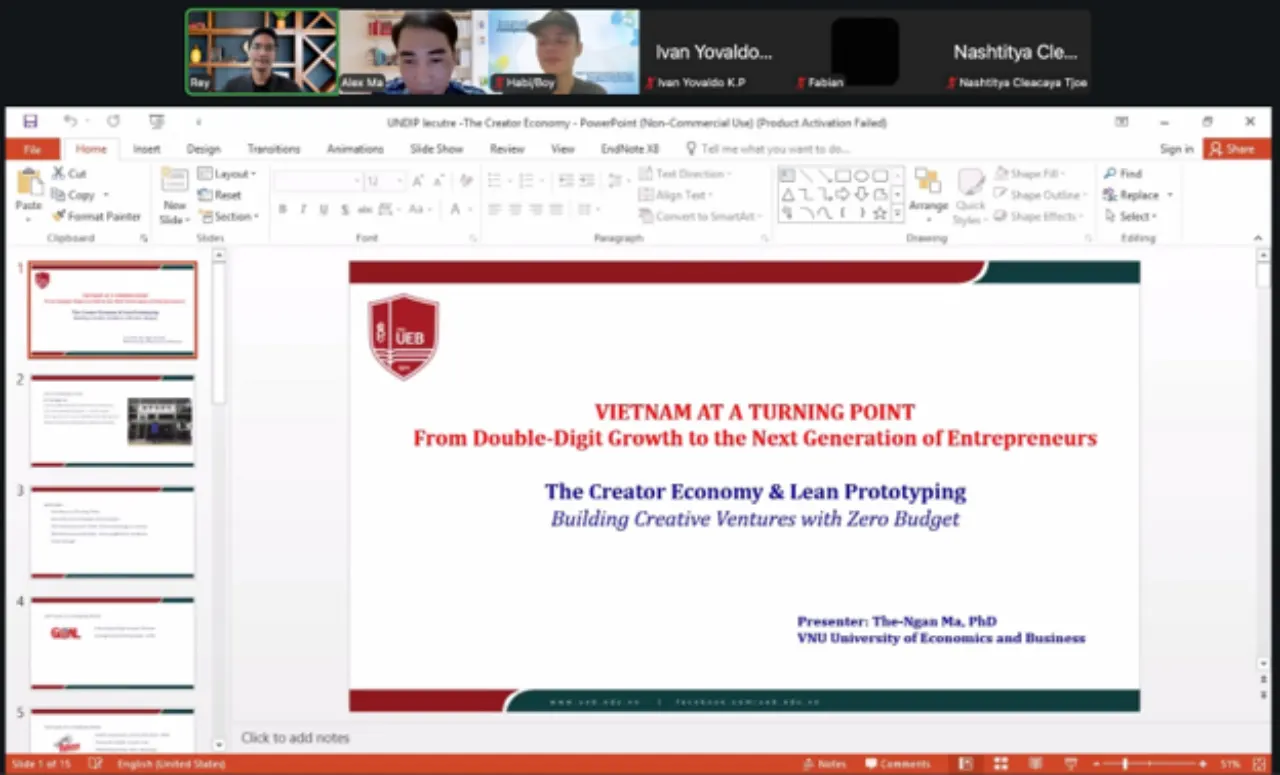
SEMARANG – The Faculty of Social and Political Sciences (FISIP) at Universitas Diponegoro (Undip), through its Bachelor of Business Administration Study Program, hosted another edition of the Undip Global Classroom. The event featured Dr. Ma Thế Ngân from VNU University of Economics and Business as the keynote speaker, addressing the topic “The Creator Economy & Lean Prototyping: Building Creative Ventures with Zero Budget.”
The learning session took place virtually via Zoom on Monday (September 28, 2026) as part of the Entrepreneurship course. Meanwhile, Robetmi Jumpakita Pinem, Ph.D., from Universitas Diponegoro served as the discussant for the academic session.
In his presentation, Dr. Ma Thế Ngân highlighted Vietnam’s development and the challenges encountered in driving the next generation’s economic growth. A primary focus was the role of the private sector, domestic innovation capacity, and entrepreneurship in powering Vietnam’s future growth.
The session also highlighted Vietnam’s business landscape, which is heavily dominated by small and medium-sized enterprises (SMEs). According to the presentation, approximately 98 percent of companies in Vietnam are SMEs with limited resources for research and development. This condition presents both a challenge and an opportunity to strengthen the domestic entrepreneurship and innovation ecosystem.
One key approach discussed was the entrepreneurship ecosystem model through the Triple Helix framework, which connects university research support, the commercialization of research findings, and startup creation. This model underscores the vital importance of collaboration between higher education institutions and the business sector in building innovation capacity.
To provide a concrete illustration, the presentation featured a case study on Dat Bike, an electric motorcycle company from Vietnam. The company originated from the development of electric vehicle technology and prototyping before scaling into a commercial business. In its early stages, Dat Bike received support from a local university, including production facilities, testing environments, and student involvement.
Another case study featured was Fitfood, a healthy meal service business that addresses public needs by providing planned, calorie-controlled meals. The venture was launched with an initial capital of around US$3,800 and was operating out of a self-prepared 30-square-meter kitchen during its early stages. Initial customers were acquired through networks of friends, colleagues, and word-of-mouth.
Through these two case studies, students were introduced to two distinct pathways for building a business: “From Technology to Startup” and “From Problems to Business.” The first path begins with technology and prototyping to develop a startup, while the second starts by identifying problems and creating solutions before scaling into a business.
The discussion also emphasized that starting a business does not always require advanced technology or huge capital. For those without proprietary technology, various resources can serve as a starting point—such as skills, knowledge, a phone, content, and personal networks.
The presentation provided students with the perspective that the entrepreneurial journey can begin with existing resources and real-world problems. A venture does not need to launch at scale immediately; rather, it can be developed incrementally through a process of learning and testing.
In the final section, the presentation emphasized the importance of having more entrepreneurs, innovative SMEs, and individuals willing to solve real-world problems. The key takeaway was that a first business venture does not need to be large, but it must effectively deliver solutions to customers’ genuine problems.
The presence of Dr. Ma Thế Ngân from VNU University of Economics and Business in the Undip Global Classroom offered an international perspective on entrepreneurship, the creator economy, and venture development under resource constraints. Meanwhile, the involvement of Robetmi Jumpakita Pinem, Ph.D., as discussant fostered an academic dialogue, enabling students to deepen their understanding of building and scaling a business.
This event also reinforces FISIP Undip’s commitment to delivering global-perspective learning through academic collaborations with international universities.