

SEMARANG, September 29, 2026 – The Public Service Management Expertise Cluster (KBK) of the Faculty of Social and Political Sciences (FISIP), Diponegoro University (Undip), held a Focus Group Discussion (FGD) entitled “Building Integrity from the Ground Up: A Capacity Building Model through the Anti-Corruption Village Program for Corruption Prevention at the Village Level.” The activity took place in the Antawirya Room, 1st Floor of Building A, FISIP Undip, as part of the series of World Class University (WCU) activities under the Business and Industrial World (DUDI) Cooperation Scheme.
The event began with a brief report from the Chair of the Public Service Management (MPP) Expertise Cluster, Prof. Dr. Dra. Endang Larasati, M.S. In her presentation, Prof. Endang explained that the purpose of this World Class University (WCU) activity under the Business and Industrial World (DUDI) cooperation scheme is to strengthen the involvement of academics in assisting village governance and to encourage sustainable knowledge transfer. She also explained the rationale behind the choice of the theme “Building Integrity from the Ground Up,” namely because the village is the frontline of public services that directly interacts with the community, so that capacity building and integrity must be built independently from the grassroots level—not merely positioning the village as an object of supervision, but rather as the main actor in corruption prevention.
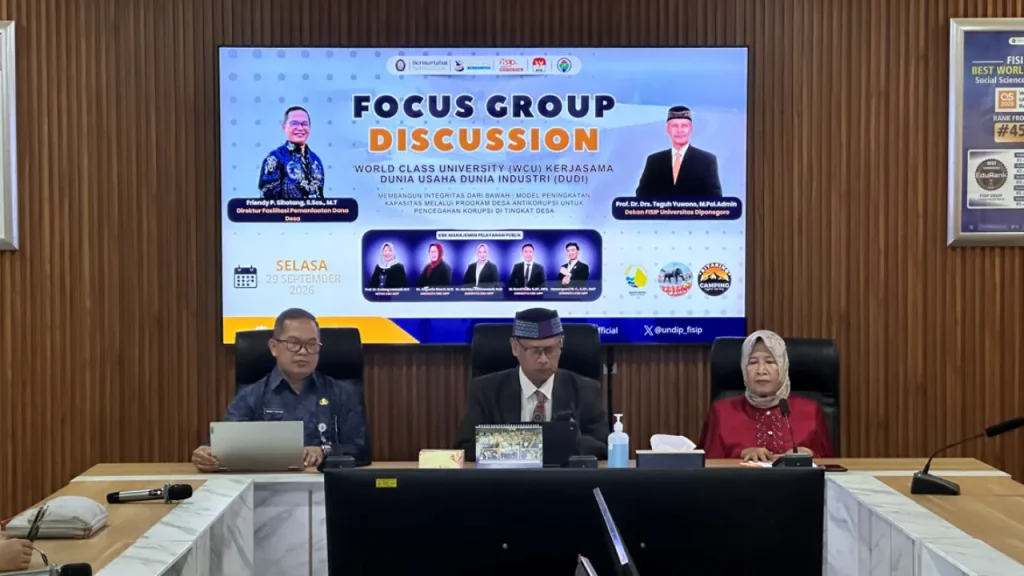
The remarks continued with the Dean of FISIP Undip, Prof. Dr. Drs. Teguh Yuwono, M.Pol.Admin. In his address, Prof. Teguh expressed high appreciation for the holding of this DUDI FGD. He emphasized that this forum is a tangible manifestation of the contribution of FISIP Undip academics in bridging theory and practice of governance at the local level. According to him, universities have a moral and academic responsibility to provide direct assistance, oversee transparency, and strengthen the institutional capacity of village governments. He hoped that the results of this FGD would not stop at academic discourse alone but would be able to produce applicable policy recommendations for strengthening village government integrity.
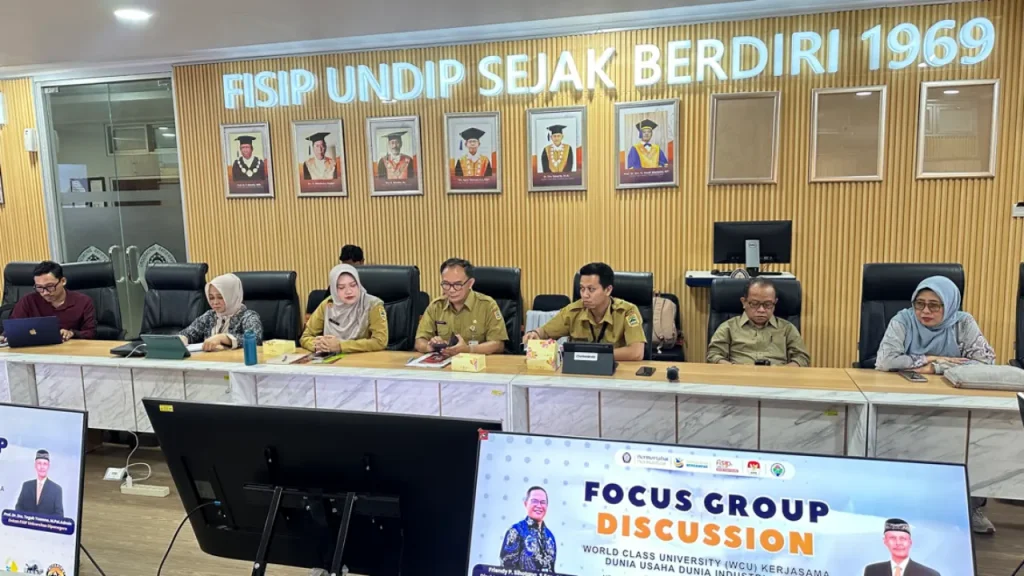
In the forum, the Director of Village Fund Utilization Facilitation at Kemendes PDT RI, Mr. Friendy P. Sihotang, S.Sos., M.T., emphasized that this activity can serve as a means to bring villages closer to the academic world, as well as bring academics closer to villages and government. He emphasized that community participation is a tangible element that needs to be strengthened in the village development process, so that the village’s position is not merely as a policy implementer, but as the main actor in building governance with integrity through capacity building from the ground up. The discussion and analysis of this activity highlighted a number of strategic issues in the field:
- Synchronization of Village Policy and Planning:
The Head of Banyubiru Village, Sri Anggoro, S.E., highlighted the time gap between new government policies and the results of Village Deliberations (Musdes) and Hamlet Deliberations (Musdus). This delay has the potential to change development priorities, increase administrative burdens, and trigger mismatches between government programs and the real needs of the community. - Alignment of Assistance Interventions:
The Head of Sraten Village, Rokhmad, S.H., emphasized that government assistance must align with the actual needs of the village (proposal). Program effectiveness is not only measured by the distribution of assistance but by its ability to address the real problems of the community. - Flexibility of Technical Guidelines (Juknis):
The Head of Kemambang Village, Heru Susanto, conveyed the challenges of implementing technical guidelines that appear forced even when field conditions do not allow it. Flexibility in regulations is needed while remaining accountable, so that regulations do not become obstacles to implementation. - Capacity Building and Sustainability:
The discussion underscored the need for assistance for new officials so that government sustainability is maintained. In addition, Ari Susanto, S.IP., from the Inspectorate of Central Java Province conveyed the importance of synergy with the Regency Inspectorate through a pilot project for Anti-Corruption Villages as a process of sustainable capacity building.
Through this DUDI synergy, FISIP Undip is committed to assisting villages in recognizing risks, building proactive corruption prevention mechanisms, and realizing transparent and accountable village governance from the ground up. As a concrete form of sustainability and accountability of this WCU DUDI Cooperation program, the outputs produced include the publication of scientific articles in International Reputable Journals, the preparation of Intellectual Property Rights (HKI) for a Policy Brief as a policy guideline, as well as press releases and activity documentation widely published through the official website and various online mass media.
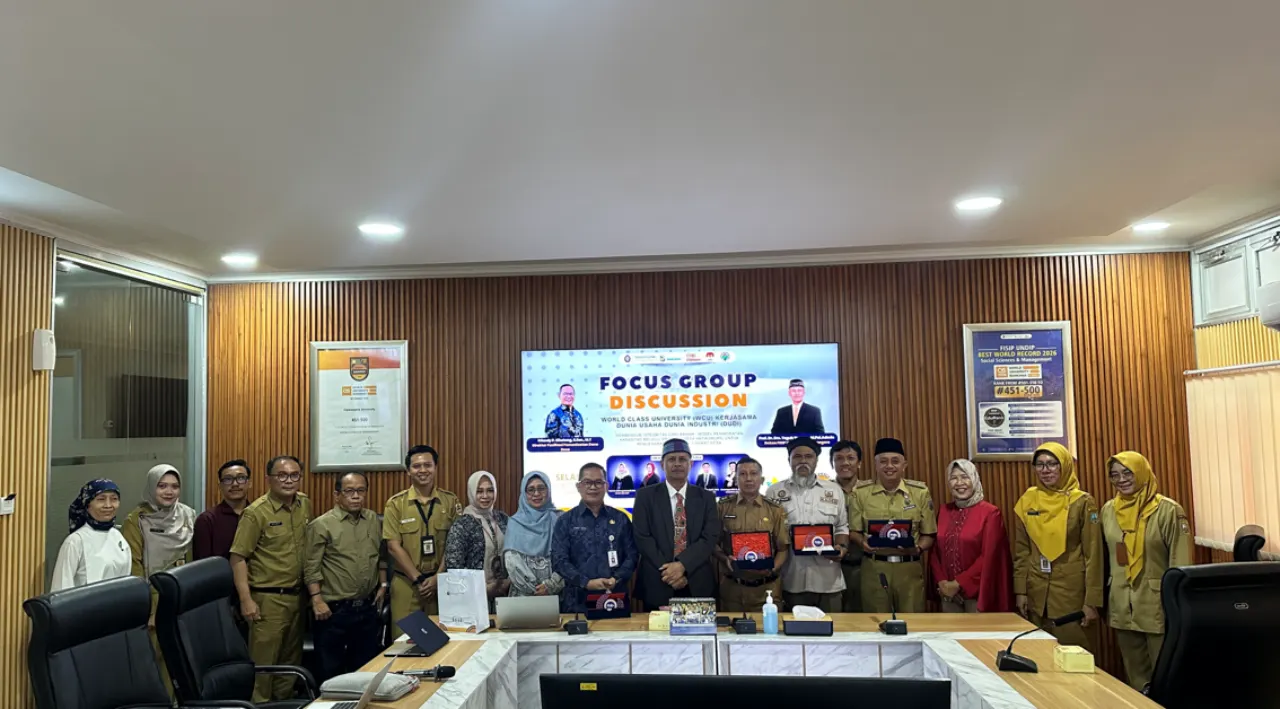
The series of FGD activities concluded with a group photo session and friendly gathering among participants, marking the beginning of a commitment to sustainable collaboration between FISIP Undip academics, Kemendes PDT RI, the Inspectorate, and village governments in realizing transparent, accountable, and integrity-based village governance from the ground up.