

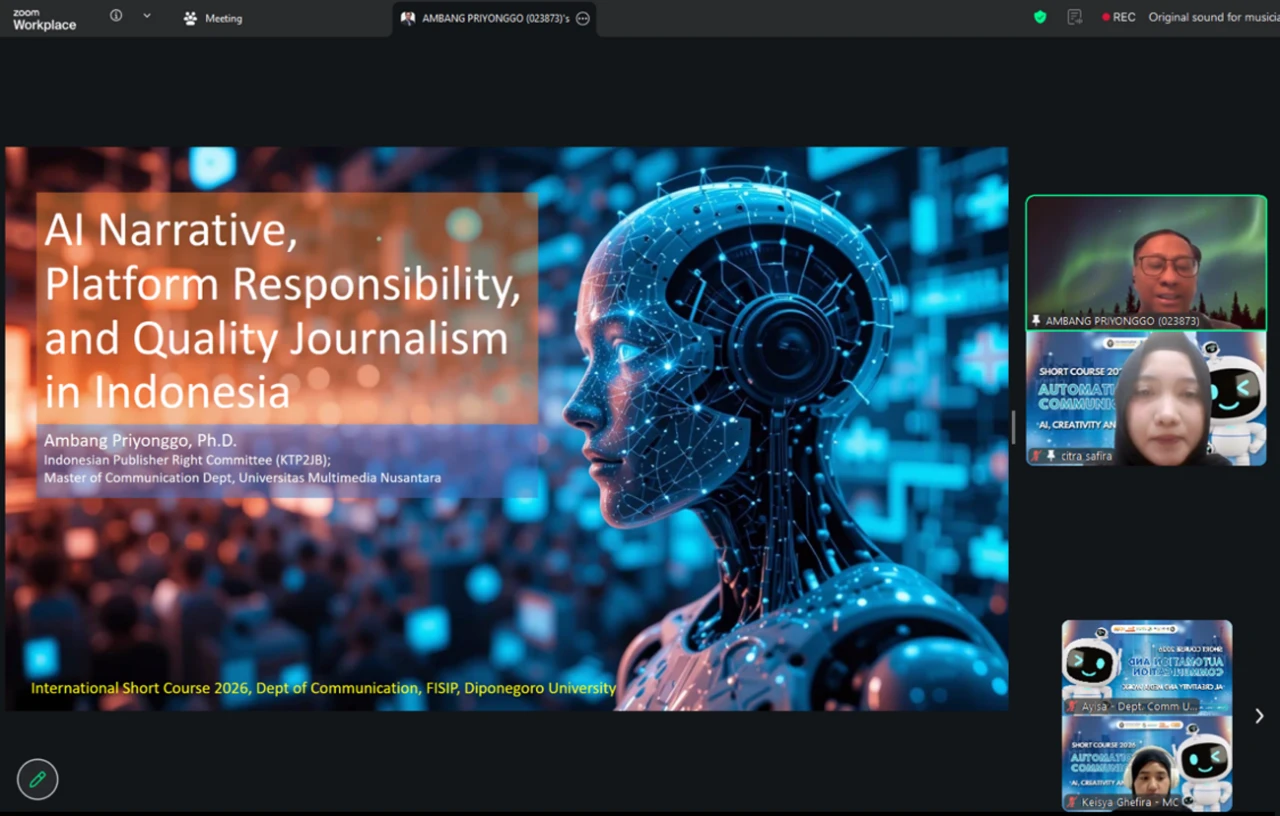
Semarang, 9 July 2026 — The Department of Communication Science, Faculty of Social and Political Sciences, Universitas Diponegoro, continued its International Short Course 2026 under the theme “Automation and Communication: AI, Creativity, and Media Work.” This session featured Ambang Priyonggo, PhD, a member of the Indonesian Publisher Rights Committee (KTP2JB) and an academic from the Department of Communication, Universitas Multimedia Nusantara, who delivered a lecture titled “AI Narrative, Platform Responsibility, and Quality Journalism in Indonesia.”
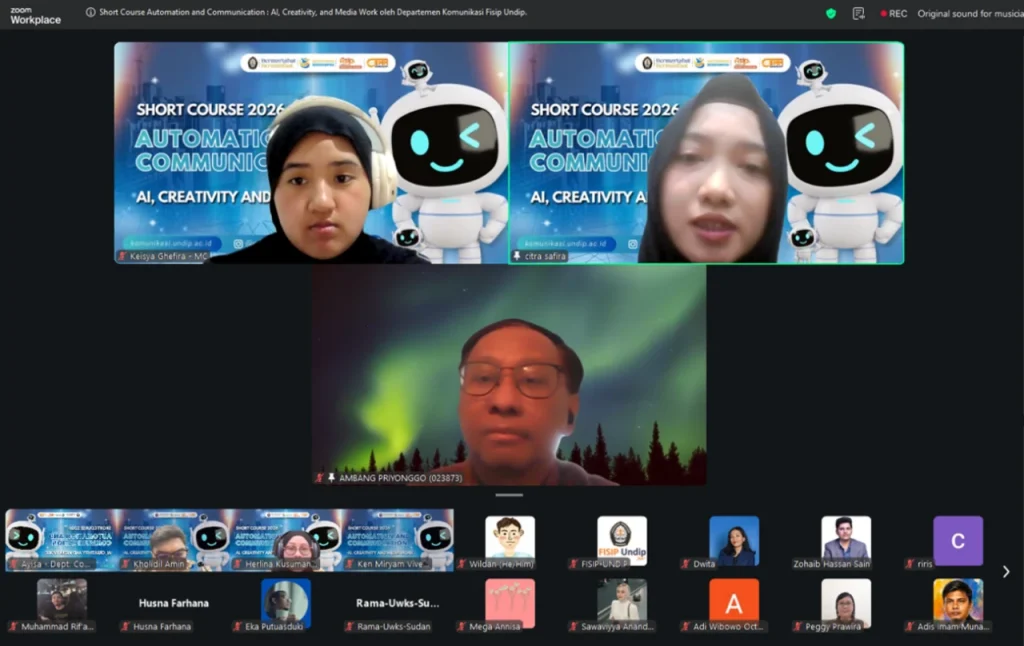
The session was guided by Keisya Ghefira, a Communication Science student, as the master of ceremony, and moderated by Citra Safira, a lecturer in Communication Science.
In his presentation, Dr. Ambang explained how artificial intelligence is increasingly shaping journalistic practices, both globally and in Indonesia. AI is now present across various aspects of media work, including automated news writing, data gathering and processing, synthetic anchors and virtual presenters, personalized news feeds, and editorial assistance such as headline optimization, translation, summarization, and narrative development.
Dr. Ambang emphasized that while AI offers efficiency and innovation for newsrooms, it also creates serious challenges for quality journalism. These challenges include ethical reporting, copyright issues, the use of journalistic works as AI training data, deepfakes and misinformation, algorithmic bias, and accountability gaps caused by the “black box” nature of AI systems.
One of the central issues discussed was the growing dependency of media organizations on digital platforms and large-scale technological infrastructures. According to Dr. Ambang, AI may deepen media dependency both directly, through the use of AI tools and services provided by platform companies, and indirectly, through reliance on cloud infrastructure and platform-controlled data.
The session also addressed the economic threat posed by zero-click search, where AI-generated summaries answer users’ questions directly and reduce traffic to original news websites. In this context, media organizations face a difficult dilemma: whether to block AI crawlers to protect their content or allow them in order to maintain visibility and audience reach through digital platforms.
Dr. Ambang further discussed the importance of Presidential Regulation No. 32/2024 on Publisher Rights as an effort to strengthen digital platform responsibility in supporting quality journalism. The regulation requires digital platforms to provide fair treatment to press companies, support the distribution of quality news, conduct programs for responsible journalism, and cooperate with press companies.
However, he also highlighted that the regulation still faces significant challenges in responding to the realities of generative AI. AI systems may answer directly without generating clicks, scrape journalistic archives for model training, and operate through global AI companies that may not have a clear local presence. These issues create new gaps in the governance of digital journalism in Indonesia.
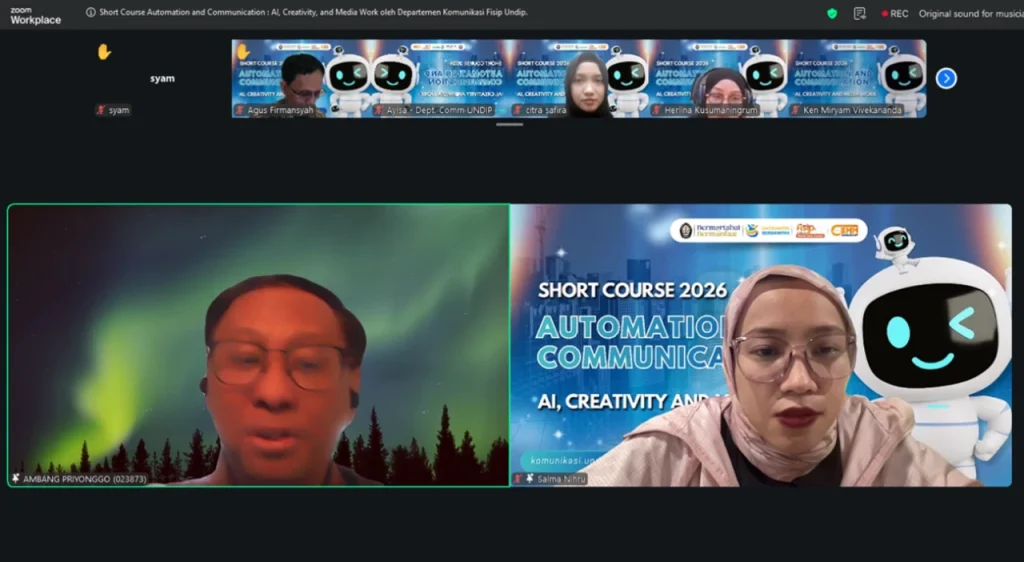
The discussion session was highly active. Participants raised questions about how to protect the economic sustainability of media organizations from giant technology companies, how to strengthen the bargaining power of news organizations in relation to platforms, how to ensure fair cooperation between digital platforms and press companies, and whether AI can strengthen local journalism or make local newsrooms more dependent on platform-driven narratives.
After the presentation and Q&A session, the program continued with a Group Discussion Session in breakout rooms. During this session, participants exchanged ideas, reflected on the lecture, and discussed further issues related to AI, platform responsibility, and the future of quality journalism in their respective contexts.
Through this session, the International Short Course 2026 provided participants with a critical understanding that the future of journalism in the age of AI is shaped not only by technological capability, but also by regulation, ethics, media sustainability, platform accountability, and the protection of public interest.
The International Short Course 2026 continues to serve as a cross-national and interdisciplinary learning space for discussing the transformation of communication, creativity, and media work in the age of automation and artificial intelligence. (WNIS)