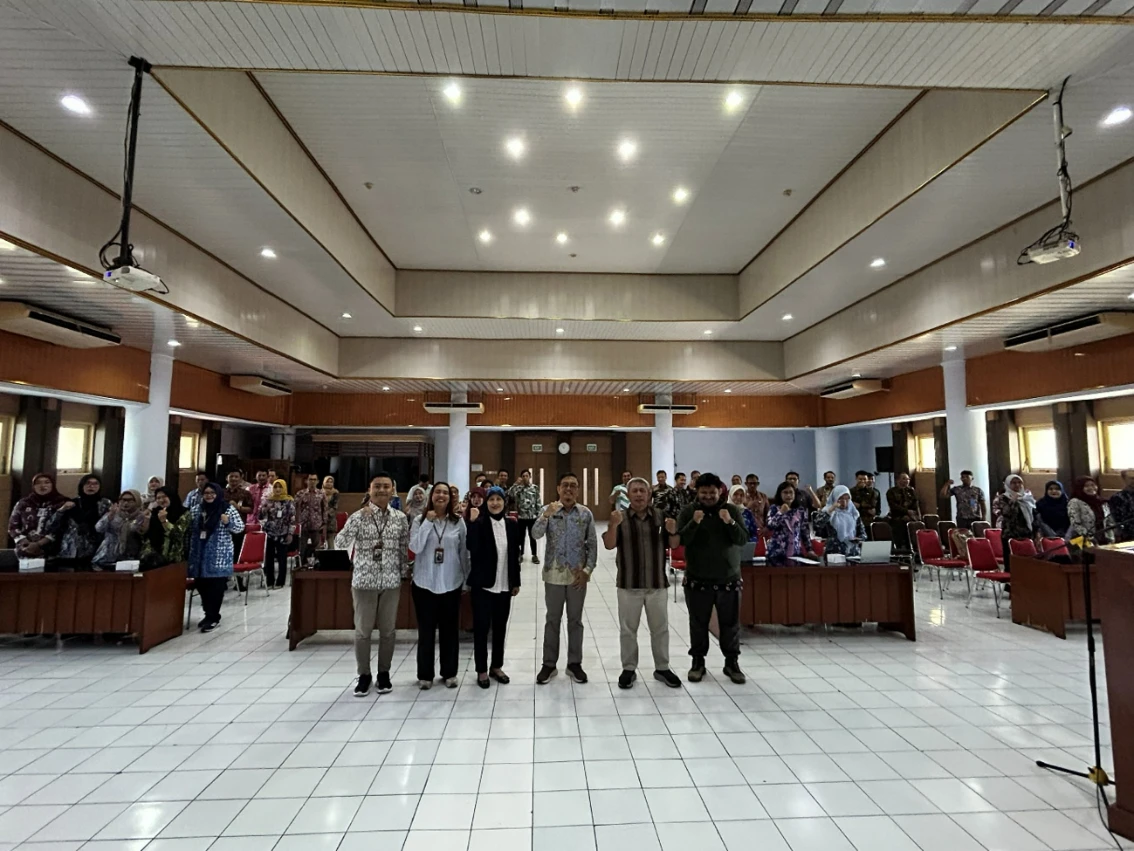
Rembang, May 26, 2026 — The Bureaucratic Reform Expertise Group (KBK), Department of Public Administration, Faculty of Social and Political Sciences, Diponegoro University, held a Community Service activity entitled “Strengthening Bureaucratic Reform in the Rembang Regency Government through Civil Service Capacity Building” on Tuesday, May 26, 2026. This activity was carried out as a form of academic contribution from FISIP UNDIP in supporting the improvement of regional governance, particularly in strengthening the capacity of civil servants at the Regional Apparatus Organization (OPD) level.
The event was attended by approximately 50 participants, consisting of representatives from Regional Apparatus Organizations (OPD) and sub-districts within the Rembang Regency Government. The presence of participants from various work units demonstrated a shared commitment to promoting bureaucratic reform that goes beyond merely completing administrative documents but is truly oriented towards improving performance, accountability, and the quality of public services.
In her remarks, Ms. Sri Jarwati, M.Pd., M.H., Assistant for General Administration (Assistant III) of the Rembang Regency Government, expressed her appreciation for the collaboration between the Rembang Regency Government and the Faculty of Social and Political Sciences, Diponegoro University (UNDIP). She emphasized that strengthening bureaucratic reform requires a shared understanding, commitment across regional agencies, and the ability of civil servants to translate bureaucratic reform policies into concrete and measurable action plans.
Meanwhile, the Chair of the Bureaucratic Reform KBK and Chair of the Community Service Team, Dr. Dra. Dyah Lituhayu, M.Si., explained that this activity was designed to strengthen the capacity of civil servants to develop bureaucratic reform activities that are based on real problems, have clear objectives, measurable indicators, and monitoring and evaluation mechanisms that can be used to assess the impact of change.
“Bureaucratic reform cannot simply be understood as an administrative obligation. Bureaucratic reform must be an instrument of change that helps regional government agencies (OPD) improve work processes, enhance service quality, and strengthen performance accountability,” said Dr. Dyah Lituhayu.
This community service program focuses on strengthening the capacity of regional government apparatus (OPD) in designing, managing, and evaluating bureaucratic reform activities. The main issue addressed is the persistent tendency for bureaucratic reform to stop at completing administrative documents, while the apparatus’ technical capacity to develop problem-based action plans, indicators, targets, and evaluations still needs to be strengthened.
Through this activity, participants received material reinforcement on performance- and impact-based bureaucratic reform. The approach used included not only outreach but also mentoring, so participants could understand bureaucratic reform in a more applicable way and tailored to the needs of their respective organizations.
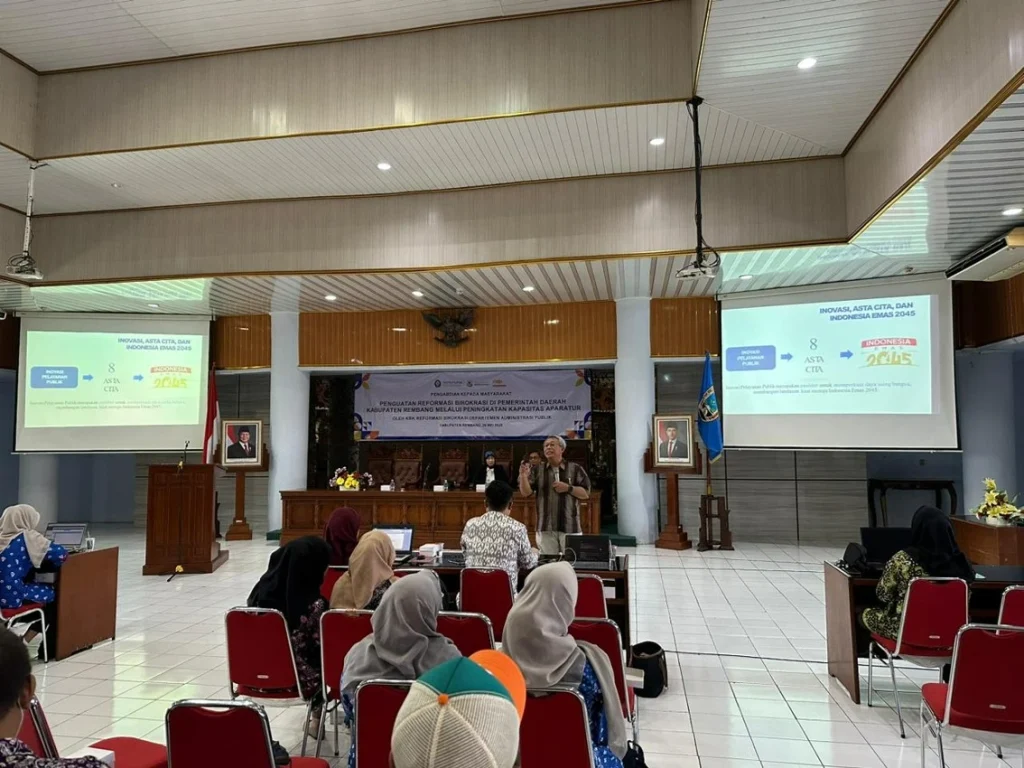
The community service team was chaired by Dr. Dra. Dyah Lituhayu, M.Sc., with members Dr. Drs. R. Slamet Santoso, M.Sc.; Satria Aji Imawan, S.I.P., MPA; Damaris Bernike Bellastuti, M.A.; and Yoga Aldi Saputra, S.A.P., MPA. Through the team’s expertise in bureaucratic reform, governance, public organization performance, and public services, this activity is expected to make a tangible contribution to strengthening the capacity of the Rembang Regency Government apparatus.
This activity also aligns with the Rembang Regency Government’s efforts to strengthen the implementation of bureaucratic reform at the regional apparatus level. With the involvement of regional government agencies (OPD) and sub-districts, this activity is expected to encourage each work unit to develop improvement measures that are more operational, relevant to service needs, and can be monitored continuously.
Through this activity, the Faculty of Social and Political Sciences (FISIP) of Diponegoro University (UNDIP) reaffirms its commitment to continuously strengthening collaboration with the regional government. Collaboration between universities and regional governments is crucial to ensuring that the bureaucratic reform agenda can be implemented in a more substantive, data-driven manner, and have a tangible impact on improving the quality of public services.