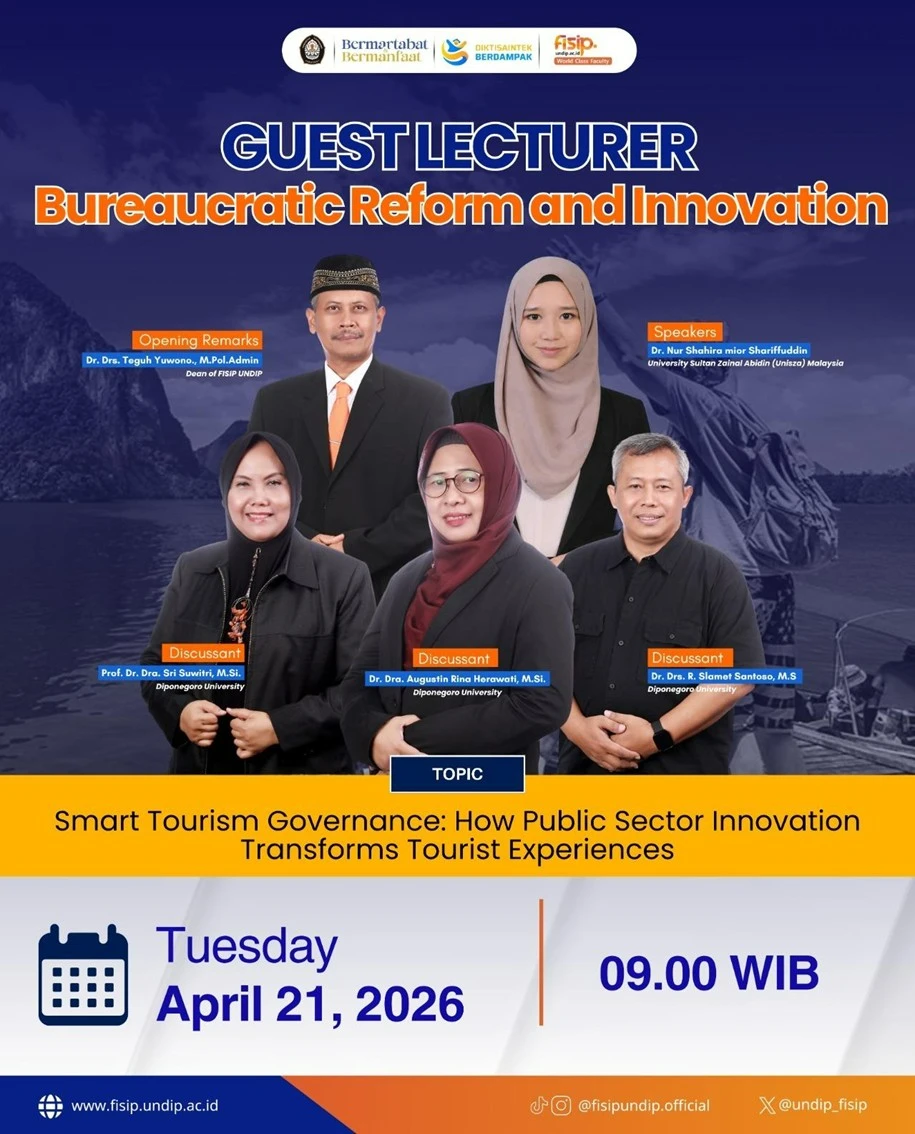
The Master of Public Administration Program, FISIP, Diponegoro University, has once again affirmed its commitment to delivering globally oriented learning through the UNDIP Global Classroom, held as part of the Bureaucratic Reform and Innovation course.
This online event featured an international speaker from Malaysia, Dr. Nur Shahira Mior Sharifuddin from Universiti Sultan Zainal Abidin (UniSZA), and was officially opened by the Dean of FISIP Undip, Dr. Teguh Yuwono, M.Pol.Admin.
Through this forum, students had the opportunity to interact directly with academic perspectives from outside Indonesia, particularly regarding bureaucratic reform, public service innovation, governance, and contemporary challenges in public administration.
The presence of an international speaker offered a fresh perspective on how the public sector responds to change through innovation, collaboration, and the use of data in policymaking.
In his opening remarks, the Dean of FISIP Undip, Dr. Teguh Yuwono, M.Pol.Admin., emphasized the importance of international academic collaboration as part of strengthening the quality of learning within the faculty.
Through activities such as this, FISIP Undip demonstrates its seriousness in building an academic ecosystem that is open, adaptive, and relevant to the advancement of knowledge.
The opening speech also signaled that internationalization is part of the institution’s orientation in preparing graduates capable of understanding public issues broadly.
This cross-border online forum reinforced the message that learning at Undip’s Public Administration program is directed toward shaping students who are sensitive to policy comparisons, accustomed to global academic dialogue, and ready to face the complexities of modern governance.
UniSZA Speaker’s Presentation
In the main session, Dr. Nur Shahira Mior Sharifuddin presented material highlighting the relationship betw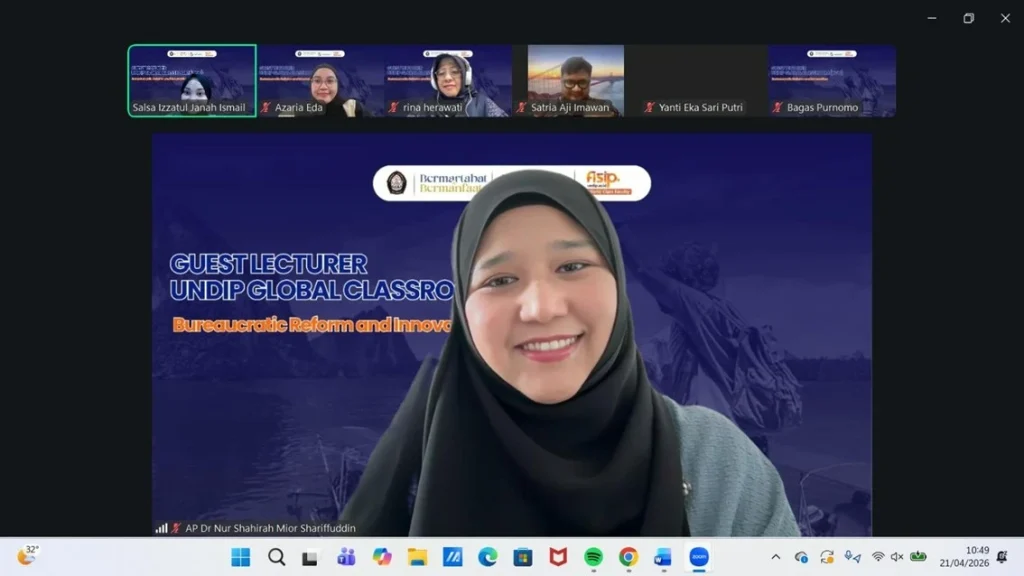 een public sector innovation and service transformation, positioning governance as a key element in the success of reform.
Her explanations, framed within the contexts of smart governance and public sector innovation, provided a foundation for students to see that bureaucratic renewal cannot be separated from the integration of technology, data, cross-actor coordination, and a focus on user experience in service delivery.
She also emphasized that change in the public sector requires more than just the digitalization of procedures. Effective innovation necessitates governance adjustments, the ability to collaborate among stakeholders, and the courage to develop new approaches to service provision.
This perspective is highly relevant to discussions on bureaucratic reform, as it shows that public administration renewal must move in tandem with the ever-evolving needs of society.
Discussants’ Responses
The discussion became increasingly dynamic when Prof. Dr. Sri Suwitri, M.Si., and Dr. Augustin Rina Herawati, M.Si., delivered their comments, enriching the international speaker’s perspectives.
Both connected the international presentation to the Indonesian context, particularly in efforts to build a bureaucracy that is responsive, innovative, and service-oriented.
The discussion also highlighted the importance of viewing bureaucratic reform as an institutional process that demands policy consistency, organizational adaptation, and the courage to change traditional working patterns.
In an interactive atmosphere, the discussants encouraged students to consider how ideas about public innovation could be contextually applied within government and public service delivery in Indonesia.
Student Enthusiasm
Public Administration students showed great enthusiasm throughout the event. The question-and-answer session revealed a strong interest in comparing public governance practices across countries, including how Malaysia has developed innovative approaches in response to public sector challenges.
This enthusiasm reflects students’ need for learning spaces that go beyond reading texts, opening direct conversations with international practitioners and academics.
For students, this activity offered tangible academic benefits by broadening their perspectives on bureaucratic reform as a dynamic and transnational theme.
Students had the opportunity to understand that issues of public service delivery, government collaboration, and institutional innovation are shared challenges requiring cross-country experience exchange.
FISIP’s Global Network
Furthermore, the UNDIP Global Classroom reaffirmed FISIP Undip’s direction toward academic internationalization by strengthening global networks with partner universities.
This activity demonstrated that academic cooperation can be realized through scientific meetings that enrich the learning process, expand scholarly references, and open doors for more concrete collaboration.
In this context, learning based on global engagement and collaborative learning is becoming increasingly important for higher education. FISIP Undip places its students as part of an academic community equipped with critical, comparative, and reflective thinking skills regarding contemporary public administration issues.
The UNDIP Global Classroom activity in the Bureaucratic Reform and Innovation course serves as a concrete manifestation of FISIP Undip’s commitment to delivering relevant, open, and internationally competitive learning.
Through this online forum, students experienced firsthand how cross-border dialogue can enrich understanding of bureaucratic reform and public sector innovation.
By featuring an international speaker, academic discussants, and active student participation, FISIP Undip has taken a firm step toward building a global, collaborative, and quality-oriented academic learning ecosystem.
Initiatives like this are an important part of strengthening the position of Undip’s Public Administration Study Program as an academic space responsive to the challenges of public administration at both national and international levels.