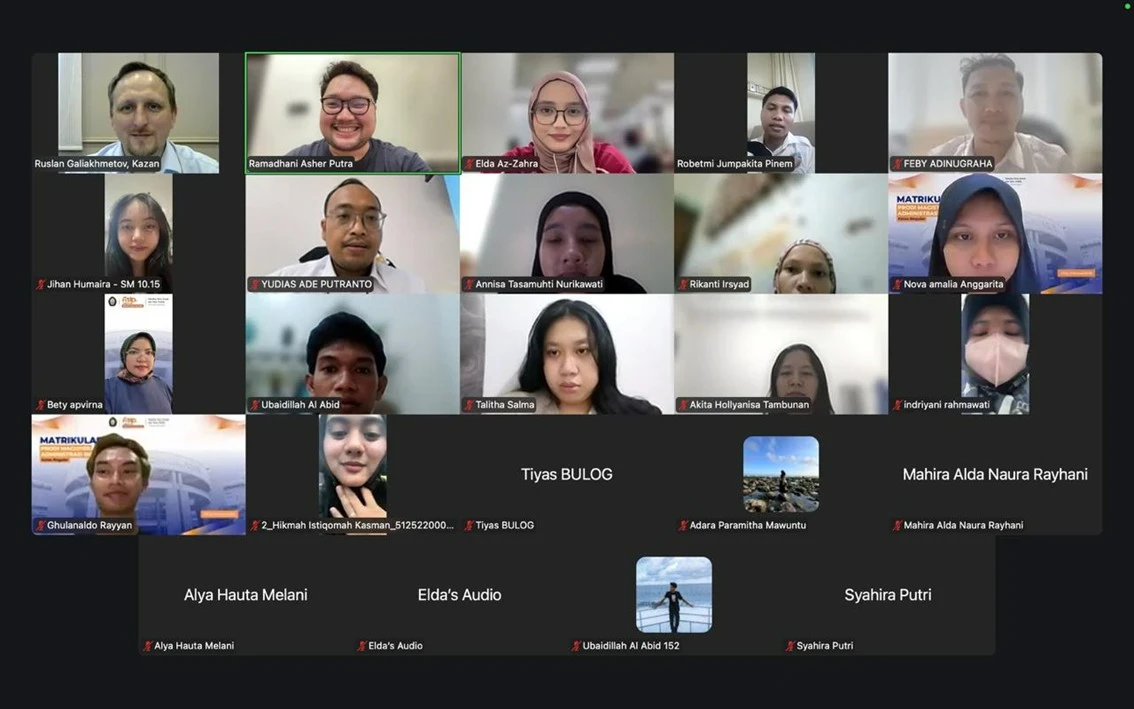
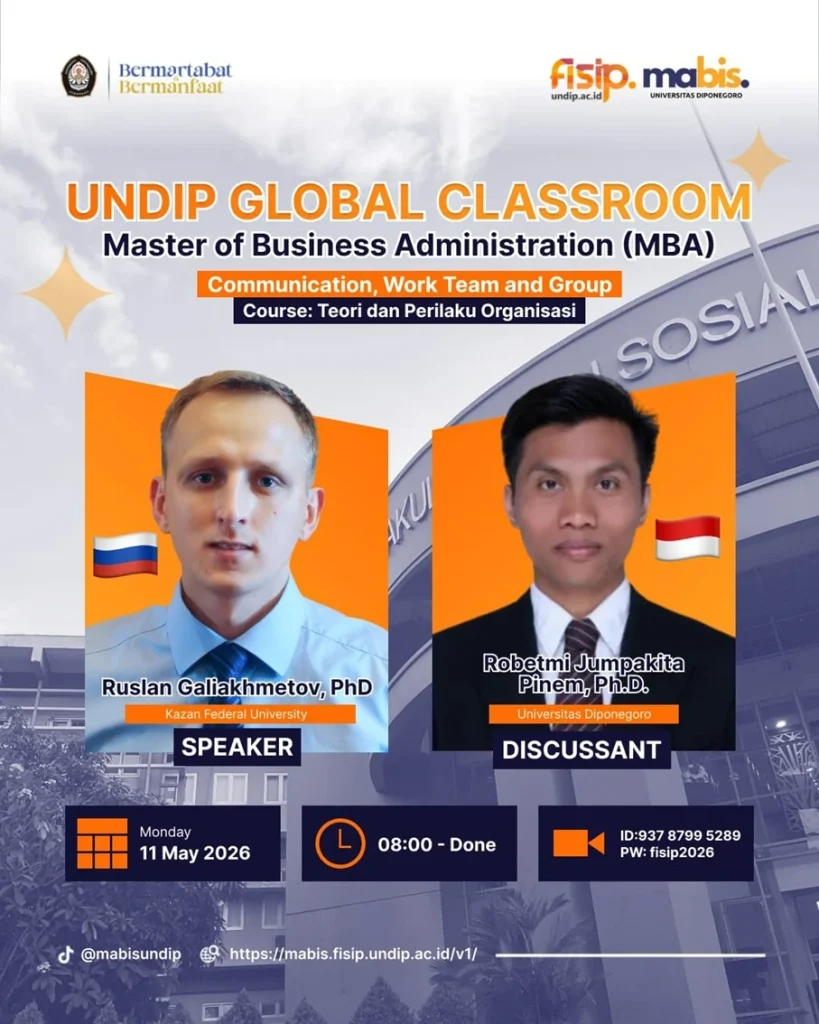
Semarang – The Master of Business Administration (MBA) Program at the Faculty of Social and Political Sciences (FISIP), Universitas Diponegoro, once again held the UNDIP Global Classroom event with the theme “Communication, Work Team and Group” on Monday (11/5/2026). This activity is part of the Organizational Theory and Behavior course and was conducted online via Zoom Meeting.
The event featured Ruslan Galiakhmetov, PhD from Kazan Federal University, Russia, as the keynote speaker, and Robetmi Jumpakita Pinem, S.AB., MBA, Ph.D. from Universitas Diponegoro as the discussant. Through this forum, MBA students were invited to understand the differences in communication patterns, work culture, and teamwork across Russia, Europe, and ASEAN countries within a global organizational context.
In his presentation, Ruslan explained that culture has a major influence on how individuals communicate, make decisions, and resolve conflicts in the workplace. Europe was described as having a work culture that tends to be direct, rule-based, and task-oriented. Meanwhile, Russian work culture places greater emphasis on hierarchy, assertive communication, and trust built through loyalty and competence. On the other hand, ASEAN countries such as Indonesia, Thailand, and Vietnam prioritize social harmony, indirect communication, and decision-making through group consensus.
One of the interesting discussions in this webinar was the different ways of expressing disagreement in an international work culture. In European culture, criticism is conveyed openly and directly. Conversely, ASEAN culture tends to use more subtle language to maintain interpersonal relationships and avoid open conflict. The material also highlighted how cultural differences can lead to miscommunication in cross-border projects if not accompanied by adequate cultural understanding.
In addition to verbal communication, the discussion also covered non-verbal aspects such as eye contact, facial expressions, the use of tone of voice, and the habit of small talk in building professional relationships. In the ASEAN context, building personal relationships is considered an important part before entering into formal business discussions. Meanwhile, Russian and European cultures tend to focus more on efficiency and the substance of the work discussion.
Through this activity, students gained insights into the importance of cross-cultural management in international organizations. Understanding cultural characteristics is considered essential for future leaders and business professionals to build effective communication, minimize conflict, and create productive collaboration in a multicultural work environment.
The organization of the UNDIP Global Classroom is a testament to the commitment of the MBA Program at FISIP Universitas Diponegoro to broadening students’ global perspectives and strengthening graduates’ readiness to face the dynamics of the international professional world.